
64 East Walnut Vote Delayed Until September
Westerville council delays 64 E. Walnut proposal after residents pack meeting in opposition
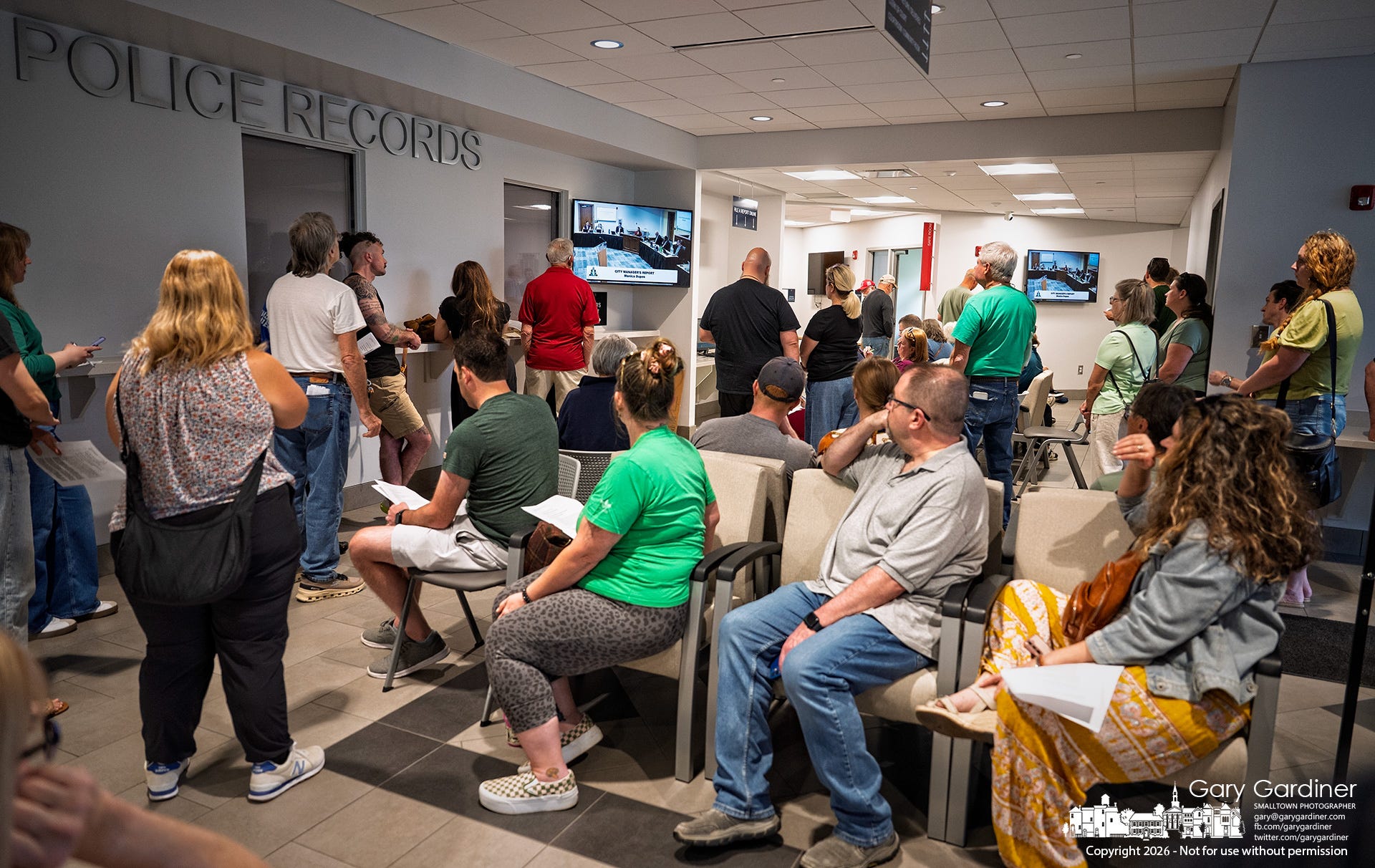
Westerville City Council unanimously delayed consideration of a proposed $2.5 million sale and redevelopment of 64 E. Walnut St. until September after hundreds of residents packed Tuesday’s meeting to oppose plans for a boutique hotel, restaurant, apartments, and parking garage near Uptown.
Council voted unanimously to delay further consideration until Sept. 15 and require two more public open houses before the proposal returns for a second reading.
The proposal, introduced on first reading, would authorize the city manager to execute a real estate purchase agreement for the sale of the former city office property. The city has identified Continental Development Ventures as the proposed buyer.
A fire inspector limited the chamber crowd to 110 people, while the rest gathered in the lobby and police academy training room to watch the meeting on televisions.
Residents who spoke Tuesday said the project is too large for the site, would add traffic and parking pressure near schools and historic homes, and was introduced through a process many said felt predetermined.
City Manager Monica Dupee addressed the issue near the start of the meeting, saying the city had heard residents’ concerns and would continue to provide information as the process moves forward. She said the city is still early in the public process, and residents will have more opportunities to participate.
“We are listening,” Dupee said.
Dupee said one open house had already taken place and another was planned for June 8 at the Westerville Community Center to accommodate a larger crowd. She also acknowledged that some residents felt the city had already decided what it wanted to do with the property and that public feedback would not matter.
Economic Development Director Rachel Ray later told council the proposal was only the first step in a longer process. She said the city would retain ownership of the property until after future approvals, including planning and zoning steps and a development agreement. Ray also said the concept could change as the public process continues.

Residents were not convinced.
Several speakers said the city’s outreach came too late. Many said they first learned of the proposal through local news coverage or flyers distributed by neighbors, not through city communication. Others said the existence of a selected buyer, purchase price, and development concept made the process feel predetermined.
Kelly Maxwell, who said she lives three blocks from the site, told the council that Uptown already functions as a successful mixed-use district because of its shops, restaurants, historic homes, library, and walkable streets.
“We already have a mixed-use development. It’s called Uptown,” Maxwell said. “You can build Arlington Gateway or Bridge Park or Westar or Polaris anywhere. But you cannot build Uptown. Don’t ruin it.”
Mack Taylor, who said he lives directly adjacent to the property, questioned how the city moved from earlier assurances that there were “no foregone conclusions” about the site to a proposed contract.
“The property is not city staff’s. It’s not mine, it’s not yours, it’s all of ours,” Taylor said. “And there needs to be a public process before any of these things are determined.”

The project’s scale drew repeated objections. Residents said the proposed plan would overwhelm the surrounding neighborhood, add too much activity near historic homes, and change the character of Uptown.
Traffic and parking were among the most common concerns. Residents said State Street already backs up through Uptown and that Walnut, Park, Vine, and nearby residential streets are not equipped to handle hundreds of additional vehicles. Some also warned that construction and long-term parking demand could affect the library, park, schools, and nearby businesses.
Peter Maxwell said State Street traffic often backs up from Walnut toward Schrock Road and sometimes toward the interstate. He questioned why the city would consider adding more vehicles to Uptown before addressing congestion.
Other speakers focused on the project’s proximity to children and schools, citing Whittier Elementary, Hanby Park, Blendon Middle School, Emerson Elementary, Westerville South High School, the school bus facility, the bike path, and the Westerville Public Library.
Julie Wildermuth, who said she lives at 63 E. Walnut St. and has children at Whittier Elementary, gave one of the night’s most emotional appeals. She said families on the street already have to be careful because of existing traffic and warned that the proposed development would make those concerns worse.
“You see, these are my kids,” Wildermuth said. “We live at 63 E. Walnut St., and they’re current students of Whittier Elementary.”
Wildermuth said her children were “just two of the kids on this most impacted strip of E. Walnut Street,” where she said students from several nearby schools live and walk.
“What we’re asking for is to go back, restore the trust and look for a safer, smaller-scale alternative,” Wildermuth said. “Show us that Westerville still values the community we have built here and the safety and well-being of our children.”
Melissa Hall, who said she has lived in Westerville for more than 45 years, said the current plan does not match Uptown’s character.
“Our Uptown Westerville is quaint, historic, charming, and idyllic,” Hall said. “It is not Bridge Park, and it is not Creekside. Nor do we want it to be.”
Several residents asked the council to consider adaptive reuse of the existing building instead of demolishing it for a larger development. Others suggested a civic or cultural use, including an arts center.
Dwight Heckelman asked the council to pause the current plan, disclose any financial incentives, and issue a request for proposals to gather community ideas. He said the site presents a rare opportunity to create a long-term legacy for Westerville.
“Would it be a hotel, apartments, or restaurant? Would that be our legacy?” Heckelman asked. “Or is it something bigger?”
Charles Taylor, who said he generally supports well-planned development, said he could not support this proposal. He called the project “massive” and said it was out of scale with the residential neighborhood, nearby schools, parks, and Westerville’s public life. He urged the council to deny the proposal and direct city staff to solicit a range of alternatives, including the reuse of the existing building.
John Wood, who said he moved to Uptown because of its walkability and neighborhood character, kept his message brief.
“Please don’t do this to our neighborhood,” Wood said.
Some residents also questioned Continental Development Ventures’ past projects.
Sean Turner, who said he recently moved to Westerville from Bexley, told council he had served for eight years on Bexley’s building, zoning, and planning board and had dealt with similar development proposals there. He said he reviewed The Fitzgerald and another project by the same developer while serving in Bexley and warned the council to be careful about promises made during the planning process.
“There were promises made during hearings that were never done,” Turner said. “You need to watch who you’re working with.”
Turner said the proposed Westerville project was too dense for the site and urged the city to seek additional proposals.
“The density is just too much for where you’re trying to put it,” Turner said. “You will be amazed at some of the projects that come in when they take into account what the citizens want.”
Council members closed the discussion by acknowledging residents’ criticism of the rollout and urging them to remain engaged.
Council member Daniela Beckett said she had not prepared remarks because she wanted to listen to residents. She thanked speakers and email writers, then apologized for how the proposal was introduced to the community.
“As your City Council, I do want to apologize for the way that this was rolled out,” Beckett said. “We are learning from those mistakes.”
Beckett said council members were reading resident emails and taking their comments into consideration, but she also asked residents not to make personal attacks or threats against city staff.
“We’re working on those mistakes,” Beckett said. “We’re working on the solutions, we’re working on bringing the transparency that you guys want.”
Council member Ken Wright said he initially thought the June 8 open house would be soon enough, but the size of the crowd changed his mind.
“I realize I was wrong about that,” Wright said. “June 8th, based on the crowd that’s in front of me and the voices that we’ve heard, would not be enough.”
Mayor David Grimes also thanked residents for attending and said the level of engagement was “energizing,” even if the criticism was not always pleasant for the council to hear. He said council members are responsible for addressing concerns about staff because “the buck stops with us.”
“As this process continues, because we are going to encourage you to continue and engage in the process with us, staff continues to stay out of your remarks,” Grimes said. “It’s on us to address it.”
The 64 E. Walnut property has been part of a broader city facilities transition after the renovation of City Hall at 21 S. State St. Dupee said municipal functions have moved from former offices at 310 W. Main St. and 64 E. Walnut into the renovated City Hall.
Although the council took no final action on the sale on Tuesday, the postponement means the proposal will not return for further consideration until September. City officials are expected to hold additional public meetings and gather further feedback before the proposal returns for a second reading.
For the residents who filled the room and overflow spaces Tuesday night, the delay was a sign council had heard them. But many made clear they want more than a slower timeline. They want the city to reconsider the proposal itself.
Because this post is public, you’re encouraged to share it on social media.
The Westerville News is a reader-supported publication by Gary Gardiner, a lifelong journalist who believes hyper-local reporting is the future of news. This publication focuses exclusively on Westerville—its local news, influence on Central Ohio, and how surrounding areas shape the community.
Reader funding, including subscribers, protects editorial independence, so coverage is guided by journalists rather than owners or corporate profit goals. It also reduces pressure to chase clicks, letting the newsroom focus on stories worth readers’ time. And it helps keep the site accessible to everyone, including people who can’t pay or live in places where a free press is under threat.
Explore more hyper-local reporting by subscribing to The Hilliard Beacon, Civic Capacity, Marysville Matters, The Ohio Roundtable, Shelby News Reporter, This Week in Toledo, and Into the Morning by Krista Steele.


