

64 East Walnut's Other Plans and Residents Hear About The Process for Redevelopment
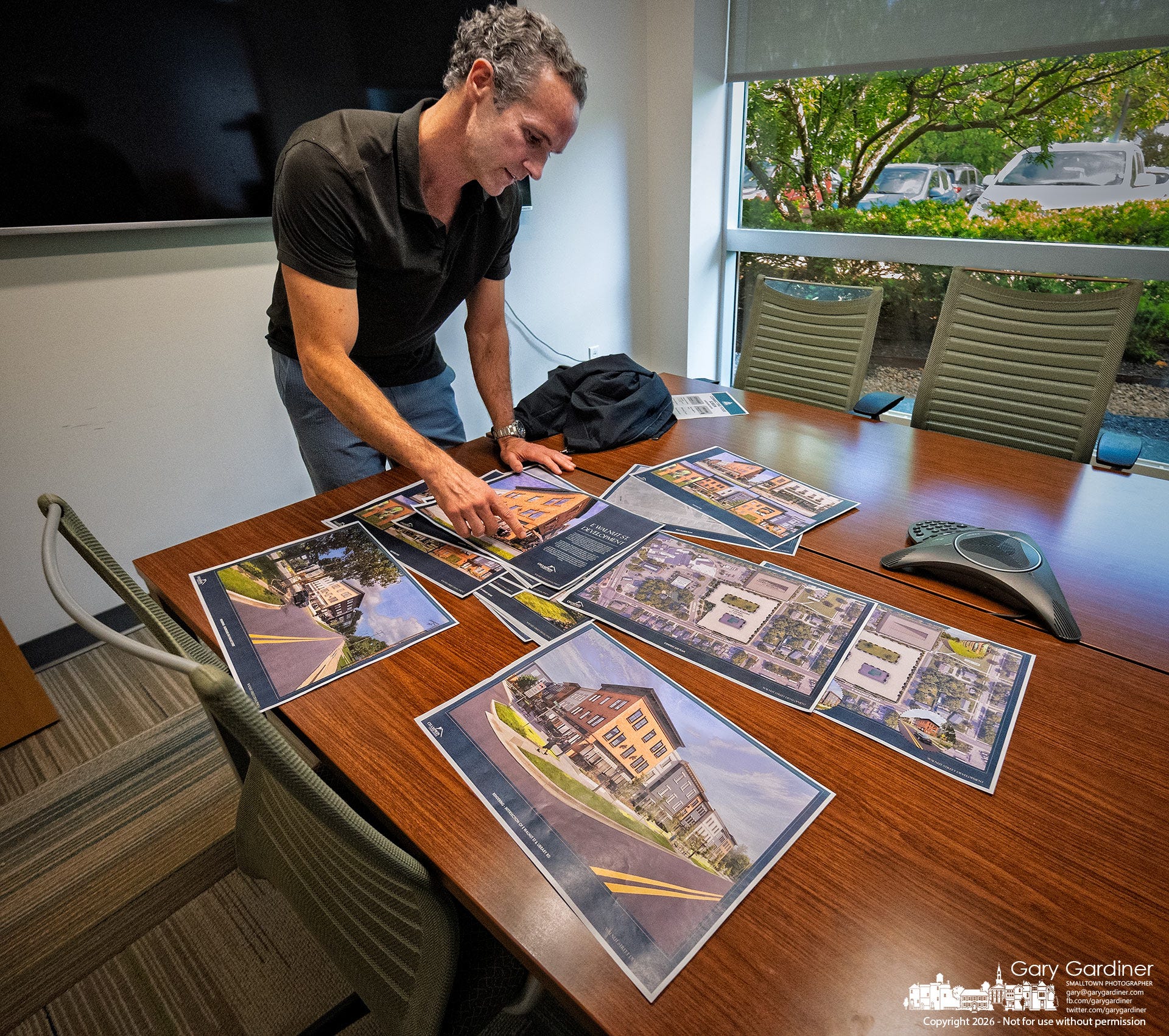
Westerville developer says city bypassed company after two years of talks on 64 E. Walnut project
A Westerville-based apartment developer says the city spent two years discussing redevelopment plans for 64 E. Walnut St. with his company — including a boutique hotel and parking garage requested by city officials — before selecting another developer without notifying Champion Companies or issuing the formal request for proposals the company expected.
Mike Mayhew, who works in acquisitions and development for Champion Companies, said city officials approached Champion about the 5.2-acre city-owned parcel and asked whether the company would be interested in proposing a mixed-use project on the site.
Mayhew said Champion met with city representatives several times and developed plans with the city, specifically requesting the hotel and garage components, and Champion shaped its concept around those requests.
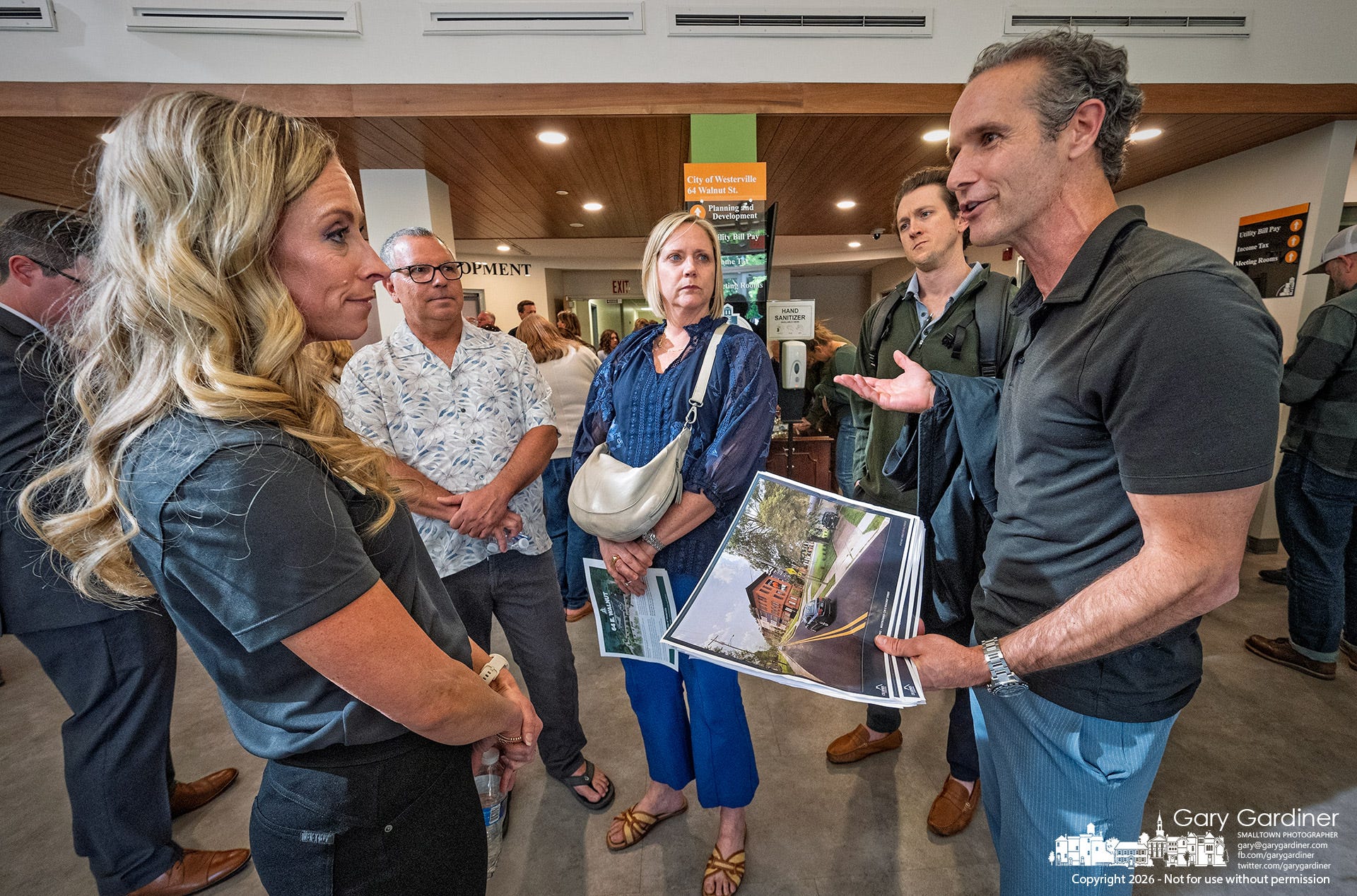
The property, located just outside the historic Uptown Westerville district, is slated for redevelopment after the city agreed to sell the land for $2.5 million. The city selected Continental Real Estate Companies to lead the project.
Mayhew said Champion learned from a news report that the city had moved ahead with Continental.
“My dad sent it to me on Sunday night, like, ‘Look at this,’” Mayhew said. “I’m like, I’ve been talking to them for the last two years. What the heck?”
According to Mayhew, Champion repeatedly asked the city when it planned to issue a request for proposals. He said the company was told the city was not ready to begin the process.
Westerville Economic Development Director Rachel Ray said Champion is headquartered in Westerville and called the company “great developers.” She said the city is proud that Champion is in the community and acknowledged the company’s interest in pursuing a project in Westerville.
Ray said Continental moved forward with a project that, in concept, met many of the city’s policy and development goals for the area, including housing and a boutique hotel to support Uptown.
“It just so happened that Continental moved forward with a project that had a level of complexity and density and checked a lot, or conceptually achieved a lot, of the policy development goals for this area,” Ray said.
Ray said the city believed Continental’s proposal was worth advancing through the process to determine whether it was the right development for the site.
She also said the proposal included a hotel component that could be managed with the Renaissance Columbus Westerville-Polaris Hotel.
“Continental was able to come forward and say, we can do this and co-manage it with the Renaissance, which we all know is very well managed and at a very high level of quality,” Ray said. “That’s kind of the unique factor here that, again, was worth advancing through this process.”
Asked about Mayhew’s concern that Champion had been locked out and that the project appeared to be a done deal with Continental, Ray said she understood why it seemed that way.
“I think how it was rolled out, which we take ownership of, I think there’s better ways we could have done that, where it might not have felt that way to him,” Ray said. “But, you know, what’s done is done, unfortunately, and I understand that.”
Ray said that density was not the city’s primary goal.
“It’s really not about the density,” she said. “It’s about the right balance of uses and also getting the project in a place where it can be financed. And can we get the things that we want as a community out of it?”
Mayhew said Champion had been prepared to buy the land and move forward with its own proposal, which he described as a lower-density version of the mixed-use development the city wanted.
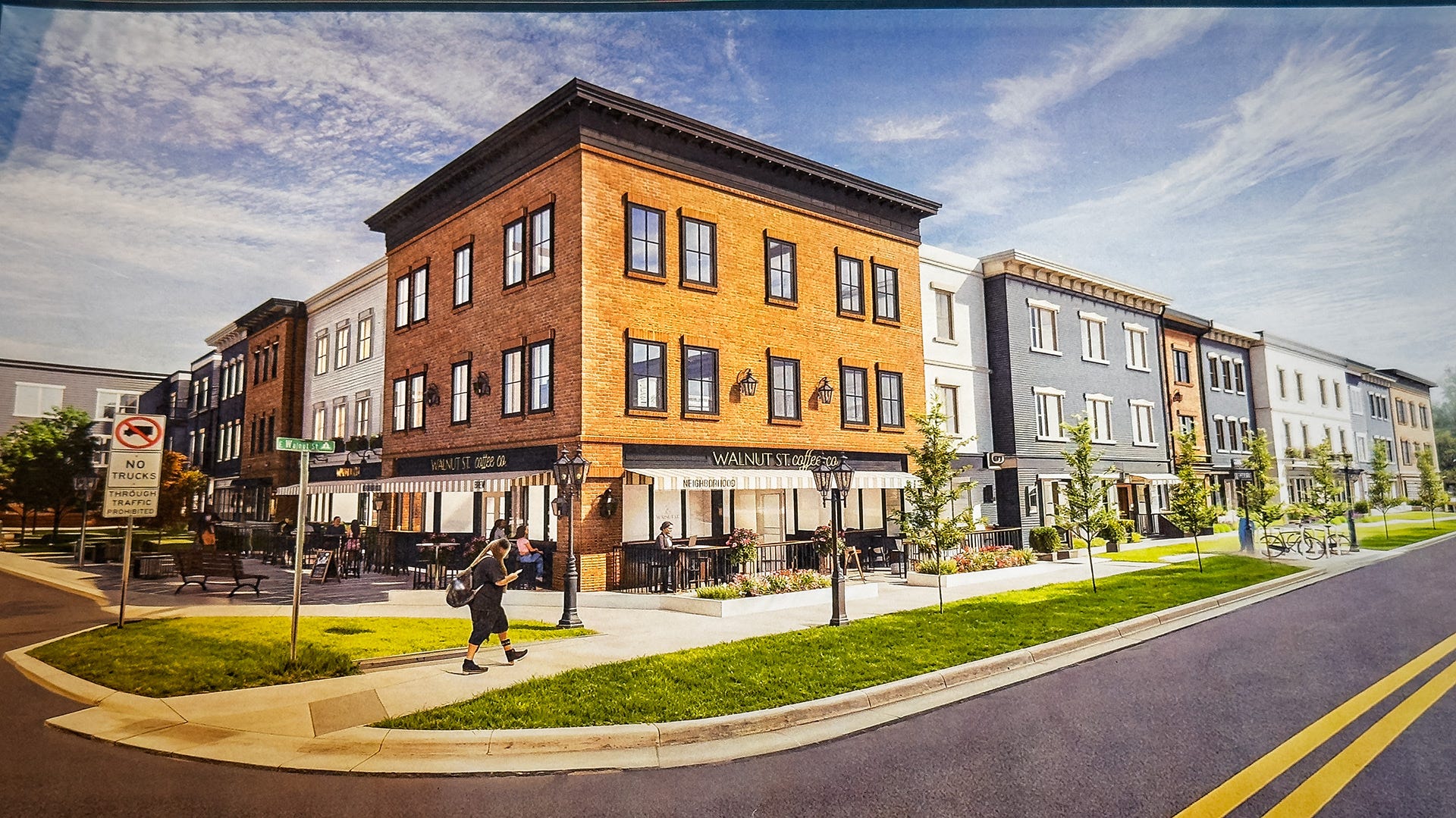
Champion’s concept included 193 residential units, a boutique hotel with about 31 rooms, a parking garage, and green space. Mayhew said the buildings would have been three stories tall.
Mayhew said the city’s preferred components were not the issue. Champion’s plan included many of the same elements, he said, but at a lower density and with a layout designed to extend the feel of Uptown Westerville.
Ray said Mayhew has discussed a proposal involving housing and perhaps a restaurant or some type of community space. She said Champion could be a strong developer if the city chose to pursue that direction, but said other regional developers would likely want a chance at that kind of project as well.
“Obviously, we’d love to have a local developer,” Ray said.
Mayhew said Champion’s proposal included more retail and a more walkable layout than the selected plan.
“There’s definitely more retail, kind of continuing the uptown with retail space,” he said. “It’s like an extension of the block of the uptown.”
“I’m not upset that it’s getting developed at all,” he said. “I like it to look nice. I live here, and I own rental properties all in Uptown. But I’m just more mad that they just waste our time. Just like, hey, just be professional. Let us know.”
Champion is locally owned and based in Westerville, employs about 150 people in the city, and has deep local ties.
According to Mayhew, Champion’s co-founders, Brian and Michelle Yeager, attended Westerville South High School and have long wanted to develop a project in the city.
He said the company owns and manages its properties rather than relying on third-party management. He added that Champion supports development in Westerville and would like to see the Walnut Street site redeveloped in a way that fits the community.

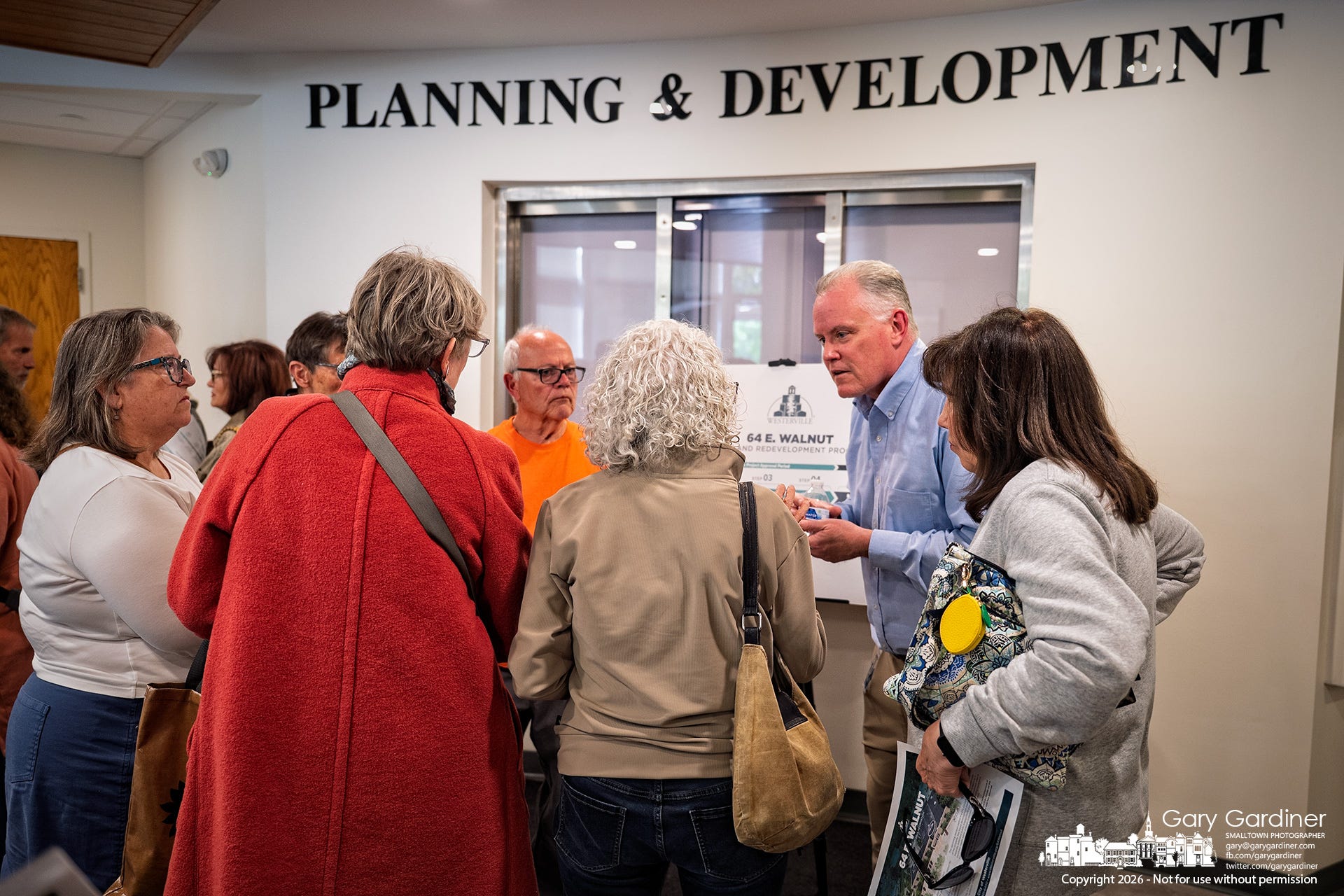
Residents line up to look at 64 E. Walnut redevelopment plans
A line of residents waiting to enter the empty 64 E. Walnut St. building eventually stretched across the parking lot, underscoring public interest in the proposed redevelopment just outside Uptown Westerville.
The city organized the open house to give residents a closer look at the project, answer questions, and gather public feedback before the proposal advances to the next stage of the city's review process.
Some of the interest stemmed from a neighborhood flyer campaign. Peter Maxwell, who lives near the site, said he distributed 1,000 flyers alerting residents to the open house and the next City Council meeting. The flyer raised concerns about the proposed building height, traffic, density, a hotel, a restaurant, and a parking garage.
Residents waited their turn to review plans for the site and speak with city officials. Inside, they entered a crowded, noisy lobby where city staff members stood near display boards explaining the development process, previous city projects, and an aerial rendering of the site after redevelopment.
However, the displays did not include the exterior rendering featured in the city’s news release announcing the proposed project.
Residents gathered in small groups around each city worker, forming tight, shoulder-to-shoulder lines around the display boards before moving to the next station.
Conversations among city staff and residents generally centered on the building’s size and design, with most objecting to the proposal, saying it was not in tune with Uptown Westerville’s small-town atmosphere.
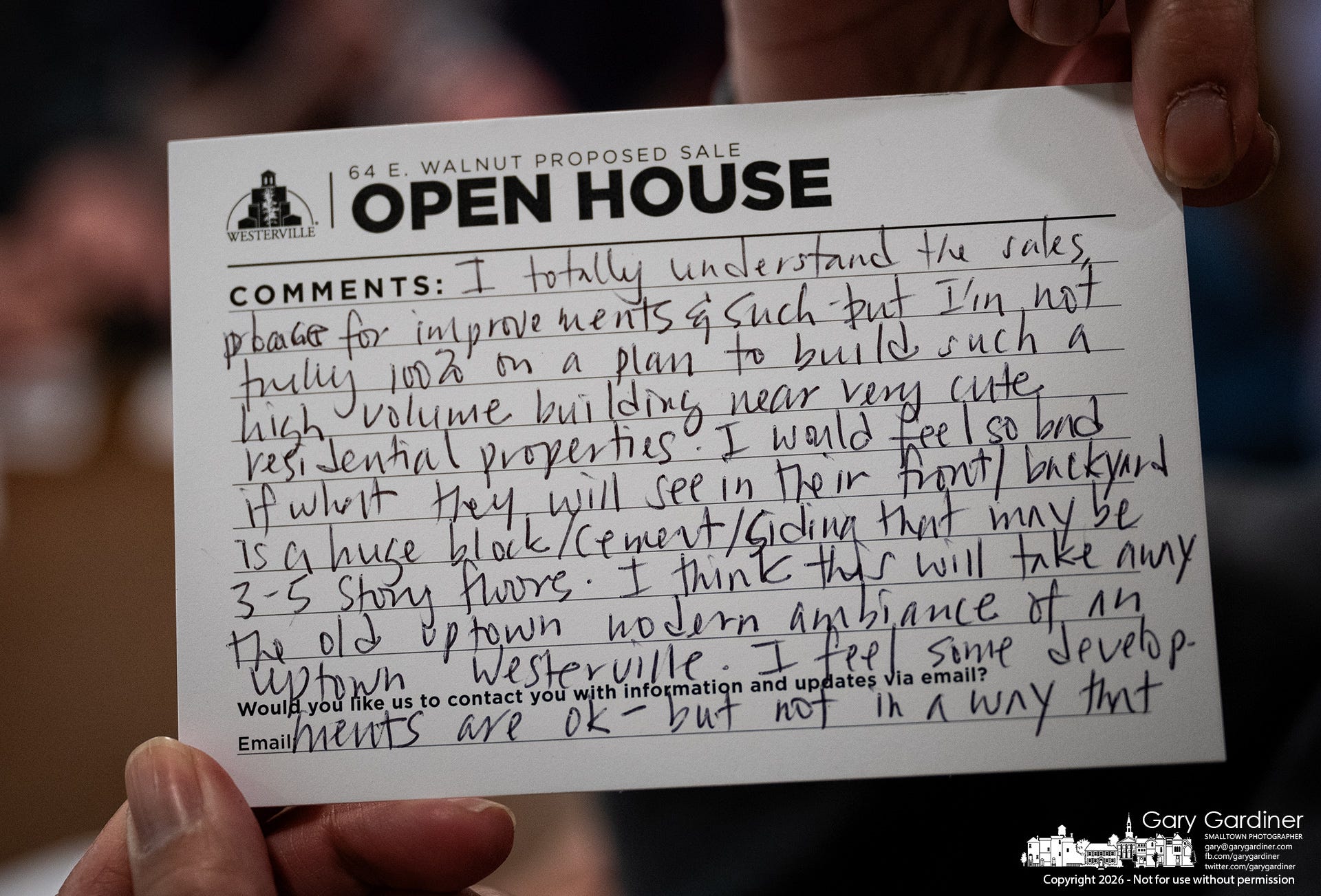
Each attendee received a comment card and was asked to return it before leaving. Hillary Bates, the city’s community affairs director, said the city collected 214 cards during the meeting, though some residents submitted more than one.
The city-owned property sits just outside the historic Uptown Westerville district, listed on the National Register of Historic Places. The city selected Continental Real Estate Companies for the project and agreed to sell the 5.2-acre parcel for $2.5 million.
Because this post is public, you’re encouraged to share it on social media.
The Westerville News is a reader-supported publication by Gary Gardiner, a lifelong journalist who believes hyper-local reporting is the future of news. This publication focuses exclusively on Westerville—its local news, influence on Central Ohio, and how surrounding areas shape the community.
Reader funding, including subscribers, protects editorial independence, so coverage is guided by journalists rather than owners or corporate profit goals. It also reduces pressure to chase clicks, letting the newsroom focus on stories worth readers’ time. And it helps keep the site accessible to everyone, including people who can’t pay or live in places where a free press is under threat.
Explore more hyper-local reporting by subscribing to The Hilliard Beacon, Civic Capacity, Marysville Matters, The Ohio Roundtable, Shelby News Reporter, This Week in Toledo, and Into the Morning by Krista Steele.
