
A Life in the Public Square: Michael Heyeck on Faith, Service and Westerville
After 32 years on City Council, the former council chair and mayor reflects on faith, conscience and the work of local government in a new book.
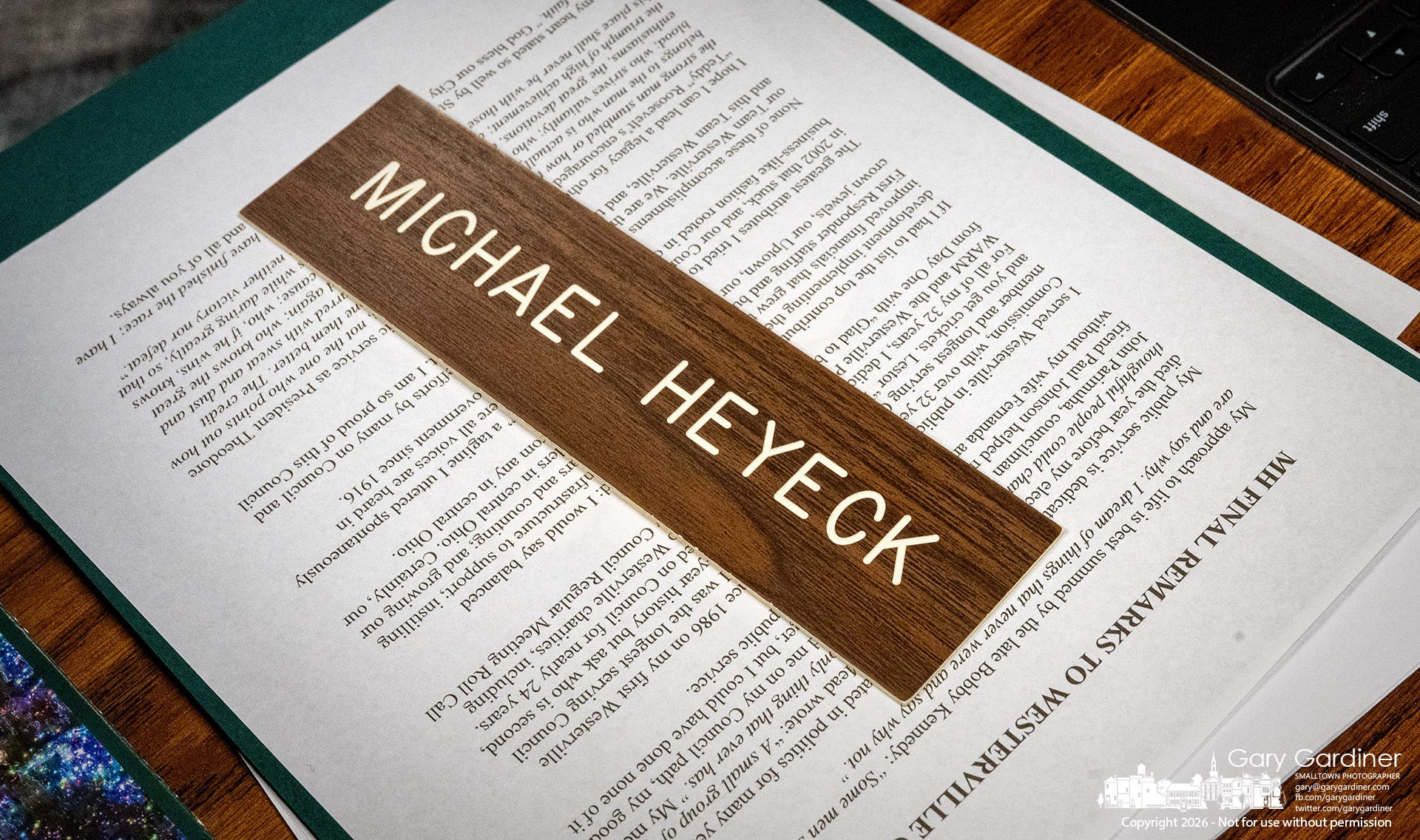
For Michael Heyeck, public service was never just a job. Influenced by his Catholic faith and his mother’s example of civic duty, he dedicated over forty years in Westerville to serving the public, including 32 years on City Council. His time on the council ended as chair after also serving as mayor, alongside a career as an engineer with American Electric Power, which he describes as a calling.
Listen to this article.
That belief is at the core of Heyeck’s new book, What Are We Looking For?, part memoir and part reflection that explores the connection between faith and public service through his years in local government. Based on his experience on the Westerville City Council and shaped by earlier work on city commissions, the book combines personal history, Catholic social teaching, and American political history to examine how conscience and civic duty coexist in public life.
The idea for the book took shape in late 2019, during a period of intense debate over Westerville’s nondiscrimination ordinance. Around the same time, Heyeck heard a homily delivered on the Feast of Christ the King that challenged Catholics to move beyond church walls and engage the public square. A meeting with the pastor, held in a quiet, darkened church in January 2020, became the moment Heyeck said clarified his thinking and set him on the path to writing the book.
The ordinance, passed by City Council in November 2019, expanded existing protections to include sexual orientation and gender identity, a move that provoked strong reactions from residents on all sides. Heyeck, a practicing Catholic, said the issue forced him to confront how to balance church teaching with civic responsibility. He ultimately supported the measure, citing Catholic teaching that emphasizes human dignity and the obligation not to discriminate, even as he acknowledged the tension such decisions can create for people of faith serving in public office.
Questions about the relationship between faith and government repeatedly during Heyeck’s tenure, especially during debates over council meeting invocations. Critics argued that prayer at public meetings blurred the line between church and state, while Heyeck responded that the issue was not establishment but expression. He believed public officials do not shed their religious identities when they take office, and the First Amendment protects both the free exercise of religion and the prohibition against establishing one. In his book, he contextualizes those debates within a broader historical perspective, noting that Americans have grappled with similar questions since the nation’s founding.
To frame these discussions, Heyeck often looks to history, which he considers a stabilizing perspective during times of political conflict. He traces debates over religion and public life back to early legislative assemblies and references the writings of Alexis de Tocqueville to demonstrate the long-standing role of faith in American civic culture. He also considers the upheavals of the 1960s and the assassinations of national leaders as reminders that political division and moral uncertainty are not new, even when they seem unprecedented.
That perspective shapes Heyeck’s focus on collegiality in local government, including his working relationship with Councilmember David Grimes, whose political views often differ greatly from his own. Despite those differences, Heyeck maintains that effective governance relies on respectful debate rather than division. “If we all agreed, you only need one of us,” Heyeck said. “The fact that we don’t agree, but we have good discourse, means we’re probably going to come up with a better outcome.” In his view, disagreement, when handled with openness and good faith, can strengthen decision-making while keeping council members focused on serving the community rather than scoring political points.
Heyeck extends that idea to public service more broadly, consistently describing it as a vocation rather than a career. Whether in elected office or in his paid work as an engineer with American Electric Power, he argues that work serves the common good when it is approached with a sense of responsibility beyond personal advancement. In the book, he challenges readers to consider how their own work contributes to the public good, noting that civic responsibility is not limited to elected office but includes volunteer boards, community organizations and everyday acts of service.
He is especially critical of how national political fights increasingly spill into local council chambers. Residents frustrated by decisions made at the federal or state level, he argues, often turn to city councils for symbolic action on issues beyond their legal authority. That dynamic, Heyeck writes, can distract from the practical work of local government, which focuses on managing services and infrastructure rather than solving national policy disputes.
Heyeck also bases his views on dignity and discrimination on personal experience. His brother, who was gay, died of AIDS at age 37, a loss that he says profoundly shaped his understanding of compassion and human dignity. That experience strengthened his belief that public policy must protect people from unjust treatment, even when moral or religious issues are complex. In the book, he presents that loss not as a political argument, but as a reminder that abstract debates can have deeply human consequences.
The book was finished as Heyeck’s time in public office was coming to an end, a coincidence he called unplanned but fitting. He said all proceeds from the book will go to the Michael and Fernanda Heyeck Endowment Fund, which is dedicated to St. Paul’s Catholic Church. After six years of writing and revision, he sees the project more as a reflection on a life shaped by faith, service, and unresolved questions than as a final statement.
For Heyeck, the question posed by the book’s title is less about politics than about purpose. He does not claim to provide easy answers, but describes the book as an act of discernment shaped by moments of conflict and uncertainty. After decades in public life, he says the value of any role, paid or unpaid, is whether it serves the common good. In that sense, What Are We Looking For? is not a final answer, but an invitation to rethink public service as a calling guided by conscience rather than ambition.
Westerville-Based Marzetti Co. Expanding with New Columbus Warehouse
Marzetti Co., the Westerville-based food manufacturer known for its salad dressings, is expanding its Central Ohio operations with a new 327,000-square-foot warehouse in west Columbus.
Located at 880 Hilliard Rome Road near Hilliard, the facility is part of the West70 industrial complex by TPA Group. Marzetti has signed a 15-year lease and expects construction to finish by late 2026, with operations starting in 2027.
The company said the new site will strengthen its warehouse and distribution network. Employment plans are still being determined.
Marzetti, which employs over 1,200 people locally, recently returned to its historic name and reported $1.91 billion in sales last fiscal year.
The Westerville News is a reader-supported publication by Gary Gardiner, a lifelong journalist who believes hyper-local reporting is the future of news. This publication focuses exclusively on Westerville—its local news, influence on Central Ohio, and how surrounding areas shape the community.
Reader funding, including subscribers, protects editorial independence, so coverage is guided by journalists rather than owners or corporate profit goals. It also reduces pressure to chase clicks, letting the newsroom focus on stories worth readers’ time. And it helps keep the site accessible to everyone, including people who can’t pay or live in places where a free press is under threat.
Explore more hyper-local reporting by subscribing to The Hilliard Beacon, Civic Capacity, Marysville Matters, The Ohio Roundtable, Shelby News Reporter, This Week in Toledo, and Into the Morning by Krista Steele.
3 Likes


Great review of Michael Heyeck’s new book … I look forward to reading it. He has been the best of public servants and provided outstanding leadership during many challenging times in Westerville. We owe him much and sincerely appreciate the example he has provided for future city leaders.
Thanks for the overview! I just received my copy today and look forward to reading it.