

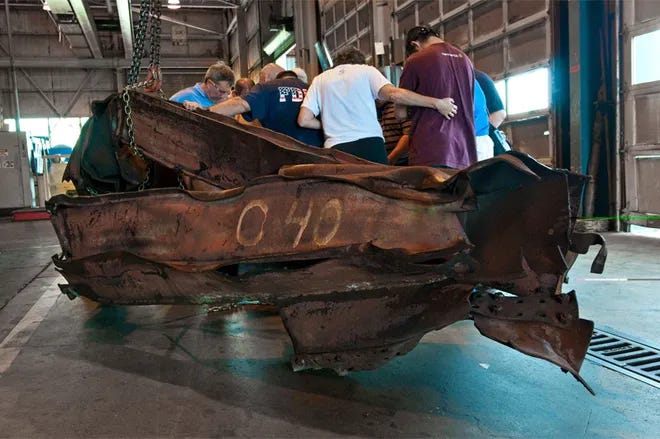
When C-40, the mangled steel recovered from the World Trade Center, arrived in Westerville in 2009, Tom Ullom placed his hand on it and prayed. Other Westerville firefighters and police officers stood around him. Beneath his hand was steel that had once been part of the North Tower, twisted and scarred by the attacks of Sept. 11, 2001.
The steel would become the centerpiece of Westerville’s Firefighters Memorial, later renamed First Responders Park, a physical connection between central Ohio and a place hundreds of miles away where nearly 3,000 people died. But before it became a monument, it was something to touch, to grieve over and to pray beside.
On Friday, as Westerville marks the 25th anniversary of the attacks, Ullom will stand near that steel again. First responders and residents will gather around C-40 to remember a day that, even a quarter-century later, is often recalled with a simple question: “Where were you on 9/11?”
For those old enough to remember, the answer can come quickly. They may have been in a classroom, an office, a firehouse, or at home with a television on. Some remember a phone call saying something had happened in New York, then watching as the enormity of the attacks became clear.
The question asks more than where someone was. It asks what they saw, whom they worried about and what they felt as the events of that morning unfolded. Those gathered at the memorial Friday will bring their own answers, along with memories of the agony and worry that swept across the country that day.
For younger people in the crowd, Sept. 11 is different. It is history rather than memory, something learned through photographs, recordings and the accounts of people who witnessed it. C-40 helps bridge that distance by giving them a physical connection to the place where the attacks occurred.
Ullom can tell visitors where the steel once stood in the North Tower. C-40 spanned floors 98 through 101 on the tower’s north face, directly above the area where American Airlines Flight 11 struck the building. A graphic mounted on the wall beside the steel helps tell that part of its story.
That provenance changes the way the steel can be viewed. C-40 is not simply wreckage removed from Ground Zero. It came from a particular place in the tower, close to one of the most recognizable wounds left by the attack.
In indoor presentations, Ullom also uses a photograph of that side of the North Tower. The image shows the enormous opening left by the impact, and its perspective corresponds with the graphic displayed beside C-40 at the memorial.
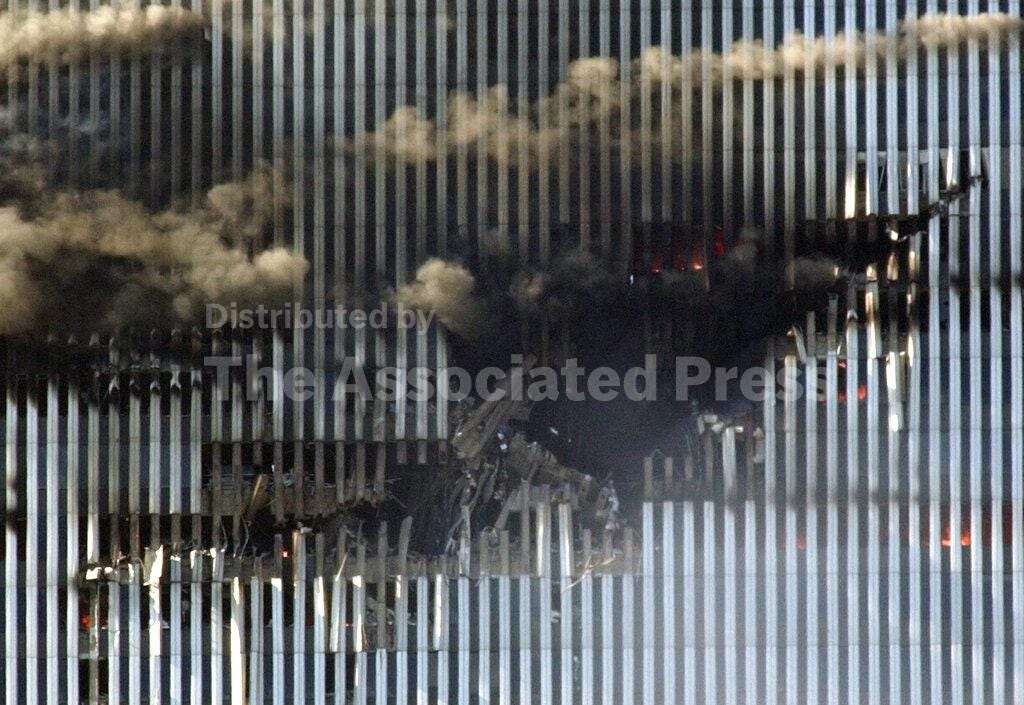
One figure is visible in the photograph: a woman standing in the gash in the side of the building. Ullom identifies her as Edna Cintron, who survived the initial impact of the plane but died when the North Tower collapsed.
The building's scale can make her hard to notice at first. Once you notice her, however, the image takes on a different meaning. The dark opening in the tower is no longer only a record of structural devastation. Someone was still alive inside it.
The photograph also carries a Columbus connection. Amy Sancetta, who earlier worked for The Columbus Dispatch and also freelanced for The Associated Press in Ohio, took. Her assignments included the familiar mix of newspaper work: features, sports and news.
On Sept. 11, 2001, Sancetta, now a staff photographer for AP, was in New York covering her tenth U.S. Open for The Associated Press. What had begun as another sports assignment put her in the middle of a day unlike any she had photographed before, one that would change her life and the lives of millions of others.
Among the images she made was the photograph Ullom now uses to help explain the history surrounding C-40. In the accompanying video, Sancetta describes that day in her own words — what she witnessed and photographed, and how she came to understand that her world, like everyone else’s, had changed.
Twenty-five years later, the photograph and the steel have become part of how the story is passed from one generation to another. People will gather around C-40 on Friday not because a piece of twisted steel can explain everything that happened on Sept. 11, but because it makes the distance between Westerville and lower Manhattan a little smaller.
It gives them something to stand beside as they remember those who died, those who responded, and those whose lives were altered in ways large and small.
And for many who gather there, the steel may call up once more the question Americans have asked one another for a quarter-century:
Where were you on 9/11?
Editor’s Note: Ceremonies begin at First Responders Park at noon.

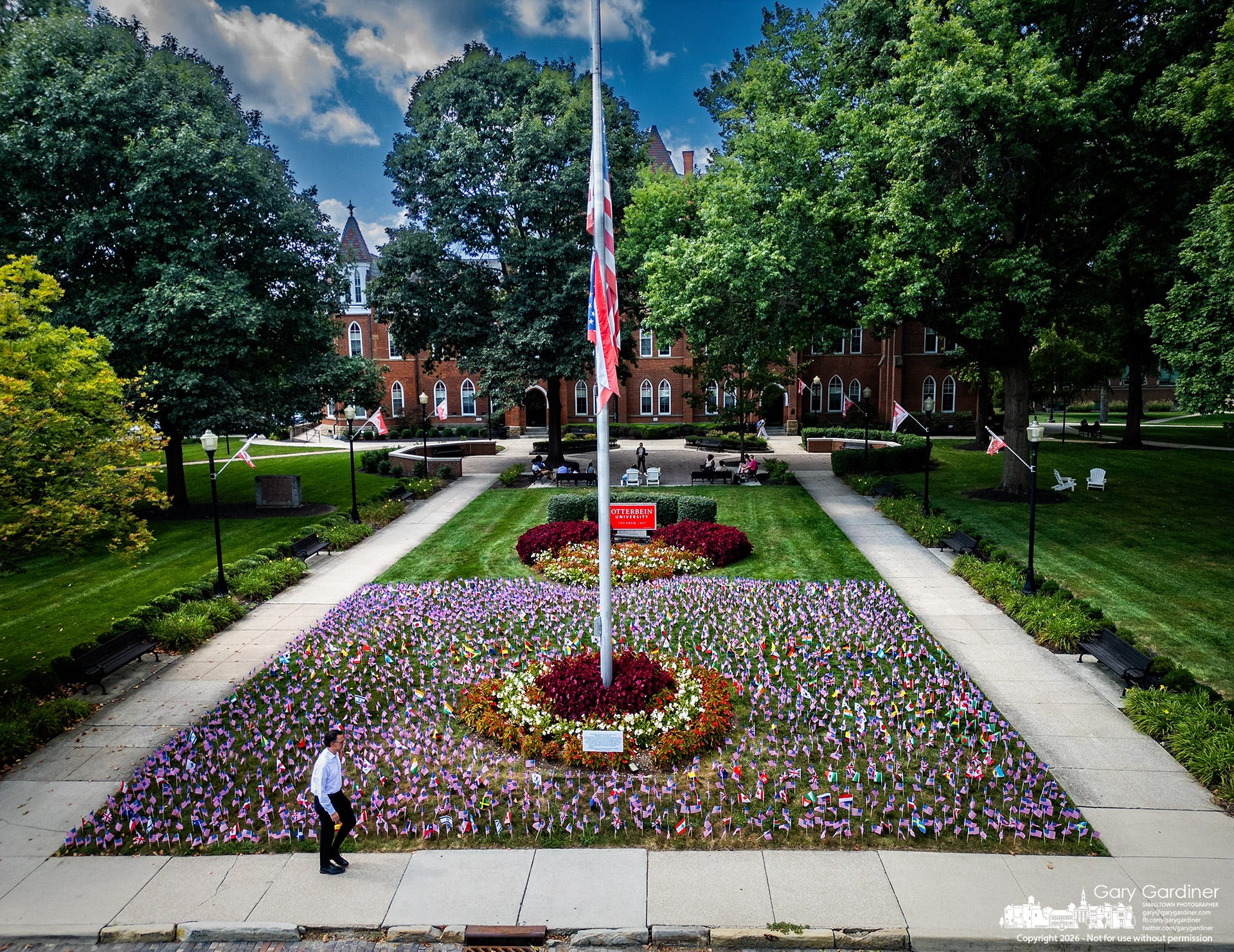
Otterbein honors 9/11 victims with flag memorial
Nearly 3,000 flags fill the lawn in front of Towers Hall at Otterbein University this week in remembrance of the 2,977 people killed in the Sept. 11, 2001, terrorist attacks.
The memorial, organized by Otterbein’s Office of Inclusion and the Office of Social Justice and Advocacy, uses flags representing the victims' nationalities. Each flag corresponds to a victim, with 62 countries represented in the display. Of the 2,977 victims, 2,605 were American citizens.
Students, faculty and staff volunteered to place the flags on the lawn.
The display will remain in place until 9 a.m. Monday, Sept. 14.
Because this post is public, you’re encouraged to share it on social media.
The Westerville News is a reader-supported publication by Gary Gardiner, a lifelong journalist who believes hyper-local reporting is the future of news. This publication focuses exclusively on Westerville—its local news, its influence on Central Ohio, and how surrounding areas shape the community.
Reader funding, including subscribers, protects editorial independence, so coverage is guided by journalists rather than owners or corporate profit goals. It also reduces pressure to chase clicks, letting the newsroom focus on stories worth readers’ time. And it helps keep the site accessible to everyone, including people who can’t pay or live in places where a free press is under threat.
Explore more hyper-local reporting by subscribing to The Hilliard Beacon, Civic Capacity, Marysville Matters, The Ohio Roundtable, Shelby News Reporter, This Week in Toledo, and Into the Morning by Krista Steele.
