City Council Told That Social Media Important, Permanent, And Unforgiving

Westerville city officials told the City Council on Tuesday that while social media is a valuable way to engage the public, elected officials now face significant legal and practical risks when conducting public business online.
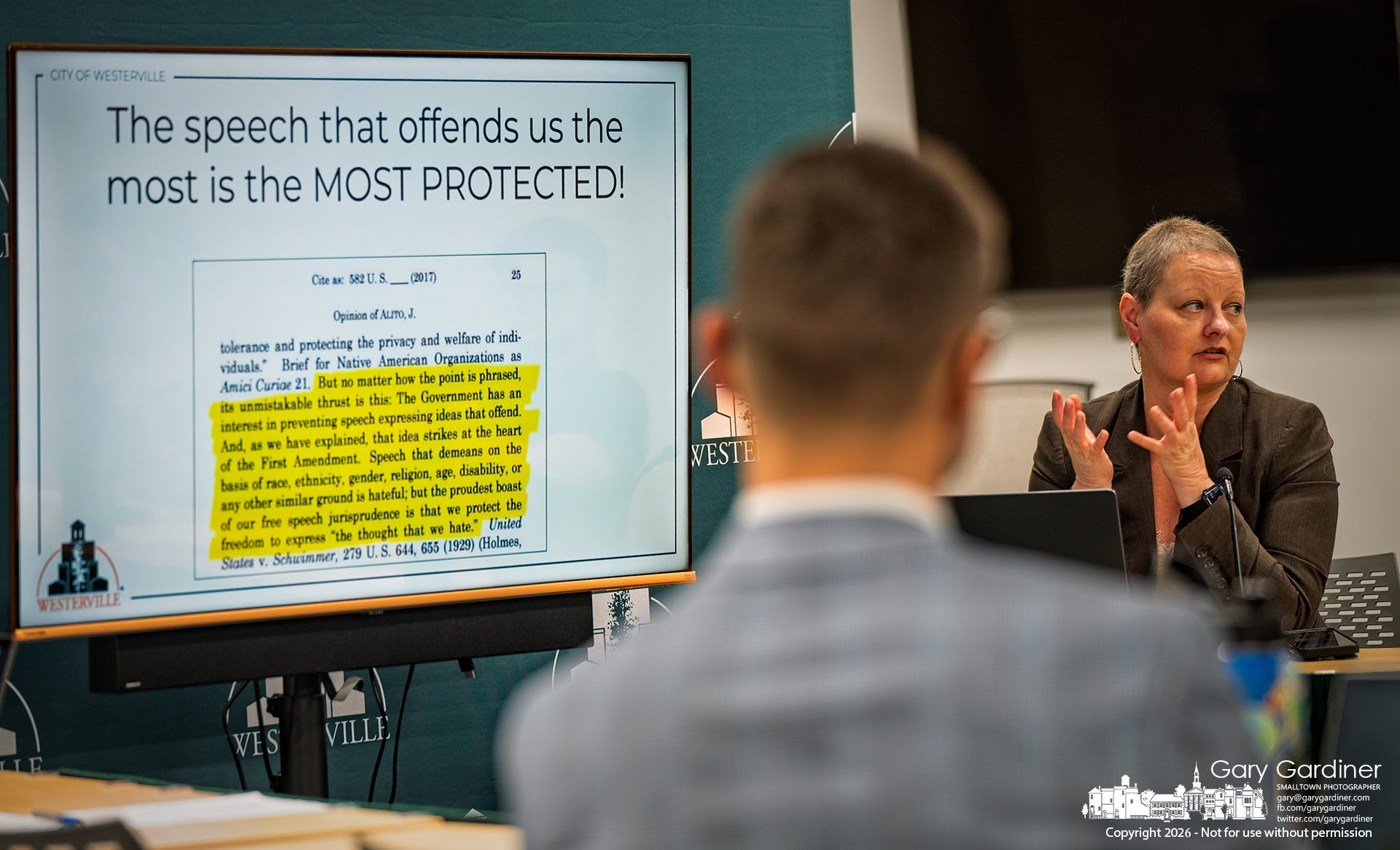
During a City Council work session, Chief of Staff Christa Dickey and Law Director Andrew Winkel outlined best practices for council members’ city, campaign, and personal accounts, with much of the discussion centered on the First Amendment and court rulings over public officials blocking critics online.
Dickey said the presentation is given annually because social media continues to change quickly and because public trust in media and institutions remains fragile.
She said social media offers visibility, engagement, and a direct line to constituents at little cost, but also brings trolling, time demands, legal exposure, and growing concerns over artificial intelligence and misinformation.
“We really need to be thoughtful about what we see and question it more than ever before,” Dickey said.
A central issue was whether public officials can block, delete, or hide comments on their social media pages.
Dickey said courts have increasingly treated official social media accounts as public forums, meaning officials generally cannot exclude people based on viewpoint. She said the most offensive speech is often the most protected under the First Amendment, though she noted exceptions such as obscenity, defamation, true threats, illegal activity, spam, malware, and copyright violations.

Winkel reviewed several court cases, including the U.S. Supreme Court’s 2024 decision in Lindke v. Freed, which involved a Michigan city manager who blocked a critic on Facebook.
Winkel clarified that the Supreme Court’s new two-part “actual authority” test helps determine whether an official’s post constitutes government speech. The test examines whether the official had authority to speak for the government on the subject and whether they acted in that official capacity in the post.
Winkel emphasized the importance of clearly labeling accounts to avoid legal ambiguity, especially with mixed-use pages.
“The most practical and actionable takeaway” is to distinguish personal accounts from official ones, Winkel said, because mixed-use pages that combine family, campaign, and government content create legal ambiguity.
He also discussed a similar case involving a California school board member. The courts found her social media activity was official because she clearly identified herself as a public officeholder and regularly interacted with constituents about government business.
Winkel cautioned council members that how they label accounts, choose content, and engage with the public can determine if an account is viewed as an official public forum.
He also pointed to Westerville’s own council bylaws. These say no council member may make a public statement of council policy unless the policy has been adopted by council or the member has been authorized to speak for the body.
That language could help show that individual members are often speaking in a personal capacity rather than on behalf of the council, he said, though he added that it is not an absolute shield.
The presentation also covered less formal guidance.
Dickey urged council members not to “scoop” city announcements by posting before official city channels release information. She also said humor and snark, common in corporate social media, are riskier in the public sector.
She showed examples of public agencies, like police departments and the Northeast Ohio Regional Sewer District, that have used humor online. However, she warned officials to be careful about the tone they adopt.
Council members asked whether comments could simply be turned off on posts meant only to share information.
Winkel said he was not aware of a case directly deciding that issue. However, he explained that disabling comments on an official page used for official purposes could expose the city to a First Amendment challenge. Dickey said the city’s practice is not to turn off comments on its pages, even when comments are rude or off-topic, to avoid such issues.
Council members also asked whether they could shut down a page altogether.
Winkel said public officials are not required to maintain social media accounts and may close them, so long as any required public records are preserved.
The discussion briefly turned to campaign pages. Winkel described these as being in a legal gray area because they can blur the distinction between private political speech and official communication. The legal takeaway, he explained, is the necessity for clear disclaimers and separate labeling to avoid confusion over the nature of the communication.
Dickey urged council members to pause before posting and consider what the public would expect from responsible leaders, reinforcing the need for appropriate online conduct.
“Before you publish, write it, read it, come back to it, consider it,” she said.
The Westerville News is a reader-supported publication by Gary Gardiner, a lifelong journalist who believes hyper-local reporting is the future of news. This publication focuses exclusively on Westerville—its local news, influence on Central Ohio, and how surrounding areas shape the community.
Reader funding, including subscribers, protects editorial independence, so coverage is guided by journalists rather than owners or corporate profit goals. It also reduces pressure to chase clicks, letting the newsroom focus on stories worth readers’ time. And it helps keep the site accessible to everyone, including people who can’t pay or live in places where a free press is under threat.
Explore more hyper-local reporting by subscribing to The Hilliard Beacon, Civic Capacity, Marysville Matters, The Ohio Roundtable, Shelby News Reporter, This Week in Toledo, and Into the Morning by Krista Steele.


