
City's Oldest Tree Falls During Storm
Westerville’s centuries-old “Codger” oak falls, revealing an old repair and new stories
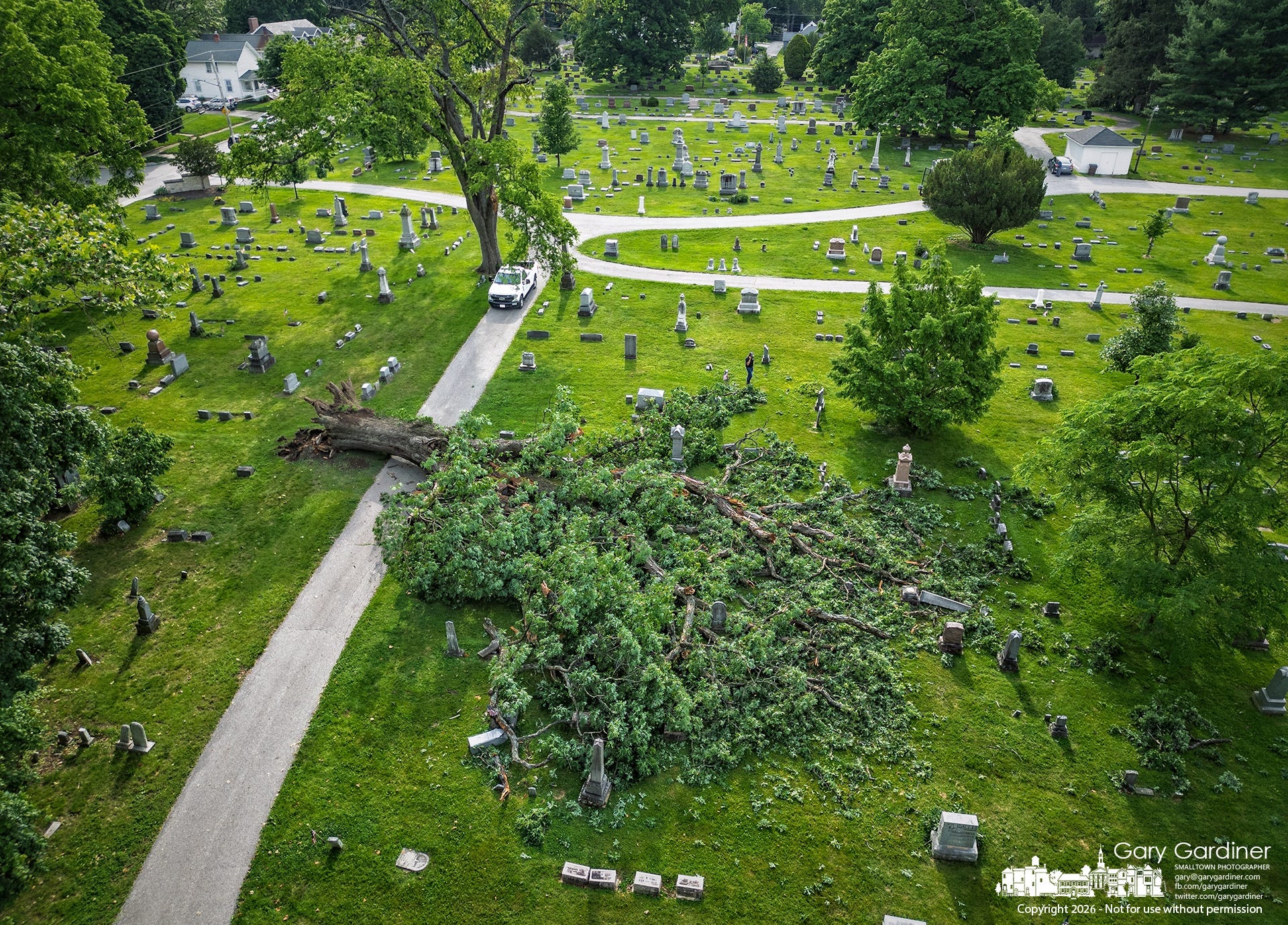
The heritage white oak in Otterbein Cemetery was brought down by storm winds. Residents may collect small pieces of the tree while the city considers ways to preserve its legacy.
A white oak that stood in Westerville for centuries, surviving the city's creation and the cemetery that eventually surrounded it, has fallen during recent storms.
Heavy wind gusts brought down the Heritage Tree in Otterbein Cemetery, according to the city. Believed to be Westerville’s oldest tree, the oak was affectionately known to some residents as “Codger.”
The falling tree also damaged gravestones in the cemetery. The city had not yet provided details about the stones, including whose graves they mark or whether repairs are planned.


Its fall has prompted sadness, curiosity, and plans to preserve pieces of the tree as keepsakes, artwork, or a permanent community tribute.
Resident Lois Szudy said she and Candy Canzoneri hope to hold what she called a “celebration of life” for the tree.
“So sad,” Szudy wrote after reporting that the oak had fallen. She contacted the city to save a piece of Codger and urged people to photograph the tree before it was removed.
A plaque still visible at the site identifies the oak as a Heritage Tree and notes that it was named a Grand Champion in 1992 by the Westerville Heritage Tree Project. The plaque lists 1674 as the year the tree was believed to have been planted.
That date would make the oak about 352 years old in 2026. Other descriptions have placed its age at approximately 400 years, suggesting it may have begun growing around 1626. Both dates are estimates unless usable rings can be counted or the wood can be scientifically dated.
City Arborist Adam Williams said crews may learn more as they cut into the fallen trunk.
“They say it’s about 400 years old,” Williams said. “We’ll be able to confirm that once we start to get cross sections of it.”
Internal decay, however, could make an exact count difficult.
“There’s a good chance there’s going to be substantial decay,” Williams said.
Older than the cemetery
Whatever its precise age, the oak was already ancient when Otterbein Cemetery was formally established.
The cemetery dates to November 1856, when four acres were purchased from Abraham Winters and divided into burial lots. If the tree began growing between the 1620s and 1670s, it would have been roughly 180 to 230 years old by the time the cemetery was created around it.
For much of its life, the oak did not stand in a cemetery or in the community of Westerville.
When it was young, Central Ohio was an Indigenous homeland of forests, streams, settlements and travel routes. The broader Alum Creek and Scioto River region has historical connections to the Wyandot, Lenape (also called Delaware in older accounts), and Shawnee, among other Native nations.
There is no known evidence that a documented village or event was located at the exact site of the tree. Still, the oak’s lifetime spanned the transformation of Central Ohio from an Indigenous landscape to settler farms and, eventually, a growing city.
By the early 1800s, settlers from Connecticut and other eastern states were arriving in the Westerville area. Forests were cleared for farms, homes, roads, fences, and fuel. The oak’s survival suggests that successive landowners chose to leave it standing, perhaps because of its size, shade, location or value as a landmark.
It later stood through the development of the cemetery, Civil War-era funerals, Westerville’s growth and the arrival of paved roads, electricity, automobiles and surrounding neighborhoods.
A published description from 1992 listed the oak at about 114 inches in circumference and approximately 106 feet tall.
Williams, who has worked for the city for 24 years, said the tree had been part of the landscape for his entire career.
“It’s been here as long as I’ve been here,” he said. “It’s a big loss for us, for sure.”
The oak stood near the top of a ridgeline overlooking bottomland. Its location may have protected it from some direct winds over the years, although the recent storm gusts proved too much.
“I’m sure that thing’s got a lot of stories to tell,” Williams said. “He’s keeping them to himself for some reason.”

An old repair revealed
The fall exposed physical evidence that someone had tried to extend the tree’s life long ago.
Among the decayed wood and roots was a large piece of concrete that had apparently been placed inside a damaged or hollow portion of the trunk.
Williams said filling tree cavities with concrete was an older repair method. He could not determine when the work on Codger was completed.
Before the concrete hardened, someone scratched a name and address into it:
“Thomas Seymour, 158 East Goodale St., Columbus, Ohio.”
It is not yet known who Seymour was, whether he performed the repair, or why his name was left inside the tree.
The inscription could give city officials or local historians a starting point for determining when the repair was made. It also adds a human chapter to the oak’s history: At some point, someone believed the tree was worth the effort to save.
As the oak continued to grow, the concrete became enclosed within the trunk and remained hidden until the tree fell.
Residents may collect pieces
Community members who would like a memento may collect small pieces of the oak at Otterbein Cemetery, 175 S. Knox St., from Thursday, June 11, through Thursday, June 18.
The city said quantities will be limited and that no staff member will be stationed at the cemetery to distribute the pieces or help with loading. All available pieces will be small enough to be picked up by hand.
Williams had previously said the city intended to make smaller pieces of limb wood available while discouraging people from attempting to move large, heavy logs.
“We just don’t want to encourage people to go in there and try to break their back getting a big log in the back of their truck,” he said.
Officials are considering whether a cross-section of the trunk can be preserved. Such a section could display the tree’s growth rings and perhaps provide a clearer estimate of its age.
Preserving a section that large may be difficult. Old wood can crack as it dries, and moisture can lead to mold or fungal growth.
“There’s a good chance that it’ll just crack right off the bat,” Williams said.
The condition of the trunk will determine what can be saved and what type of tribute is practical.
For Szudy and Canzoneri, even a small piece would preserve a connection to a tree they had named and admired. Their proposed celebration of life could give the wider community a chance to remember it as more than a large tree brought down by a storm.
For most of its existence, Codger stood before the cemetery, before Westerville and before Ohio became a state. Its rings may record droughts, storms, injuries, and periods of rapid growth.
Its fall has now revealed another record: an old concrete repair, a name scratched by hand, and evidence that generations before this one also tried to keep the tree standing.
Because this post is public, you’re encouraged to share it on social media.
The Westerville News is a reader-supported publication by Gary Gardiner, a lifelong journalist who believes hyper-local reporting is the future of news. This publication focuses exclusively on Westerville—its local news, influence on Central Ohio, and how surrounding areas shape the community.
Reader funding, including subscribers, protects editorial independence, so coverage is guided by journalists rather than owners or corporate profit goals. It also reduces pressure to chase clicks, letting the newsroom focus on stories worth readers’ time. And it helps keep the site accessible to everyone, including people who can’t pay or live in places where a free press is under threat.
Explore more hyper-local reporting by subscribing to The Hilliard Beacon, Civic Capacity, Marysville Matters, The Ohio Roundtable, Shelby News Reporter, This Week in Toledo, and Into the Morning by Krista Steele.


