
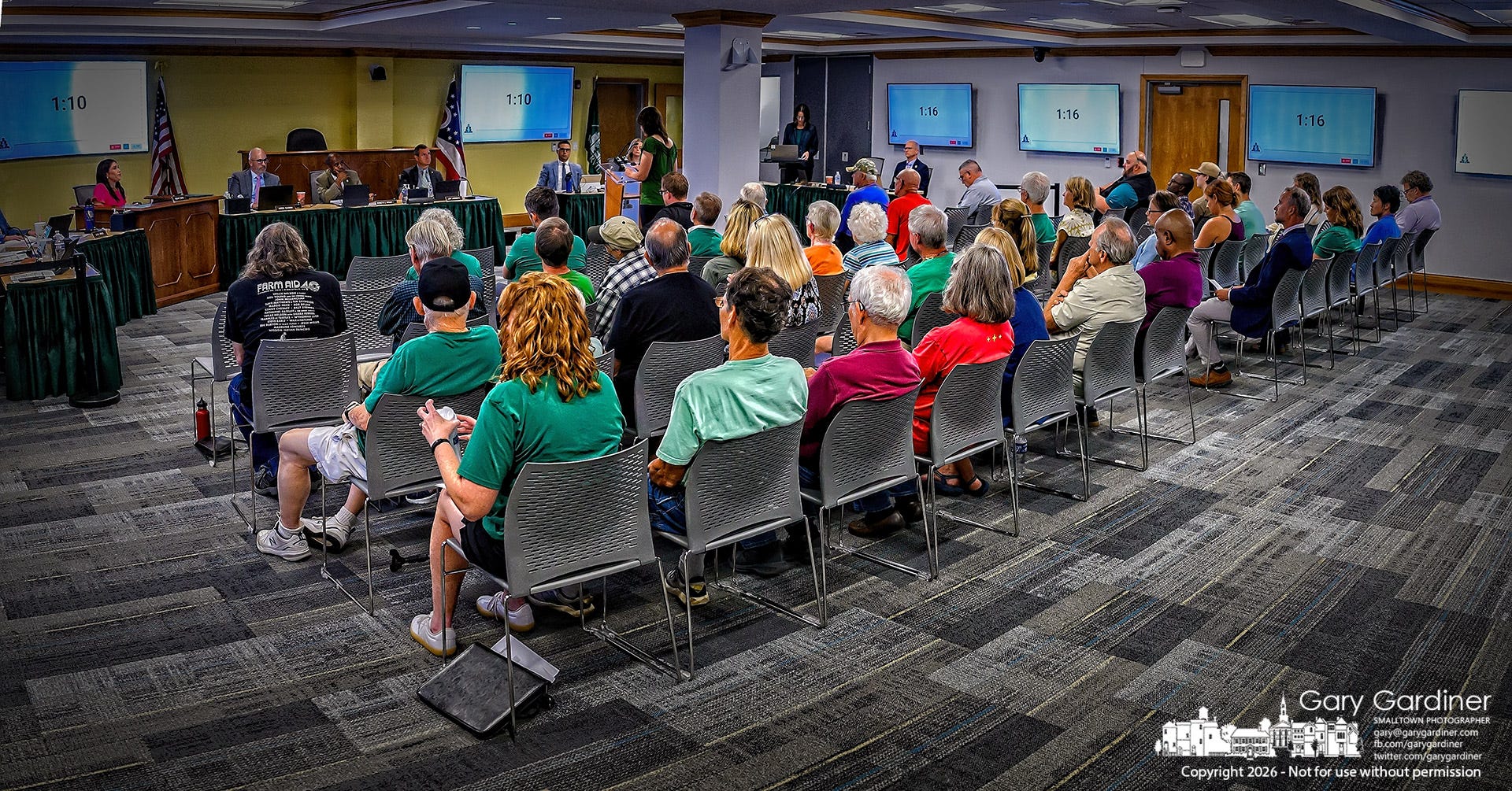
Although 64 East Walnut was not on Tuesday’s City Council agenda, it dominated the citizen-comment period that preceded the council’s reading and action on its scheduled agenda items.
Residents questioned whether the city’s reset of the process is truly open-ended, challenged the premise that the property must generate revenue, raised concerns about transparency and the collection of public input, and urged officials to consider a broader range of options for the city-owned site. The comments came at the council’s first meeting following its summer recess and the first since an Aug. 11 public meeting about the property. The previously proposed development has been canceled, but the city continues to study what should happen at the site.
Peter Maxwell of University Street told the council that one factor he believes should play a larger role in the discussion is the property’s location within the city’s planning framework. “64 East Walnut Street is not in Uptown,” Maxwell said. “Uptown ends at its western property line.” Instead, he said, the property is within the Old Westerville Special Overlay District, whose development standards are intended, in part, to address the erosion of single-family residential neighborhood character.
Maxwell said those standards consider the compatibility of new buildings and development through factors such as placement and orientation on the lot, scale, proportion, and height. “Why did city management propose a new structure at 64 East Walnut, which so obviously is not in alignment with the basic requirements of this existing zoning ordinance?” Maxwell asked.
He said the city purchased the property two years after the adoption of the overlay standards and converted it from industrial use to office space. The existing building, he said, is a single story, screened by mature trees and surrounded by single-family residential properties. Maxwell also noted the property’s public parking, saying Parking Lot G, built in 2016, serves the Westerville Public Library, nearby park users, and Uptown businesses. “It is irreplaceable,” Maxwell said of the property. “It is the most valuable parcel of land in Westerville.”
Other residents questioned whether assumptions that shaped the earlier development proposal are carrying over into the city’s reset. Mac Taylor of East Park Street focused on what he described as a mandate that 64 East Walnut generate revenue to support city services. Taylor pointed to Grandview Heights, where he said the site of a former municipal building adjacent to Wyman Woods is being incorporated into the park rather than sold for commercial redevelopment.
He urged Westerville to begin its reconsideration without a predetermined financial or development outcome. “You all said we’re going to do a reset,” Taylor said. “Let’s do a reset and not have a preconceived notion about what that site needs to be.”
Julie Wilderman also questioned the revenue expectation. Before it becomes a basis for deciding the future of 64 East Walnut, she said, the city should explain the financial need, the required revenue, what the money would support, and what alternatives have been considered. “I believe the revenue expectation is the crux of our issue,” Wilderman said. “The higher the expectation, the greater the pressure for the scale and intensity of development that residents are raising concerns about.”
Wilderman also urged the city to reconsider how it solicits development ideas if officials ultimately decide to sell and redevelop the property. She pointed to a 2010 process Westerville used for another property near Uptown, in which the city sent a request for redevelopment proposals to more than 30 firms, set community objectives and constraints, and evaluated proposals based on more than their financial return. She contrasted that approach with one in which a developer first creates a concept and the community then reacts to it.
“Casting a wider net gives us a better chance of finding something that achieves the city’s goals and the community’s priorities, not forcing us to choose one over the other,” Wilderman said.
Kacy Walco focused on how the city gathered resident input during the Aug. 11 workshop. Walco said she appreciated what she called a “positive shift in communication and collaboration” since discussions of the property began in May, but her experience with the workshop facilitators left her concerned about the accuracy of public comments. She said two facilitators were assigned to a table with four participants, and the primary facilitator did not appear prepared to take detailed notes or to be familiar with basic information about the property and the earlier proposal.
Walco said the facilitator offered opinions, repeatedly asked a question about housing, and did not accurately reflect the group’s conversation when reporting back to the larger gathering. “To be clear, our facilitators seem to be lovely, friendly and very professional people,” Walco said. “They simply did not seem to be trained or prepared.” She said residents who spent their time attending the workshop and completing the city’s survey deserve to have their views accurately recorded.
“As we reboot, I’m still hopeful that council and staff will not just use this summer’s activities to check a box, but will truly hear our community members and take our input to heart,” Walco said.
Other speakers questioned whether the city should sell the property at all. Dan Vermeier, who lives adjacent to 64 East Walnut, thanked council for resetting the process and holding the workshop but questioned why there should be “non-negotiables” in what has been described as a true reset. “Why do we need to sell the building at all?” Vermeier asked. “Why not retain a valuable asset?”
Liz Ryan, who said she has lived on East College Avenue for 40 years, urged the city to consider the property’s value beyond what it could yield from a sale or redevelopment. “We have an opportunity to create something special on a property already owned by the city, by us,” Ryan said. She cited ideas from the Aug. 11 discussions, including a multifaceted arts center or a permanent farmers market, that could serve the community while generating revenue.
City Manager Monica Dupee said earlier at Tuesday’s meeting that 64 East Walnut will be the sole topic of City Council’s Sept. 8 work session. Staff is expected to present summaries of the Aug. 11 workshop and a related survey that closed on Aug. 25, along with answers to questions council previously posed. Dupee said the information presented to council will also be made available on the city’s website.
Council Chair Megan Zako said at the end of Tuesday’s meeting that the Sept. 8 session will be a work session rather than a regular council meeting and will not include a public-comment period. Comment cards will be available for residents attending the meeting to submit questions and comments to council. The Sept. 8 work session begins at 7 p.m. at the Justice Center.
The continuing debate over 64 East Walnut was not the only unresolved issue residents raised with council after its recess. Elizabeth Moes reminded council of continuing concerns about the Scioto Materials asphalt plant near Interstate 270 and Route 3 in Blendon Township and urged Westerville officials to remain involved as the Ohio EPA considers renewing the plant’s air permit.
Moes said odors from the plant affect Westerville neighborhoods and can extend farther into the city under certain conditions. She thanked Dupee for submitting a letter on Westerville’s behalf during the EPA’s public-comment period and said the Ohio EPA received 100 comments and plans to hold a public hearing and reopen the comment period. A hearing date had not yet been announced as of Tuesday.
“You have time to figure out as individual representatives and as a body how you will show up for your residents in that public hearing,” Moes told council. She urged Westerville to work with Blendon Township and Columbus as the permit review moves forward. “It’s time to collaborate again,” Moes said.
Because this post is public, you’re encouraged to share it on social media.
The Westerville News is a reader-supported publication by Gary Gardiner, a lifelong journalist who believes hyper-local reporting is the future of news. This publication focuses exclusively on Westerville—its local news, its influence on Central Ohio, and how surrounding areas shape the community.
Reader funding, including subscribers, protects editorial independence, so coverage is guided by journalists rather than owners or corporate profit goals. It also reduces pressure to chase clicks, letting the newsroom focus on stories worth readers’ time. And it helps keep the site accessible to everyone, including people who can’t pay or live in places where a free press is under threat.
Explore more hyper-local reporting by subscribing to The Hilliard Beacon, Civic Capacity, Marysville Matters, The Ohio Roundtable, Shelby News Reporter, This Week in Toledo, and Into the Morning by Krista Steele.


