

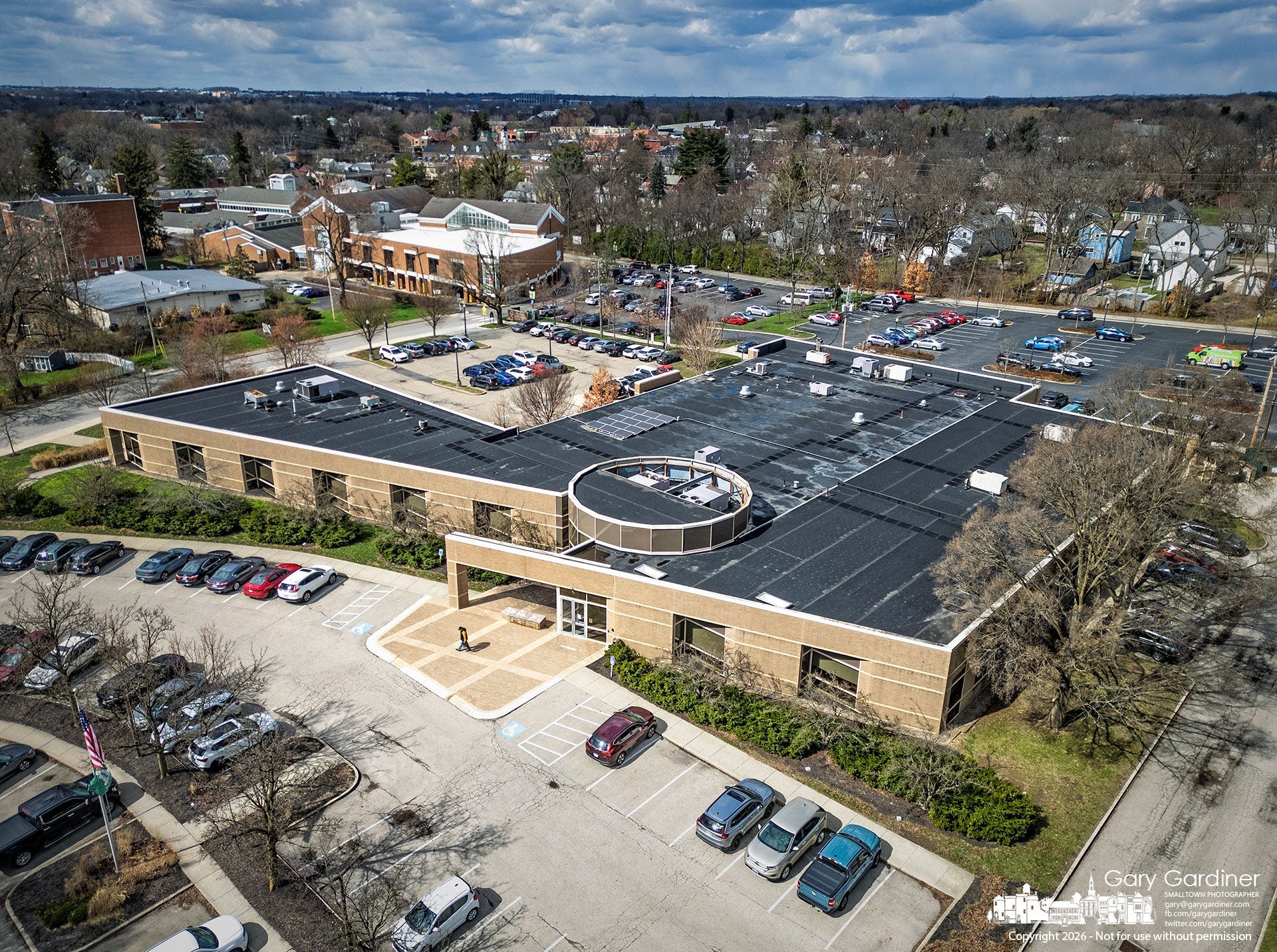
Westerville City Council will hear Tuesday how city administrators answered the questions council required them to address before any new proposal for 64 E. Walnut St. can return for consideration.
Council unanimously rejected a proposed sale and redevelopment of the approximately 5.2-acre property June 2. The plan called for 247 apartments, an 81-room boutique hotel and restaurant, and a 400-space parking garage, including 100 spaces reserved for public use. The city would have sold the property for $2.5 million to an entity connected to Continental Real Estate Cos.
After rejecting the agreement, council directed the administration to return with information on four subjects: community goals for the property, the city’s development-review process, the financial effects of a potential sale and redevelopment, and how the city determines the price of publicly owned property.
Council asked the city to compile goals and priorities from resident comments, council priorities, and city planning documents, including the community plan and economic development strategy.
It also asked for an explanation of how development proposals move through City Council, zoning review, and the Planning Commission, including the traffic-study process. Council asked how proceeds from the sale of public property are handled, where revenue from a sale and redevelopment of 64 E. Walnut could go, and how a sale and resulting tax revenue would affect city finances.
The city has said no legislation, sale proposal, or development item involving the property will return to council until that information has been presented publicly.
Tuesday’s work session is also expected to include a summary of comments collected during and after an Aug. 11 community workshop.
The city used facilitated table discussions during the workshop and offered the same questions through an online survey and printed comment cards. Participants were asked what they valued about the property, what goals should guide its future, and what ideas they had for its use.
The workshop report and complete results had not been posted on the city’s project page as of Monday. The page continued to state that consultants would prepare the report and present it at Tuesday’s work session.
The session begins at 7 p.m. Tuesday at the Westerville Justice Center, 229 Huber Village Blvd. The city has said 64 E. Walnut will be the sole subject.
Residents may attend and submit written comment cards but will not be permitted to ask questions, make public comments or respond to remarks by city officials or council members. Work sessions are used for city presentations, council questions and discussion rather than formal legislative action.
Council members also received results of a separate survey conducted by Uptown United, a local residents’ group formed in opposition to the rejected redevelopment proposal.
The group said it created the survey after months of conversations with residents to measure the importance of recurring concerns, what tradeoffs people would accept and which priorities were shared most broadly.
Uptown United reported receiving 828 submissions between July 25 and Sept. 3. It removed 36 submissions with repeated digital fingerprints and included 792 responses in its analysis.
Of those respondents, 86% identified themselves as Westerville residents. About 27% said they lived in Uptown or Old Westerville, meaning most respondents lived elsewhere in the city or outside Westerville.
Respondents also reported frequent use of the area. About 88% said they visited Uptown at least weekly, and 70% said they visited the library, Hanby Park, the Ohio-to-Erie Trail, or parking areas adjacent to 64 E. Walnut at least weekly. About 83% described themselves as somewhat or very familiar with discussions about the property.
Continued public ownership received one of the survey’s strongest responses. About 84% said the city should definitely or probably retain ownership of the property. About 5% said it should definitely or probably sell, while 86 respondents expressed no preference.
A related question found that about 76% considered it very or extremely important for the city to retain ownership of strategically located public properties in Uptown.
Preservation also drew broad support. About 38% said the existing building should be renovated and reused if feasible, while another 36% said preservation and renovation should receive equal consideration with demolition and new construction. About 6% preferred demolition and complete redevelopment.
Safety and compatibility ranked among respondents’ highest considerations for future decisions. Pedestrian safety, school safety, public safety, traffic, and compatibility with the surrounding neighborhood repeatedly ranked above hotel accommodations, housing opportunities, and tax revenue, according to charts in the group’s report.
Tax revenue was not dismissed: about 65% considered it at least somewhat important. But respondents assigned greater importance to safety, compatibility and several community uses.
The survey did not identify one dominant preferred use for the property. Support was divided among a community gathering space, educational or community services, a civic arts center, additional green space, and a farmers or public market.
Hotels and apartments drew the greatest opposition, with 79% opposing a boutique hotel and 74% opposing apartments.
Parking produced a clearer result. About 81% wanted the current 205 public parking spaces maintained or increased if possible. Eighteen respondents supported reducing the number, while 128 expressed no preference.
The survey also asked about the city’s public-engagement process. About 42% said they were somewhat or very dissatisfied, compared with about 29% who said they were somewhat or very satisfied. Another 213 respondents were neutral.
Conversational meetings between residents and the city, along with continued online information and surveys, were the two most frequently requested forms of future participation.
Uptown United did not release respondents’ written answers to the survey’s final open-ended question. The group said some respondents entered material they did not want shared publicly and that it would determine later how those responses could be handled. The report therefore provides aggregate results but no direct quotations from individual respondents.
Residents also used the city’s Plan Westerville Community Check-In page to comment on 64 E. Walnut. Commenters proposed uses for the East Walnut property. Comments specifically addressing the site generally favored public or community uses, additional parking, and development compatible with surrounding neighborhoods.
One resident proposed “a combined parking garage/community or market type space.” Another called for a year-round farmers market and suggested locating the previously proposed hotel near Cleveland Avenue and Main Street instead.
Other suggestions included an arts and performance center, public space for entertainment and vendors, a small local movie theater, an Uptown grocery store, and additional space for Parks and Recreation programs.
Several residents also urged the city to favor smaller-scale development and seek public input earlier in the planning process.
One commenter called on the city to “pursue incremental urbanization as opposed to mega-developments to retain pedestrian scale and authenticity.” Another asked the city to let residents react to plans for streets, buildings and parks “well before they are set in stone.”
The comments were not unanimous. Some residents used the broader planning page to support less-expensive, higher-density housing for younger adults, family-sized apartments and mixed-use projects with workforce housing. Those comments did not specifically propose placing that housing at 64 E. Walnut.
City staff and consultants are expected to present their summary of the workshop responses and related public comments on Tuesday. Council members will then be able to question the findings and discuss what, if anything, should happen next at 64 E. Walnut.

Because this post is public, you’re encouraged to share it on social media.
The Westerville News is a reader-supported publication by Gary Gardiner, a lifelong journalist who believes hyper-local reporting is the future of news. This publication focuses exclusively on Westerville—its local news, its influence on Central Ohio, and how surrounding areas shape the community.
Reader funding, including subscribers, protects editorial independence, so coverage is guided by journalists rather than owners or corporate profit goals. It also reduces pressure to chase clicks, letting the newsroom focus on stories worth readers’ time. And it helps keep the site accessible to everyone, including people who can’t pay or live in places where a free press is under threat.
Explore more hyper-local reporting by subscribing to The Hilliard Beacon, Civic Capacity, Marysville Matters, The Ohio Roundtable, Shelby News Reporter, This Week in Toledo, and Into the Morning by Krista Steele.
