

Does White Count? Whit’s Sign Wins Approval After Uptown Color Debate
Why Uptown has a review board
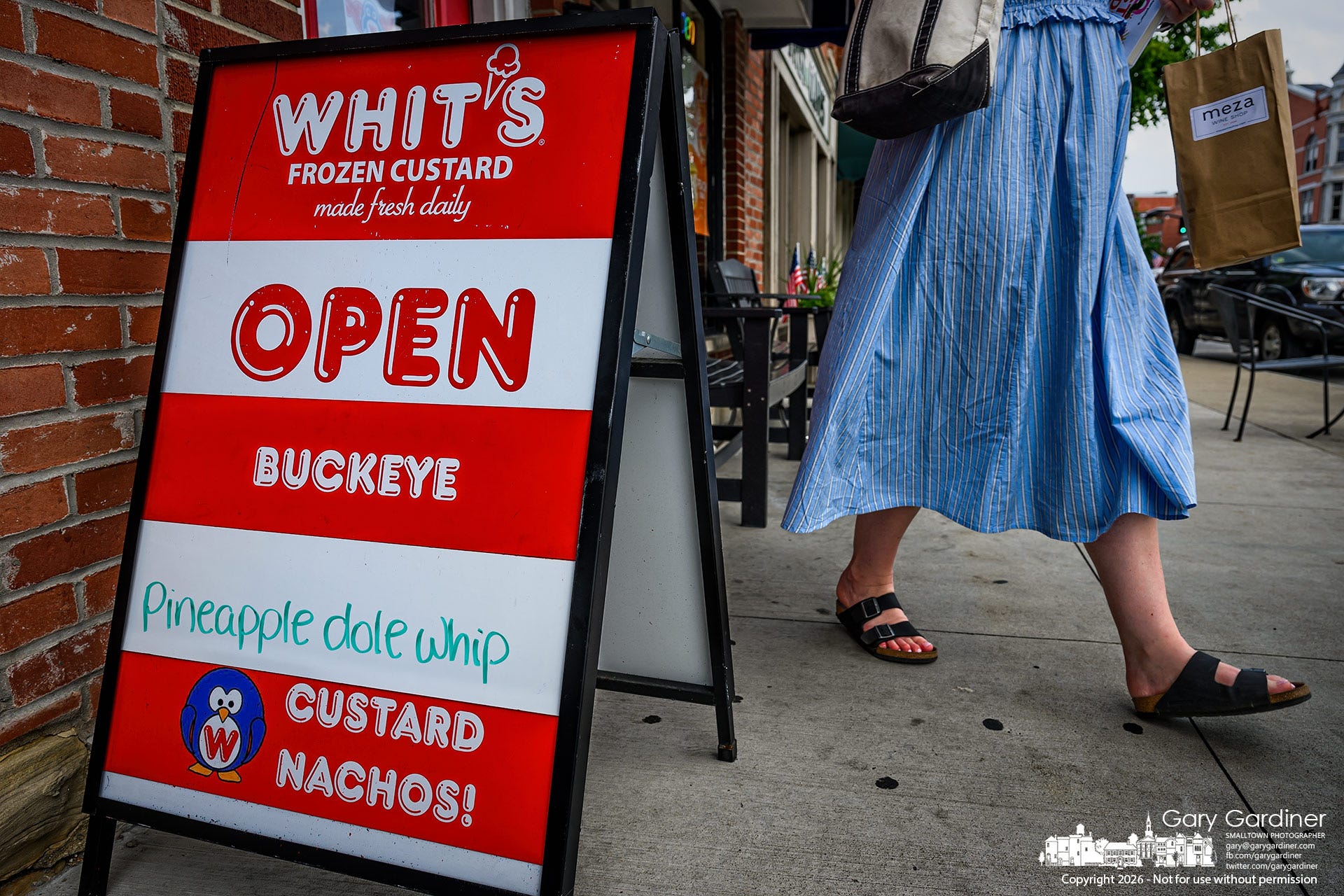
Editor’s Note: Today’s Westerville News is a two-part report on the Uptown Review Board. The first part details the travails Whit’s Frozen Custard owner Joe Schertzinger faced in getting approval for a sandwich board in front of his shop. The second part explains the duties of the Uptown Review Board and why a sign's colors are important.

Westerville panel spends nearly 40 minutes considering interchangeable magnets before settling on a seven-color limit
How many colors are in a penguin?
That became a question of municipal interpretation on June 4 as the Westerville Uptown Review Board considered whether Whit’s Frozen Custard could place a sandwich board outside its shop at 46 N. State St.
After nearly 40 minutes, a failed motion, a 3-3 vote, and a vote to reconsider, the board approved the sign with a limit of seven colors. White would not count.
The board reviews signs and other exterior changes in Westerville’s historic Uptown district. The written guidelines recommend that sandwich boards contain no more than four colors and avoid moving or interchangeable parts.
Whit’s proposed a portable black metal sign with interchangeable magnetic panels showing the shop’s weekly and daily custard flavors.
The frame, dimensions and general design met the city’s recommendations. The dispute centered on the magnets.
City staff were willing to accept them because they had a finished appearance and did not resemble temporary paper inserts. Staff recommended, however, that the magnets use the same background color, font style, and size.
That condition would have prevented owner Joe Schertzinger from using many of the flavor magnets he already had.
“They’re different colors,” Schertzinger told the board. “It just depends on what we’re running that week as weekly and daily flavor.”
A Buckeye magnet could add red. Black raspberry could add purple. A banana flavor could add yellow. An affogato panel included the colors of the Italian flag.
Then came the penguin.
“Does staff consider black and white to be colors?” the board chairman asked.
The answer depended on context. Black lettering probably would count, staff said. White probably would not. The sign’s black metal frame would not.
Schertzinger described a possible white magnet with black lettering and a small penguin containing black and red details.
“I mean, I don’t know,” he said. “It’s up to you guys.”
City planner Jeff Buehler repeatedly reminded the board that the four-color standard was a guideline rather than an absolute provision of city code.
When the chairman said “the wording of the guideline is the wording of the guideline,” Buehler added, “And they are guidelines.”
Buehler also said approval would not bind the board to allow the same number of colors on every future sandwich board. Each application could be judged by its design, location, and surroundings.
Schertzinger said the sign would be placed outside when the store opened and taken inside each night. Its purpose, he said, was to tell people walking through Uptown which flavors were available.
He also expressed frustration with the approval process.
Whit’s received approval for a chalkboard-style sign in 2015. After it broke, it was replaced without board approval. Schertzinger said he inherited that replacement when he bought the store in 2022 and did not know it had not been approved.
The board later allowed him to use it temporarily while requiring a replacement. Schertzinger said he bought additional flavor magnets before learning they might not comply with the guidelines.
“If you don’t want me to have it out there, then I’m not going to put it out anymore,” he said. “I’m just tired of dealing with it, to be honest.”
Board members generally agreed that the proposed sign looked clean and professionally made. Some said it appeared better than chalkboard or dry-erase signs with handwritten messages.
“If you didn’t know those are magnets, you wouldn’t necessarily assume that it is a changeable copy,” Buehler said.
Schertzinger also questioned whether the city applied its standards consistently. He pointed to other multicolored sandwich boards in Uptown, while a board member asked whether businesses with chalkboard signs were monitored to ensure they used no more than four chalk colors.
Staff said they were not.
The discussion also touched on seasonal paintings on the windows of Uptown storefronts. Buehler said the paintings could technically qualify as signs under the city’s broad definition, though most had not been reviewed by the board.
“I’ll just paint them on the windows every week,” Schertzinger said before quickly adding that he was joking.
The board’s first attempt at a motion broke down when members and staff described its effect differently. It died for lack of a second.
“Let’s start over,” Buehler said.
“Good plan,” someone responded.
A second motion would have approved the sign while allowing more than four colors. It failed on a 3-3 vote with one member absent.
Buehler then explained that a member who voted against the motion could ask the board to reconsider. A motion to reconsider was made and approved.
The board had voted to hold another vote.
Members then searched for a color limit they could accept. Seven was proposed because of the number of colors commonly associated with a rainbow. Other suggestions included eight and 10.
Schertzinger said he had 40 or 50 magnets and could not list every possible color combination. The company selects the weekly flavor, he said, while the Westerville shop chooses a daily flavor based on what customers might enjoy—not which magnets use the fewest colors.
The board ultimately settled on seven colors, excluding white, and approved the sign.
Whit’s can now use it to tell passersby which flavors of frozen custard are inside.
Why Uptown Has A Review Board
Historic districts are built on a tradeoff.
A community decides that certain buildings, streets, and storefronts are worth protecting because they give a place its identity. In return, property owners and businesses accept an extra layer of review when they want to change what the public sees from the sidewalk.
That is the role of Westerville’s Uptown Review Board.
Ohio History Connection, which includes the State Historic Preservation Office, says the most effective local preservation ordinances create a design review board or commission and allow communities to designate local historic districts and individual landmarks. Such ordinances typically explain why the board exists, how members are appointed, what responsibilities they have, and how proposed work in historic areas will be reviewed.
The agency also says that design guidelines should explain why a commission exists, what it does, how to submit an application, and how the review process works.
In Westerville, the Uptown Review Board reviews signs, exterior remodeling, new construction, demolition, landscaping and other visible changes within the city’s Architectural Review District. Its purpose is preservation. It is meant to keep one storefront, one sign, or one renovation from gradually weakening the historic character of Uptown.
Uptown Westerville Inc. Executive Director Lynn Aventino said the board plays an important role in protecting the business district's character and authenticity.
“The details matter because the district matters,” Aventino said.
Aventino said a sign, awning, window or facade improvement may seem small by itself, but those decisions collectively shape Uptown’s character, identity and sense of place. She said the board helps balance preservation with support for the businesses that invest in the district and bring it to life each day.
“In a successful historic district, preservation and economic vitality go hand in hand,” Aventino said.
Aventino also noted that Uptown Westerville Inc. successfully nominated the Uptown commercial district to the National Register of Historic Places in 2019. National Register recognition identifies a district’s historic significance, she said, but local historic district regulations, administered by a review board, are what help protect and preserve the district’s character over time.
That can work well when the issue is large and clear: a building addition, a demolition request, a new facade, a wall sign, a mural, or a major exterior change.
A recent case before the board involved an illuminated sign in a restaurant’s window. The sign was approved after the owner confirmed it was not neon or flashing, both of which are not allowed in the historic district.
It can become harder to explain when the same system is applied to smaller details of everyday commerce.
A sandwich board outside an ice cream shop may seem minor to a customer walking by. To a review board, it is still a sign in a protected district. Its size, materials, colors, lettering, placement and changeable parts can all matter because each approval becomes part of the district’s visual pattern.
That is where preservation boards can produce results that confuse or irritate the public.
A board might spend 40 minutes discussing a sign that a customer sees for only five seconds. It may debate colors, fonts, or materials that seem trivial outside the meeting room. It may ask a business owner to replace something that appears harmless because the rules were designed to prevent many small exceptions from adding up over time.
The public often sees the individual case.
The board is expected to see the accumulated effect.
That does not mean every decision is straightforward, or that every rule applies neatly to every circumstance. Historical review often relies on judgment. Guidelines are designed to inform decisions, but they also require interpretation. The same flexibility that allows a board to approve a reasonable exception can also make the process seem uncertain.
The Whit’s case showed both sides of that system.
The board was not deciding whether frozen custard belongs in Uptown. It was deciding whether a portable sign with interchangeable flavor magnets still looked permanent, orderly, and compatible with the district.
The answer took nearly 40 minutes, a failed motion, a tied vote, a motion to reconsider, and a final decision that white would not count as one of seven allowed colors.
That is the peculiar work of preservation at street level.
It protects the look of a historic district one detail at a time, even when the detail is a penguin on a frozen custard sign.
Because this post is public, you’re encouraged to share it on social media.
The Westerville News is a reader-supported publication by Gary Gardiner, a lifelong journalist who believes hyper-local reporting is the future of news. This publication focuses exclusively on Westerville—its local news, influence on Central Ohio, and how surrounding areas shape the community.
Reader funding, including subscribers, protects editorial independence, so coverage is guided by journalists rather than owners or corporate profit goals. It also reduces pressure to chase clicks, letting the newsroom focus on stories worth readers’ time. And it helps keep the site accessible to everyone, including people who can’t pay or live in places where a free press is under threat.
Explore more hyper-local reporting by subscribing to The Hilliard Beacon, Civic Capacity, Marysville Matters, The Ohio Roundtable, Shelby News Reporter, This Week in Toledo, and Into the Morning by Krista Steele.
