

E-Bike Ordinance Passes - Citizens Continue Discussing 64 East Walnut

Westerville City Council unanimously approved new rules Tuesday night for e-bikes, scooters, motorized skateboards and similar devices, responding to concerns about crashes, injuries and conflicts with pedestrians on sidewalks, trails and in busy areas such as Uptown.
The rules passed 5-0 after their third reading and will be paired with an “education first” rollout before broader enforcement begins. City officials have said the changes are meant to update Westerville’s traffic code for newer micromobility devices that do not fit neatly under existing bicycle, moped or motor vehicle rules.
The regulations set speed limits for sidewalks, shared-use paths, city parks, park trails, and bicycle lanes where riding is allowed. They also require riders younger than 18 to wear properly fitted and fastened helmets while operating or riding as passengers on e-bikes or other covered devices. Operators in shared areas must yield to pedestrians and give an audible signal before passing.
Assistant Police Chief Aaron Dickinson said the city is preparing a three-part education effort involving police officers, school resource officers and outreach at large public events such as Fourth Friday. Officials said the goal is to ensure riders and parents understand the rules before the city moves to broader enforcement.
Vice Mayor Kelley Stocker said the approach strikes a balance between residents who want more enforcement and those who do not want children unfairly targeted. She said clear expectations are needed before enforcement can be effective.
Council members also discussed how the city will measure whether the new rules are working. Dickinson said the police department can track incidents through its reporting systems, including problem locations. Stocker suggested signage at common e-bike areas, including Highlands Pool and the community center, as well as handouts parents could take home. Council Chair Megan Czako also suggested more signage Uptown clarifying where bicycles should be walked and where they may be ridden.

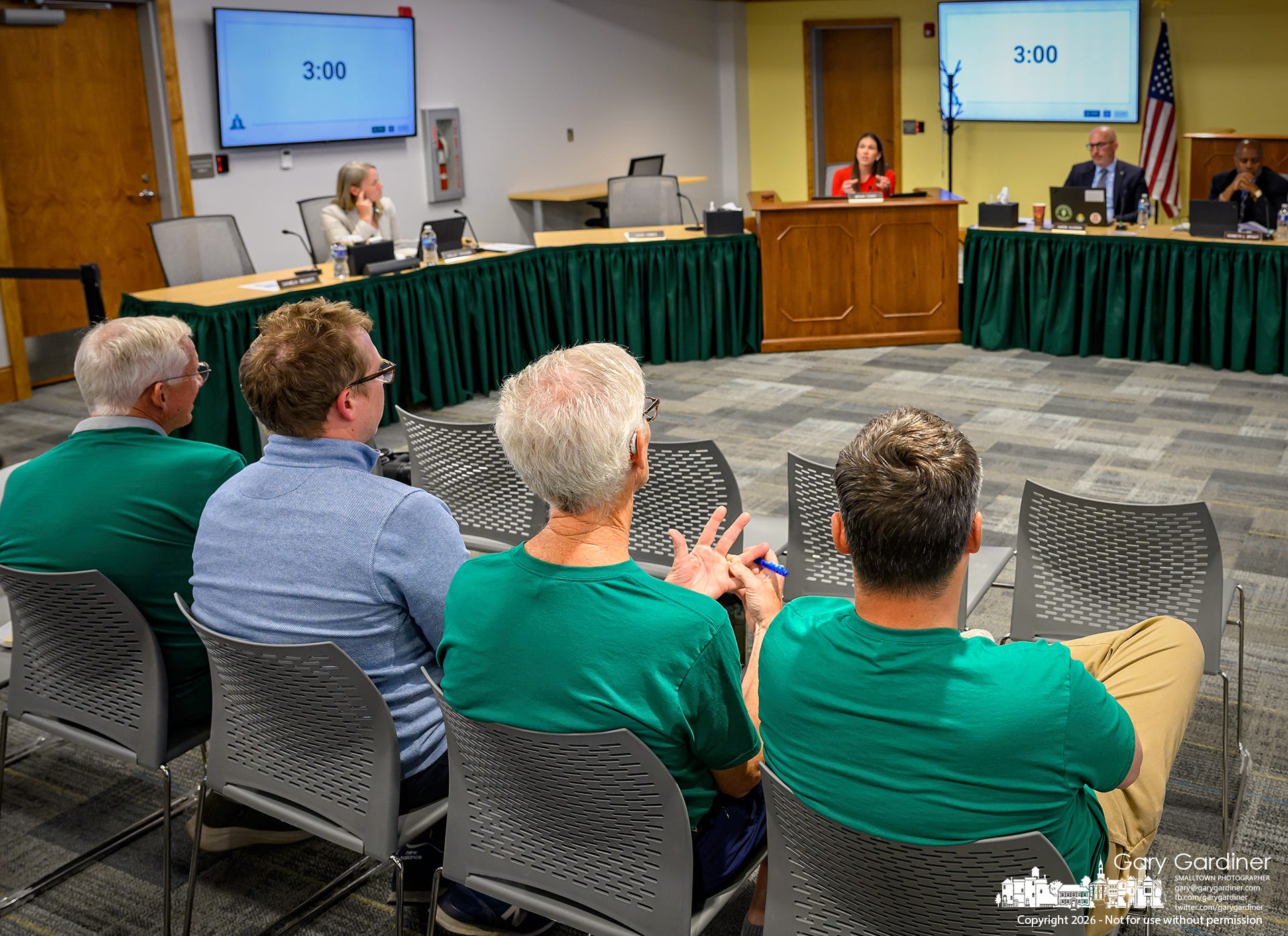
Residents again used the public comment period to press the Westerville City Council over the future of 64 E. Walnut St., urging officials to slow down, improve transparency and consider reusing the existing city-owned building rather than pursuing demolition and redevelopment.
Peter Maxwell told the council the property should not be viewed as vacant land. He said the roughly five-acre site includes mature trees, a 30,000-square-foot building and more than 200 public parking spaces near Uptown, the library and Hanby Park.
“So 64 East Walnut Street sits empty, rather than welcoming a new user that we all are excited about, who could be contributing to the Uptown community without negatively impacting it,” Maxwell said.
City Manager Monica Dupee said earlier in the meeting that the city will hold a community work session on 64 E. Walnut from 6 to 8 p.m. Aug. 11 at the Westerville Community Center. Unlike previous drop-in events, she said, the session will be a facilitated two-hour conversation designed for staff and council to listen to residents.
Several residents said their concerns extend beyond the prior redevelopment proposal and now include the city’s public engagement process.
Peg Duffy said residents came to council not because the system worked, but because “they knew it was malfunctioning.” She said the council should ensure that public concerns about density, safety, traffic, and parking are addressed in a public forum where residents can hear the same information.
Chris Murphy criticized the city’s handling of public records requests related to 64 E. Walnut, saying some requests have been pending for two months. He urged city officials to be more direct with residents about the site's future.
Julie Wildermuth said residents remain skeptical that a new proposal process will be different from the one that produced the earlier plan. She questioned how the city summarized public feedback from a previous open house and said the city should explain how resident input will be used before any new proposal is developed.
Daniel Vermeir, speaking on behalf of 90 E. Walnut St., said he opposes redevelopment based on the original plan and supports adaptive reuse of the existing structure. He asked the city to make studies and analyses readily available, publish materials well before future meetings, hold public tours of the building, and meet directly with nearby property owners.
“We instead support adaptive reuse of the existing structure,” Vermeir said. “I repeat this to assure no confusion where our comments are summarized for analysis.”
Other speakers focused on parking, traffic, trees, and trust. Matt Duncan said residents have distributed more than 400 yard signs opposing the earlier concept and warned that Uptown cannot afford to lose public parking. Charles Taylor argued that the previous proposal would have reduced the number of available public parking spaces rather than increased them.
Chair Megan Czako later clarified that the Aug. 11 session and a separate September council work session will have different purposes. The August meeting will focus on community input specific to 64 E. Walnut, while the September work session will be a presentation-style council meeting that will be recorded.
Other public comments touched on traffic and transportation safety. Chris Gordon Smith asked whether Westerville has rules on rental property density and raised concerns about speeding on East Rock Road. Joe Dietz, a longtime resident, urged the city to address safety at North Otterbein Avenue and County Line Road and also spoke in support of tighter controls on e-bikes, gas-powered bikes and similar devices on trails.
Because this post is public, you’re encouraged to share it on social media.
The Westerville News is a reader-supported publication by Gary Gardiner, a lifelong journalist who believes hyper-local reporting is the future of news. This publication focuses exclusively on Westerville—its local news, influence on Central Ohio, and how surrounding areas shape the community.
Reader funding, including subscribers, protects editorial independence, so coverage is guided by journalists rather than owners or corporate profit goals. It also reduces pressure to chase clicks, letting the newsroom focus on stories worth readers’ time. And it helps keep the site accessible to everyone, including people who can’t pay or live in places where a free press is under threat.
Explore more hyper-local reporting by subscribing to The Hilliard Beacon, Civic Capacity, Marysville Matters, The Ohio Roundtable, Shelby News Reporter, This Week in Toledo, and Into the Morning by Krista Steele.
