

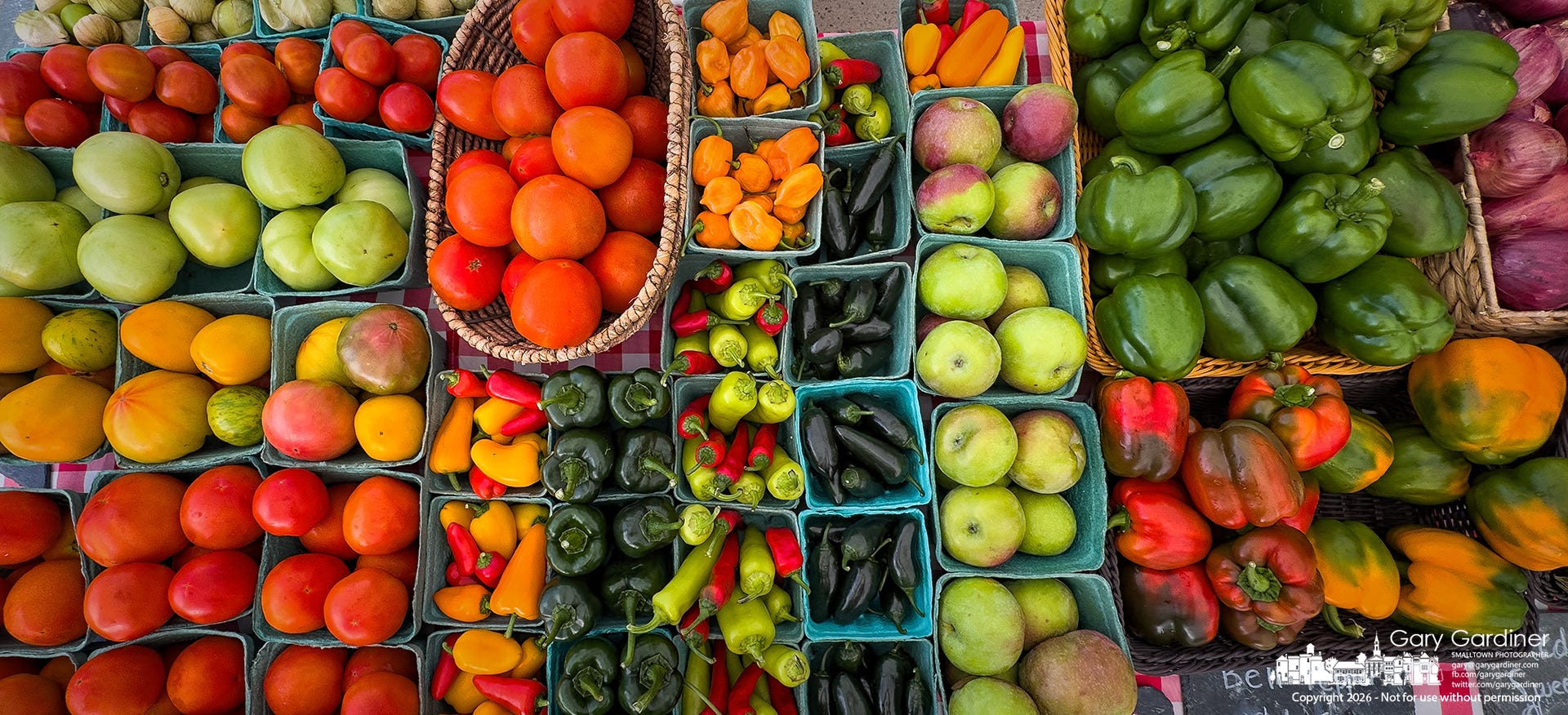
At last week’s Saturday Farmers Market, a moment brought me close to tears. The morning sun, missing for several weeks, cut its way through the clear blue sky, casting shadows across the market and reminding me of something photographers and farmers know equally well: Good photographs and great crops depend on light.
I have a routine for Saturday mornings. I walk counterclockwise through the market on my first pass, taking in the colors and shapes arranged on the tables. I’m looking for something I haven’t yet defined, waiting for the moment when the farmer’s bounty meets the photographer’s bounty. When two worlds overlap in such a way that I pull myself away from observing and begin to participate in a visual dance, finding tempo, tone, and movement within the frame.
On the tables at New Albany Organics sat a spilled cornucopia of produce, rich in color and arranged in a way that seemed to invite me into another world, one where this was every Saturday, where the tomatoes never disappeared, the peppers remained plentiful, and the bounty endured.
But this was the next-to-last market of the season. Soon the tables would be empty, the tents folded and the parking lot returned to its weekday purpose. Perhaps what nearly brought me to tears was not the sadness of an ending but the sudden recognition of how much these mornings had given me.
I have an expansive collection of photographs from years of Saturday markets, from the Wednesday market that preceded them and from the street vendors who came before that. Thousands of images recording the changing colors of the seasons, the arrangements of vegetables, the faces behind the tables and the small moments that made one market different from another. What began as a search for photographs has become an archive of experiences I never knew would matter so much.
We think of the farmers market as a singular event stretching from May through September. But the broccoli market gives way to the strawberry market, then the blueberry market, the corn market and the tomato market. We seldom notice the departures because something new is always arriving. The last strawberries are easier to accept when the blueberries are plentiful. The disappearance of blueberries matters less when the corn is finally worth buying by the dozen.
Until the final Saturday, when there is no next crop coming to take the place of what has disappeared.
This Saturday, shoppers will examine what’s left with a different kind of attention. They'll decide which tomatoes are worth taking home, whether another package of meat belongs in the freezer, and how many jars of something might help carry the memory of summer through winter. Some will ask farmers whether they expect to return next year. Others will make purchases knowing this particular opportunity will not come again for months.
I’ll do some of that myself. But I’ve been thinking about what else I’ve been bringing home all summer.
There are the palate memories, of course. The first strawberry that actually tastes like a strawberry. Corn sweet enough to make you wonder why you bother eating it any other time of year. A tomato worth eating over the sink because the juice is going to run down your hands no matter how carefully you approach it.
Yet the photographs remind me of things beyond the frame. Conversations with farmers about what was coming next. Familiar greetings. Recommendations about how to prepare something I had never cooked before. The pleasure of discovering that a favorite vendor had returned. Some Saturdays I came home with more food than I intended to buy; others, the most satisfying thing I carried away was a photograph or a conversation.
The food is the reason we gather. What happens while we’re gathered is what makes us want to return.
Sometime during the winter, or perhaps as spring approaches, they'll announce next year’s market dates. I’ll study the vendor list, looking for familiar names. I’ll want to know whether the farmer with the tomatoes I love is returning, whether the people with the good pork chops will be back, and whether the vendors whose tables have become part of my Saturday routine will be there again.
On Saturday, I don’t intend to lament summer’s end. I intend to walk counterclockwise through the market, looking for the colors and shapes that invite me to stop. I’ll talk with the farmers, buy what I can use and perhaps a little more than I should. I’ll make photographs that may someday remind me of something I didn’t know I was experiencing.
The days will grow shorter and colder. The food I’ve carried home will gradually disappear from the freezer and the shelves. But the photographs, the conversations and the pleasure of those Saturday mornings will remain.
And somewhere beyond the winter snow, another market will be taking shape.
I’ll be eager to return for another helping.

Because this post is public, you’re encouraged to share it on social media.
The Westerville News is a reader-supported publication by Gary Gardiner, a lifelong journalist who believes hyper-local reporting is the future of news. This publication focuses exclusively on Westerville—its local news, its influence on Central Ohio, and how surrounding areas shape the community.
Reader funding, including subscribers, protects editorial independence, so coverage is guided by journalists rather than owners or corporate profit goals. It also reduces pressure to chase clicks, letting the newsroom focus on stories worth readers’ time. And it helps keep the site accessible to everyone, including people who can’t pay or live in places where a free press is under threat.
Explore more hyper-local reporting by subscribing to The Hilliard Beacon, Civic Capacity, Marysville Matters, The Ohio Roundtable, Shelby News Reporter, This Week in Toledo, and Into the Morning by Krista Steele.
