
Electric Power Planning and Storm Repairs Report
Just weeks after Westerville Electric restored power following a rare 36-hour storm outage, the city’s utility manager told City Council that Westerville needs to strengthen its long-term power supply plan.
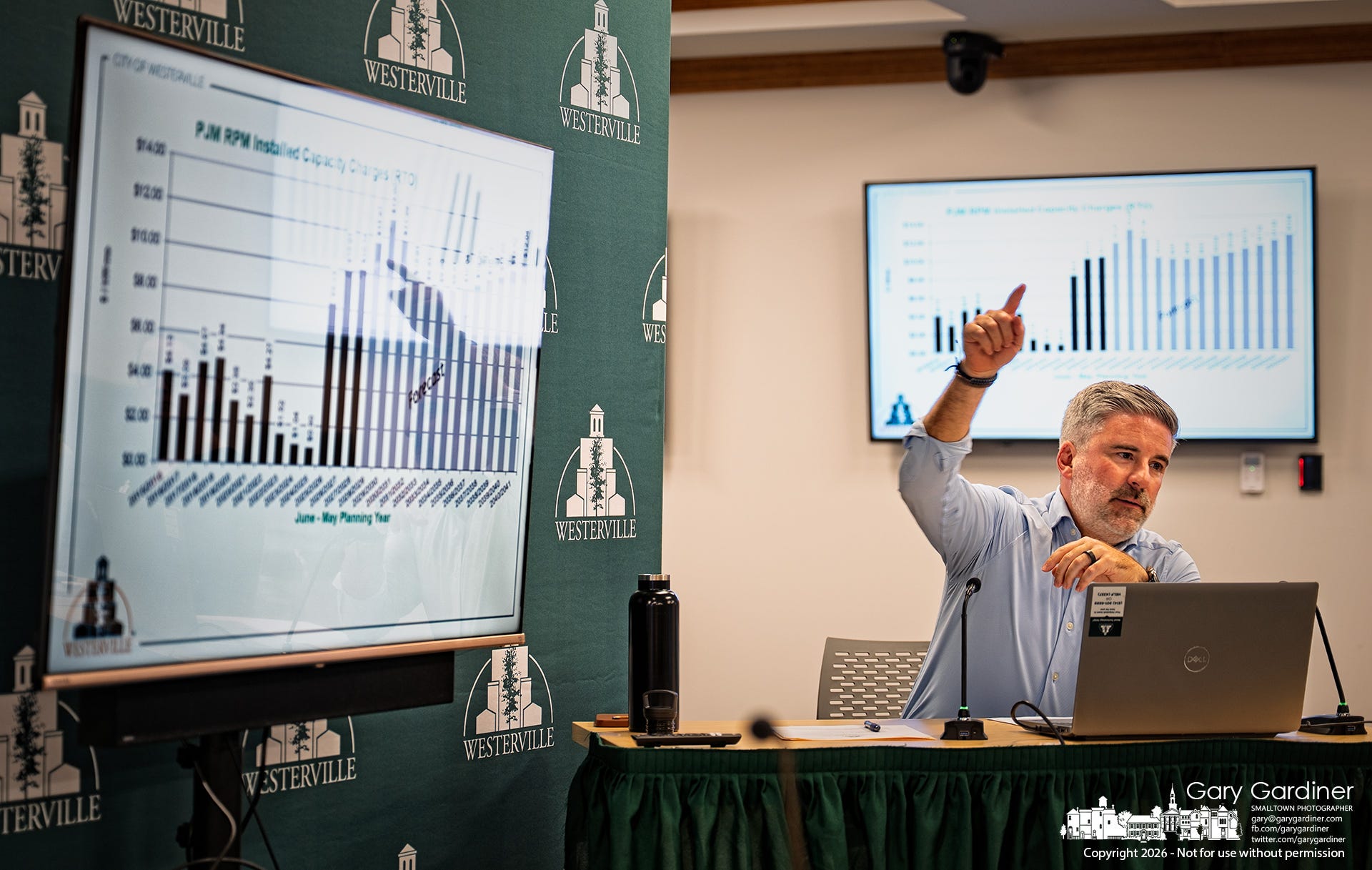
At Tuesday’s work session, Electric Utility Manager Chris Monacelli asked council members whether they were prepared to move forward with legislation for two new power purchase agreements: 10 megawatts from Potomac Energy, a natural gas plant in Virginia, and 15 megawatts from Bright Mountain Solar in Kentucky.
Monacelli said the agreements fit Westerville’s “block and index” strategy, which is intended to diversify energy sources, improve predictability, and give the city more control as demand rises and capacity costs increase across the grid. Under the plan, Westerville’s renewable energy share would rise from about 2% in 2025 to about 20% by 2029.
The discussion came weeks after a March 13 windstorm caused one of the city’s most significant outages in recent memory, leaving more than 6,000 of its 19,000 customers without power at its peak and forcing Westerville to seek mutual aid from outside central Ohio for the first time in at least two decades.
For Jessi Hodge, a lifelong Westerville resident, the outage became a family memory. Hodge said she lost power around 3 p.m. Friday and got it back just before 7 a.m. Saturday. Instead of dwelling on the disruption, she, her husband, and their two sons spent time with friends who still had power and later played card games at home by flashlight and candlelight.
“We just made the best of it,” Hodge said. “It was just basic as basic gets. And it couldn’t have been better.”
Hodge’s experience reflected how unusual the outage was in Westerville, where outages are usually brief. Most last no more than 15 minutes. When service stays out for hours, it usually signals a more serious problem.
Monacelli said Westerville Electric began preparing by midday Friday as forecasts warned of high winds. But the storm hit after heavy snow and rain had saturated the ground, making trees more likely to fall when gusts approached 70 mph.
“What we can’t always predict is how trees are going to respond to wind,” Monacelli said. “In this case, a couple of weeks before that, we had 12 inches, 13 inches of snow on the ground, and it was rainy and wet. So all of those shallow-root trees mixed with 70-mile-an-hour winds just won that day.”
The damage went beyond a typical outage. Trees fell into lines, poles were damaged, and cross arms were broken. On one circuit, crews found 11 broken cross arms, turning restoration into a rebuilding effort.
At the same time, the city was trying to respond with the staffing it would normally have for a weekend, not the level required for a storm of this size. Westerville called in available employees and shifted to full storm response, but the work quickly became too widespread and labor-intensive for routine outage response.
By about 9 p.m. Friday, the city had a clearer picture of the outage’s scope. Crews worked through the night, and because Westerville could not find help closer to home, a mutual-aid crew from Hamilton arrived the next morning to assist with repairs. By 4 a.m. Sunday, the last of the initial outages had been restored.
Monacelli said crews had to prioritize repairs that would restore service to the largest number of customers first while continuing to assess new reports as they came in. The work stretched through the night, and as the hours wore on, restoration also depended on managing fatigue and giving workers time to rest between dangerous repairs.
The same utility that spent that weekend rotating tired workers through a storm response is now trying to secure greater control and stability in a power market reshaped by rising demand, retiring baseload generation, and higher capacity costs.
He pointed to hyperscale data centers in central Ohio as one example of how quickly electricity demand is changing. Westerville’s peak load is about 100 megawatts, he said, while a single large data center can seek 300, 400, or 500 megawatts.
The proposed agreements would begin helping fill out the city’s portfolio in 2027. According to Monacelli’s presentation, the Potomac agreement would run 15 years, and the Bright Mountain Solar agreement would run 25 years.
The council agreed to consider approving the legislation at council meetings.
The Westerville News is a reader-supported publication by Gary Gardiner, a lifelong journalist who believes hyper-local reporting is the future of news. This publication focuses exclusively on Westerville—its local news, influence on Central Ohio, and how surrounding areas shape the community.
Reader funding, including subscribers, protects editorial independence, so coverage is guided by journalists rather than owners or corporate profit goals. It also reduces pressure to chase clicks, letting the newsroom focus on stories worth readers’ time. And it helps keep the site accessible to everyone, including people who can’t pay or live in places where a free press is under threat.
Explore more hyper-local reporting by subscribing to The Hilliard Beacon, Civic Capacity, Marysville Matters, The Ohio Roundtable, Shelby News Reporter, This Week in Toledo, and Into the Morning by Krista Steele.


