

EMWTTSFM - A Revolutionary Idea of Satisfaction
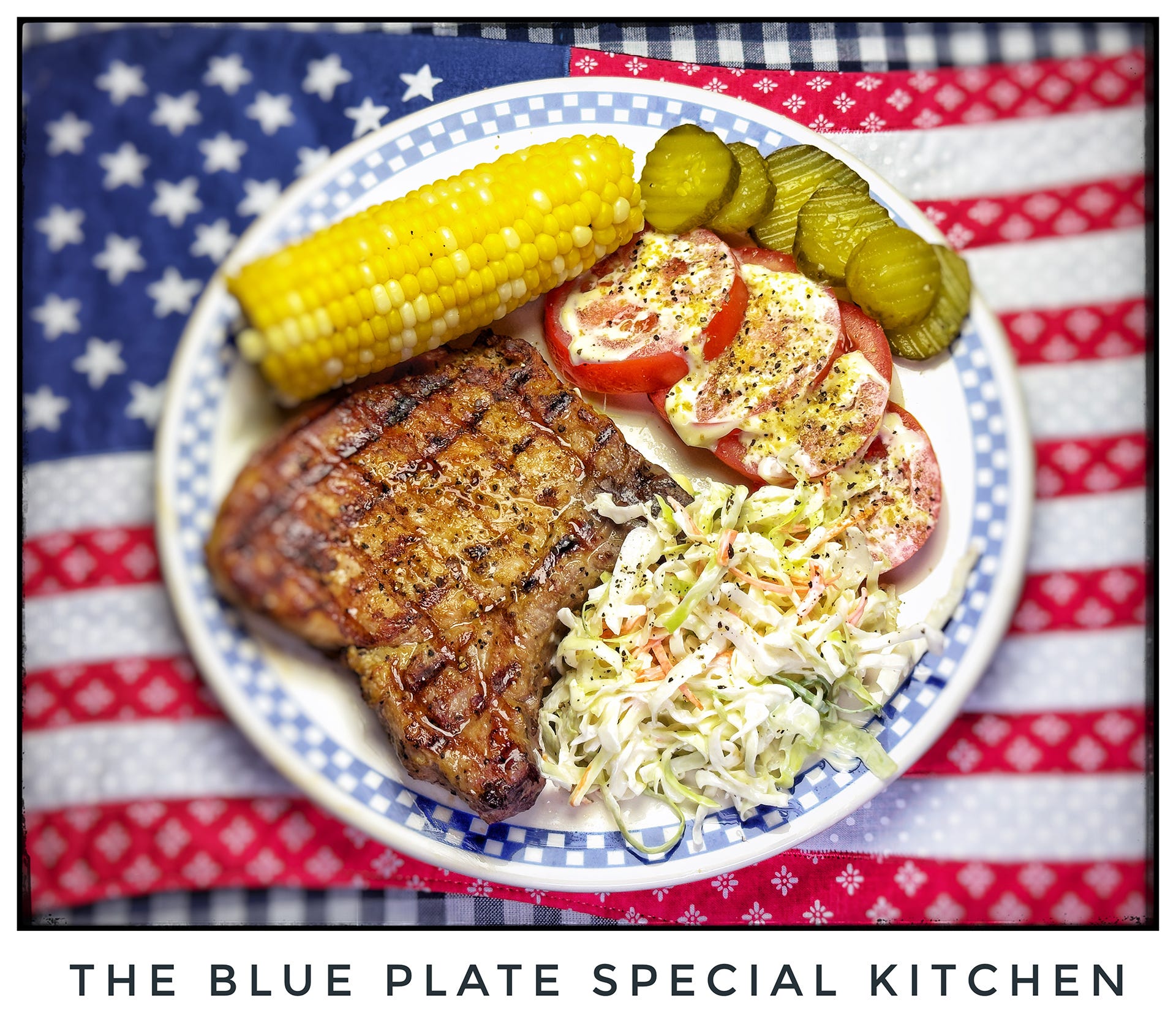
The first week corn shows up at the Saturday Farmers Market, I usually pass it by. I am glad to see it, and I always take that first sighting as a sign that summer has settled in, but I have had better luck waiting one more week.
This was the week to buy it. The ears were sweet, firm, and not too big, which matters when corn is sharing a plate with a bone-in pork chop, tomatoes under mayonnaise and lime pepper, bread-and-butter pickles, and cole slaw.
The pork chop was salted, peppered, seasoned with garlic and onion, then grilled. The cole slaw did what cole slaw is supposed to do, which is keep its cool beside smoke, salt, and fat.
The Fourth of July market has a different hum to it, though not because the parade crowd can be seen from the stalls. The market sits in the parking lot behind what used to be the National Guard Armory, beside the concrete-block storage building that has found a second life as a restaurant, while the parade watchers gather out front along the street, close enough to change the morning but hidden from the tables by brick, block, and the old arrangement of the place.
The two crowds do not exactly mingle. They work around each other. Shoppers slip in before the street gets tight, parade families find their way around back after parking wherever they can, and for a little while the town is divided between people choosing tomatoes and people unfolding chairs, each group aware of the other by sound, timing, and the small pressure of a holiday morning.
By noon, many of them will have gone home with something from the market and something from the parade to talk about, and the afternoon will become what it usually becomes on the Fourth: food set out on counters, someone tending a grill, ballgames left on in the background, family moving through the kitchen, somebody asking whether the corn was worth buying yet, and later, when the day has finally burned down enough, thousands gathering again for fireworks.
At the edge of town, near the entrance from the Interstate Outer Belt, Pioneer Cemetery holds the city’s Revolutionary War soldiers, though the parade does not pass by them and the fireworks do not open above them.
That might seem like an omission, but their presence in the day has less to do with the route than with the life around it: the market morning, the full plate, the complaint about parking, the choice of one ear of corn over another, the trip home after the parade, and the small argument over whether anything on the table needs more butter.
A Revolutionary War soldier would have recognized parts of this plate, though not the comfort of it. Pork, corn, cabbage, vinegar, salt, and grain all belonged to the food world of the army, and on paper the ration could sound almost generous: meat, bread or flour, peas or beans, Indian meal, vinegar, and beer or cider when the army could get it.
Between the regulation and the soldier stood weather, mud, bad roads, poor storage, failed contracts, broken wagons, and the steady confusion of an army trying to feed men faster than hunger could weaken them. What began as a ration could arrive late, spoiled, reduced, or not at all, and the distance between what was promised and what was eaten often became the real measure of the war.
When supplies ran thin, the meal could shrink to firecake, flour and water cooked over a fire because there was only flour and water left. It was not supper in the way anyone hopes for supper, but it could be swallowed, and sometimes that was enough to keep a man moving.
My father knew a later version of that bargain in the Second World War, first aboard a Navy destroyer in the Mediterranean and later in the Aleutian Islands, where food did not come by wagon over rutted roads but across open water in cargo nets borne on cables from a supply ship, the two vessels keeping their distance while the next several weeks of eating swung between them.
He loved green beans and potatoes, yellow squash, okra, watermelon, and stewed tomatoes over white rice, foods that belonged to gardens, kitchens, heat, and the patience of someone cooking for people expected at the table.
Those were not the foods a destroyer could offer very often.
What it could offer was what could be stacked, stored, shipped, and served, and too often that meant SPAM, the meat protein that could survive what fresh things could not. A single cargo net drawn tight between two ships might carry enough of it to feed men for weeks, which made it useful, necessary, and deeply unwelcome.
SPAM never came into our house after the war. No speech was made about it and no rule was written down, but some foods carry a history stronger than appetite, and a man who had eaten enough of something at sea did not need it at his own table.
When his destroyer was sunk off North Africa, he found one small mercy in the loss, strange as that sounds. The ship went down with a full supply of SPAM aboard, which meant that whatever else had been taken by the water, those cans were gone too, and none of that particular future would be sliced, fried, and served back to him.
That is where ration food keeps its hold, not only in hunger and not only in complaint, but in the knowledge that being fed is not the same as being restored. Firecake in a Revolutionary camp and SPAM aboard a destroyer have almost nothing in common as foods, but both belong to the world of men kept alive by systems that could not pause to ask what they wanted.
The market plate stands at the far end of that distance, not because it is grand or rare, but because it begins in choice: corn bought in its second week, tomatoes good enough to take mayonnaise and lime pepper, pork seasoned for the grill, pickles for their sweet vinegar, and slaw because cabbage, cut and dressed, still knows how to steady a plate.
So the corn gets the notice this week, as it should. Not first-week corn, but second-week corn, sweet and firm and properly sized, eaten on a Fourth of July when the market ran behind the old Armory while the parade gathered out front, and the day moved on toward porches, kitchens, ballgames, fireworks, and the ordinary pleasure of enough.
The soldiers in Pioneer Cemetery do not need the parade to pass them to be part of that pleasure.
They are already there, not in the noise alone, but in the ease beneath it.

Because this post is public, you’re encouraged to share it on social media.
The Westerville News is a reader-supported publication by Gary Gardiner, a lifelong journalist who believes hyper-local reporting is the future of news. This publication focuses exclusively on Westerville—its local news, influence on Central Ohio, and how surrounding areas shape the community.
Reader funding, including subscribers, protects editorial independence, so coverage is guided by journalists rather than owners or corporate profit goals. It also reduces pressure to chase clicks, letting the newsroom focus on stories worth readers’ time. And it helps keep the site accessible to everyone, including people who can’t pay or live in places where a free press is under threat.
Explore more hyper-local reporting by subscribing to The Hilliard Beacon, Civic Capacity, Marysville Matters, The Ohio Roundtable, Shelby News Reporter, This Week in Toledo, and Into the Morning by Krista Steele.
