

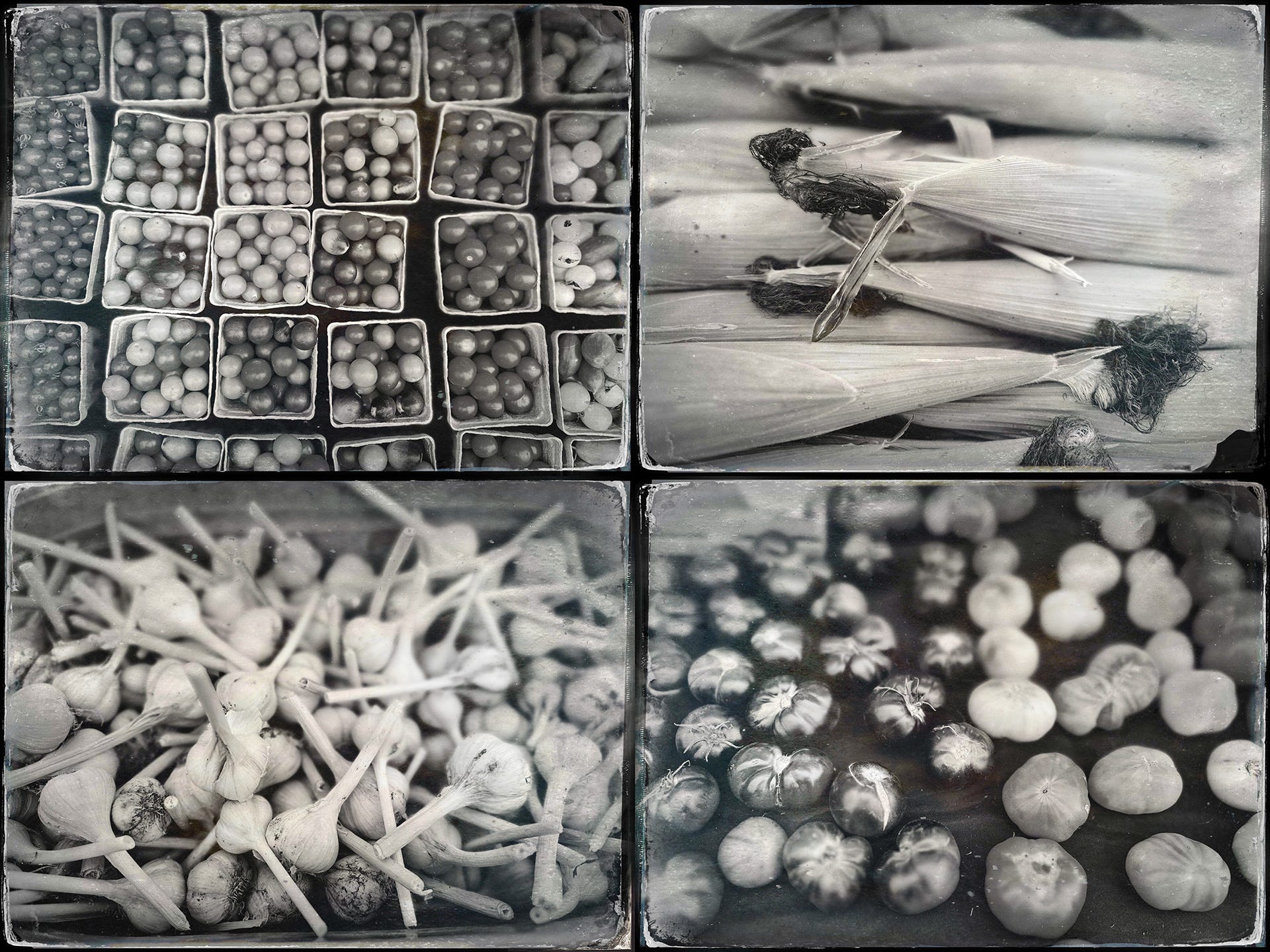
I have bratwurst, pork chops, chicken breasts and thighs, and several filets in my freezer. In tightly sealed jars are coffee beans, waiting for early in the morning just-in-time grinding. Artisanal apple vinegar sits on the shelf beside an unopened jar of strawberry-rhubarb jelly and a jug of maple syrup, the latter not to be opened until the first snow falls. These are the physical, measurable artifacts of the Saturday Farmers Market. They are also emotional ones.
Other artifacts won’t last nearly as long. Tomatoes on the counter. Corn in the refrigerator. Whatever I bring home this Saturday and eat before the next one. Some things from the market can be frozen or canned or sealed tightly in a jar. Others have to be eaten now. All summer, without realizing it, I have been using the Saturday Farmers Market as a kind of existential ruler.
A clock measures seconds and a calendar measures days, but the market measures what those days have done.
That is a different kind of measurement. Seven days is seven days on a calendar whether nothing much seems to happen or an entire field of corn reaches maturity. At the market, those same seven days can be enough for something to appear, ripen, become abundant, and begin to disappear. The calendar tells me how much time has passed. The market tells me what happened while it was passing.
Early in the summer, the appearance of something new is an event. Strawberries arrive. Then corn. Tomatoes move from anticipation to abundance. For a while there is so much of everything that abundance itself becomes ordinary. That may be one of the peculiarities of having enough. Eventually, enough feels like enough. Another tomato? More corn? What exactly am I going to do with another zucchini? The miraculous becomes Saturday.
There is nothing unusual about this agricultural cycle. Crops have always marked time. Planting, flowering, ripening, and harvest follow biological clocks that pay no attention to the dates printed on ours. Weather can hurry them along or hold them back. Rain matters. Heat matters. Sunlight matters. A farmer experiences those changes in the field. A customer at a farmers market sees the result arranged on tables.
The supermarket has made it easier to forget this. Much of what we eat can be purchased year-round, transported from places where the growing season differs from ours. A tomato in January is unremarkable because there are tomatoes in January. But at a local farmers market, absence remains part of the experience. Things arrive. Things leave.
Then someone tells you there are only two Saturdays left, and suddenly the ruler reads differently. The tomatoes I had become almost indifferent to are finite. Corn becomes something I should perhaps buy one more dozen of. The desire to preserve becomes almost urgent precisely when I have become satiated with the things I am trying to preserve.
Scarcity has restored some of the value that abundance had taken away. The first tomato mattered because I had waited for it. Somewhere in the middle of summer, tomatoes became ordinary. Now, as they disappear, I notice them again.
But preservation isn’t preservation, at least not entirely. The corn I freeze is no longer the corn I carried home Saturday morning. I shucked it, blanched it, cut it from the cob, put it in a bag, and froze it. The strawberry-rhubarb jelly is not strawberries and rhubarb. The vinegar is not apples. Each is an artifact of something that existed before it became something else.
I can preserve some of the harvest. I cannot preserve the season that produced it.
And none of it preserves Saturday.
I should say here that I am not a physicist. I am not even someone who should be left alone for very long with the word “quantum.” Like most of us, I feign just enough expertise to get through each day’s explorations. But I recently listened to a physicist talk about time, and something much simpler than the physics stayed with me: Measuring time and experiencing time are not the same thing.
Physics can describe time with a precision far beyond anything I need on a Saturday morning. My phone can tell me exactly what time it is. A calendar can tell me exactly how many days have passed since the first market of the season. Neither measurement tells me what those days have done.
For that I need tomatoes.
Every Saturday this summer I have gone to the market to see what summer looks like now. I thought I was shopping. I was taking measurements. The strawberries told me where and when I was. So did the corn. So did the first tomato worth eating over the sink. Later, the overwhelming quantity of tomatoes explained bounty. Now the apples are telling me something I would rather not hear.
Seven days have passed since I last walked through the market. My clock could have told me that, and my calendar certainly could. But neither could tell me what those seven days had done. The market could. Something ripened. Something disappeared. Something became abundant. Something that had been abundant became scarce. The angle of the sun changed. The morning became cooler. My appetite changed. So did I.
That last measurement is harder to make.
Heraclitus is credited with the observation that we cannot step into the same river twice. The water has moved on. Less often included in the shorthand is the other half of the thought: We have moved on, too. I have never gone to the same Saturday Farmers Market twice.
The tents may stand in the same places, and many of the same people may be behind the same tables, but the market I enter this Saturday did not exist last Saturday. The local corn, once piled high, is gone for the season. There are fewer large tomatoes now, now only the remnants of a rich cherry tomato crop scattered across the farmers’ tables. The field crops that defined summer are disappearing, their space increasingly taken by apples. The people behind the tables have lived another week. So have the people standing in front of them.
We call it the same market because we need a name for the river.
Next Saturday will be the final market of the season. After that, the parking lot will still exist. The farmers will exist. Their farms will exist. Somewhere there will still be tomatoes and corn and apples. But the particular universe that comes into existence for a few hours every Saturday morning will not. No market for me to observe. There will only be artifacts: bratwurst, pork chops, chicken, coffee beans, vinegar, jelly, maple syrup waiting for snow, perhaps some corn in the freezer, and memory.
Then, sometime next year, the Saturday Farmers Market will appear again. We will say that it is back, but it won’t be. It will be another market, made from another year’s rain and sun, another planting, another harvest, perhaps some different farmers and certainly different vegetables. The people behind the tables will have traveled through another winter. So will I.
I will step into that river carrying everything that happened while the market did not exist for me, and I will begin measuring again.
Until then, I have two Saturdays left.

Because this post is public, you’re encouraged to share it on social media.
The Westerville News is a reader-supported publication by Gary Gardiner, a lifelong journalist who believes hyper-local reporting is the future of news. This publication focuses exclusively on Westerville—its local news, its influence on Central Ohio, and how surrounding areas shape the community.
Reader funding, including subscribers, protects editorial independence, so coverage is guided by journalists rather than owners or corporate profit goals. It also reduces pressure to chase clicks, letting the newsroom focus on stories worth readers’ time. And it helps keep the site accessible to everyone, including people who can’t pay or live in places where a free press is under threat.
Explore more hyper-local reporting by subscribing to The Hilliard Beacon, Civic Capacity, Marysville Matters, The Ohio Roundtable, Shelby News Reporter, This Week in Toledo, and Into the Morning by Krista Steele.
