
From Iwo Jima To Westerville, Irwin Kuhns marks 100 years
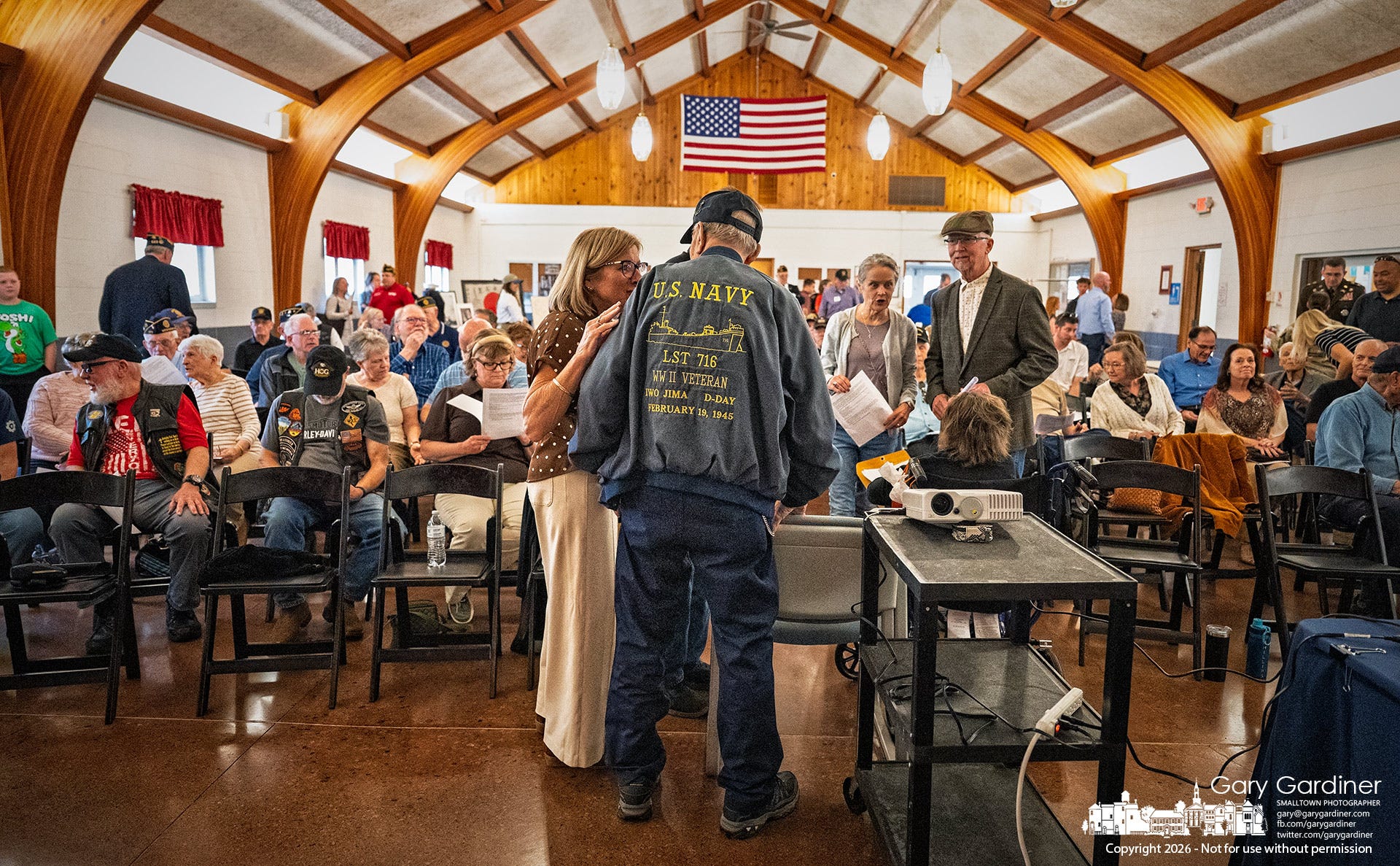
World War II and Korean War veteran Irwin Kuhns marked his 100th birthday Friday at the American Legion post in Westerville, where family members, fellow veterans and community leaders gathered to honor his service and sacrifice.
Kuhns was joined by his wife and family as speakers and guests paid tribute to a life that spanned a century and included service in two wars. He stood with members of the Young Marines as representatives of military, veterans, civic and state organizations offered thanks and congratulations.
A number of speakers took part in the program. American Legion Commander Jeff Frazier opened the event and led the Pledge of Allegiance. American Legion Chaplain Dan Carey gave the prayer, followed by welcome remarks and guest recognition from VFW Commander Andy Tompkins. Westerville VFW Service Officer Gary Swank read from Tom Brokaw’s The Greatest Generation. Kuhns’ son, Thom, presented a slideshow on his father’s life. Additional tributes came from Beth Johnson, executive director of Honor Flight Columbus, along with representatives of the National Veterans Memorial and Museum and the Navy unit at Rickenbacker. A proclamation from the governor was also presented on Kuhns’ behalf.


Born in 1926 in McKeesport, Pennsylvania, Kuhns grew up during the Great Depression, an experience that helped shape the resilience and self-reliance that would define his life. As a teenager, he spent time with family in Ligonier, where relatives farmed, logged and operated a sawmill. He learned hard work, hunting and gardening, and developed an early fascination with machines and building things.
In early 1944, at 17, Kuhns left high school and joined the U.S. Navy. After boot camp at Great Lakes, he trained in Florida as a small boat coxswain, learning to operate landing craft used in amphibious assaults. He also trained alongside members of the Navy’s early Underwater Demolition Teams, the forerunners of today’s Navy SEALs.
Kuhns was later assigned to LST 716. An LST, or landing ship, tank, was designed to carry troops, vehicles and supplies for amphibious invasions. But Kuhns’ job also took him into smaller craft. At Iwo Jima, he piloted Higgins boats, the landing craft that ferried Marines and equipment from ship to shore during the assault.
According to Thom Kuhns, his father was so skilled at handling the boats in the surf that the Marines he delivered to the beach “never got their shoes wet.”
Kuhns and the crew of LST 716 supported the brutal fighting at Iwo Jima and later Okinawa. At Iwo Jima, he took Marines and supplies to the beach and then transported wounded service members back to hospital ships. During the battle, he witnessed one of the war’s most iconic moments, seeing the American flag raised atop Mount Suribachi.
After World War II ended, Kuhns continued serving in the Pacific before returning home in 1946. He joined the Naval Reserve, resumed his schooling and went to work in the Pittsburgh area. When the Korean War began, he was called back to active duty. By then, he had retrained as an electronics technician and served aboard the USS Jason and USS Ajax, repairing electronics on naval vessels during an 18-month deployment.
Kuhns eventually settled in central Ohio after marrying Barbara in 1955. He went to work for North American Aviation at Port Columbus, where the company produced F-100 Super Sabres and T-28 Trojans. According to his son, Thom, Kuhns did design work on both aircraft. Thom said his father also helped convert the T-28 from a trainer into a close-support and rescue aircraft for use in Vietnam and designed a fuel system that allowed the plane to fly upside down, giving pilots more time to observe terrain during rescue missions.
That lifetime of service and work remained at the center of Friday’s celebration. Kuhns also accepted challenge coins from the National Veterans Memorial and Museum and several military representatives, another tribute in a day filled with recognition.
Alongside his wife, children and grandchildren, Kuhns was surrounded by friends, veterans and community leaders who came to honor not only his military service, but also the century of life and work that followed.
The Westerville News is a reader-supported publication by Gary Gardiner, a lifelong journalist who believes hyper-local reporting is the future of news. This publication focuses exclusively on Westerville—its local news, influence on Central Ohio, and how surrounding areas shape the community.
Reader funding, including subscribers, protects editorial independence, so coverage is guided by journalists rather than owners or corporate profit goals. It also reduces pressure to chase clicks, letting the newsroom focus on stories worth readers’ time. And it helps keep the site accessible to everyone, including people who can’t pay or live in places where a free press is under threat.
Explore more hyper-local reporting by subscribing to The Hilliard Beacon, Civic Capacity, Marysville Matters, The Ohio Roundtable, Shelby News Reporter, This Week in Toledo, and Into the Morning by Krista Steele.


