

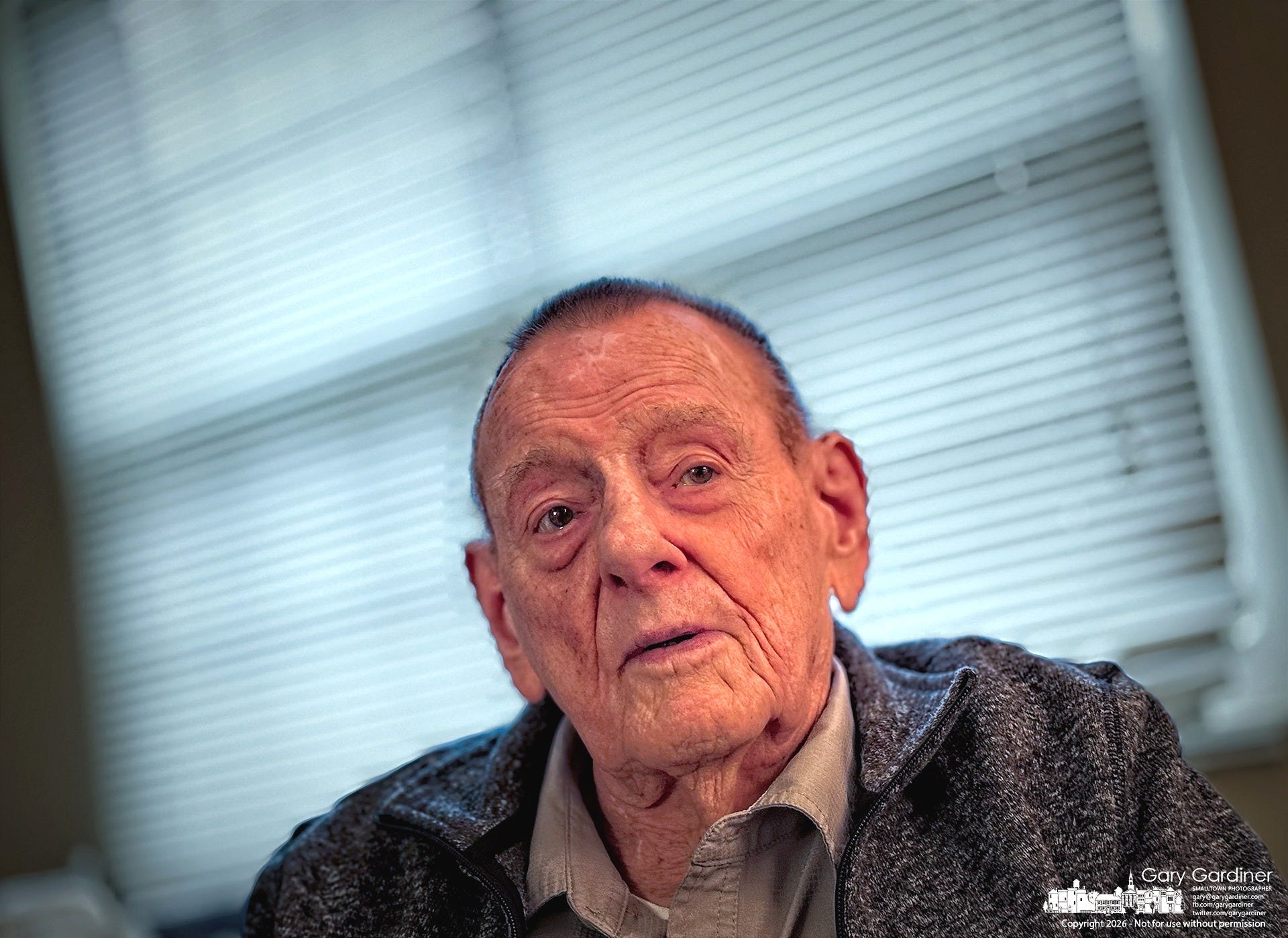
Mortar shells were exploding around Ed Dennis, some landing just 15 or 20 feet away. He remembers waiting for the shelling to stop, then running with the other soldiers toward the protection of the trees.
“That scared the living hell out of me,” he said.
More than 80 years later, the 105-year-old Westerville veteran makes no attempt to disguise what he felt as a young soldier fighting in Europe during World War II. “Don’t let anybody tell you, ‘Oh, it was nothing. It didn’t bother me at all,’” Dennis said. “They were all damn well scared ... Same as I was. You can’t help be scared.”
Dennis, a retired Army lieutenant colonel, served in two wars during a military career that began eight months before the Japanese attack on Pearl Harbor and ended in 1962. A graduate of Westerville High School, he fought in the Battle of the Bulge, parachuted into Germany during an Allied airborne assault, and later served in Korea. He received the Bronze Star Medal and Purple Heart.
But when asked about his decorations during a recent interview, Dennis brushed aside the suggestion that he had done anything extraordinary. “I didn’t do anything special,” he said. “I just lived day to day, had a fight.”
His military service spans more than two decades and several continents. His memories are more personal: bitter cold, enemy artillery, friendships formed among soldiers and the shock of learning that a man he knew had been killed.
Dennis enlisted in the Army Air Corps in April 1941 at Fort Hayes in Columbus. His father had been an Army colonel, and Dennis was eager to enter military service, although joining the Air Corps was not necessarily his plan.
“I just went to the recruiting office,” he recalled. “I didn’t specify Army Air Corps. They just put me in it, I guess. And I didn’t care. I was anxious to get in.”
He eventually was assigned to Luke Field near Phoenix, Arizona, where he worked with automatic weapons mounted in military aircraft. Among the pilots training there were members of the Chinese Air Force, which was fighting Japan. Dennis helped prepare the aircraft’s machine guns for firing exercises, loading ammunition when the pilots returned from shooting at airborne targets.
“When they came back down, we’d get our ammunition and load up the machine guns,” he recalled. “And they took off.”
Dennis also spent time at Ajo, Arizona, a remote desert installation where soldiers lived in tents. He was sitting on the top bunk in his barracks, apparently writing a letter, when he learned that Japan had attacked Pearl Harbor on Dec. 7, 1941.
“I was probably just as glad as not because that’s what I joined the Army for,” he said. “But you get into a war and help fight the battle.”
Eventually, Dennis became interested in the airborne troops, thinking that “a paratrooper would be a pretty good job.” Asked whether jumping out of an airplane seemed like a good way to make a living, he had a simple answer: “I didn’t see anything wrong with it.”
Dennis completed parachute training in May 1944 and was assigned to the 17th Airborne Division. He sailed aboard the Queen Elizabeth to Scotland, then moved to England to prepare for combat.
In December 1944, German forces launched a major counteroffensive through the Ardennes region of Belgium and Luxembourg, beginning what became known as the Battle of the Bulge. The 17th Airborne Division was sent from England to join the fighting.
His introduction to the battlefield was not what he expected. After arriving in France, Dennis and his fellow soldiers were loaded onto trucks and driven toward the fighting. At about 4 or 5 in the afternoon, they were dropped off in the woods, where snow reached nearly to his knees.
“I said, where are we going from here?” Dennis recalled asking. The answer was not reassuring: “You’re not going anywhere from here. You’re staying here tonight.”
The soldiers spent the night in the bitter cold. The fighting that followed left an impression that has endured for more than 80 years, even as some details have faded. “I will say that was one hell of a war,” Dennis said. “It was bad.”
The Battle of the Bulge was not his last encounter with German forces. On March 24, 1945, Dennis participated in Operation Varsity, the Allied airborne assault across the Rhine River into Germany. Serving with the 513th Parachute Infantry Regiment of the 17th Airborne Division, he made the combat jump at approximately 10:16 that morning, according to his military chronology.
He received the Bronze Star Medal and Purple Heart for his actions, honors Dennis is reluctant to make much of. Asked what he had done to earn the Bronze Star, he insisted he hadn’t done anything extraordinary. “I don’t know why I got it,” he said. “I didn’t do anything special for it.”
His Purple Heart, however, brings back a particular memory. German forces had trapped a group of American soldiers, Dennis recalled, and he was among those sent to try to reach them. Heavy enemy fire prevented the effort from succeeding, and Dennis was wounded by mortar shrapnel.
When he returned, he found his flight jacket torn. During the interview, he reached toward his left forearm and made a sweeping motion to indicate where the jacket had been damaged. He went to have the wound examined, and the treatment, as he remembered it, amounted to little more than a bandage.
But the person treating him mentioned that he qualified for a Purple Heart. Dennis recalled asking why he would want one. The answer was practical: The decoration would give him five additional points toward going home under the Army’s system for determining which soldiers would return to the United States.
“And that was how I got the Purple Heart,” Dennis said.
World War II ended, but Dennis wasn’t finished with the Army. He left active duty in December 1945, only to return the following year. When war broke out in Korea in 1950, Dennis was back in uniform, this time as a captain.
He arrived in Korea in August 1952 and served with Headquarters, X Corps, and later the Eighth U.S. Army. Unlike his experiences in Europe, his assignments generally kept him some distance behind the front lines. “Korea wasn’t much,” he said. “I was behind lines a fair amount.”
Dennis nevertheless served in Korea during the final year of the fighting, and his records show a temporary duty assignment with the Military Armistice Commission in June 1953. The armistice was signed July 27, 1953, ending the fighting without formally ending the war. Dennis was still in Korea when the agreement was signed and remembers being glad the fighting was over.
His military career continued long afterward, including assignments with the 187th Airborne Regimental Combat Team in Japan and the 101st Airborne Division at Fort Campbell, Kentucky. By 1959, he was stationed at Kagnew Station in Asmara, Eritrea, where he held personnel and administrative responsibilities with the Army Security Agency.
Through much of that journey, Dennis had a traveling companion: his wife, Marie. She accompanied him from duty station to duty station as the Army took the couple far from their Ohio roots. They traveled to several countries together, making military life the backdrop for much of their marriage. They were married for 75 years before her death.
Dennis was promoted to lieutenant colonel in August 1962 and retired three months later, on Nov. 30, after more than 20 years of military service. He had entered the Army Air Corps as a private before the United States joined World War II. By the time he retired, American military involvement in Vietnam was growing, and another generation of soldiers would soon be sent to war.
For Dennis, the memories that remain most vivid are not necessarily those recorded in his military files. Asked about the men he served alongside, he recalled a close friend from his platoon. The two often made their way to a hill overlooking a river, with German positions on the opposite bank, where they set up their weapons and fired across the water before returning to their own positions.
“I don’t think we’d done it every day, but pretty close to it,” Dennis recalled. Eventually, German fire began coming closer, and the two stopped making the trips. What Dennis remembers most about his friend, however, is not the shooting. He described the man as honest and brave.
“You’d pick out certain people that you liked,” he said. “You’d spend more time with them than the others. And then sometimes you’d buddy up pretty close to somebody.”
Not all those friendships survived the war. Dennis recalled learning that one of three soldiers who regularly spent time together had been killed shortly after entering combat. “That was my first shock,” he said.
The friendships and losses have stayed with Dennis long after the battles themselves have faded from memory. He remembers the soldiers as ordinary men doing what they were sent to do, facing the same dangers and fears he did.
Now 105, Dennis still speaks warmly about his years in uniform. Asked what he enjoyed most about military life, his first answer was practical and offered with a grin: “Well, they fed you pretty good.”
Then he offered a broader assessment. “I liked the military. It was good. I enjoyed it. And they treated me great. And I had done what I could for them.”
As the interview wound down, Dennis had another concern. He wanted to know what time it was. He had plans to meet friends and didn’t want to be late.
The conversation had taken him back more than eight decades, from an Army barracks on the day Pearl Harbor was attacked to the frozen woods of the Battle of the Bulge, a parachute jump into Germany and another war in Korea. But Dennis had spent enough time talking about the past for one afternoon.
At 105, he still had friends to see.

Because this post is public, you’re encouraged to share it on social media.
The Westerville News is a reader-supported publication by Gary Gardiner, a lifelong journalist who believes hyper-local reporting is the future of news. This publication focuses exclusively on Westerville—its local news, its influence on Central Ohio, and how surrounding areas shape the community.
Reader funding, including subscribers, protects editorial independence, so coverage is guided by journalists rather than owners or corporate profit goals. It also reduces pressure to chase clicks, letting the newsroom focus on stories worth readers’ time. And it helps keep the site accessible to everyone, including people who can’t pay or live in places where a free press is under threat.
Explore more hyper-local reporting by subscribing to The Hilliard Beacon, Civic Capacity, Marysville Matters, The Ohio Roundtable, Shelby News Reporter, This Week in Toledo, and Into the Morning by Krista Steele.
