
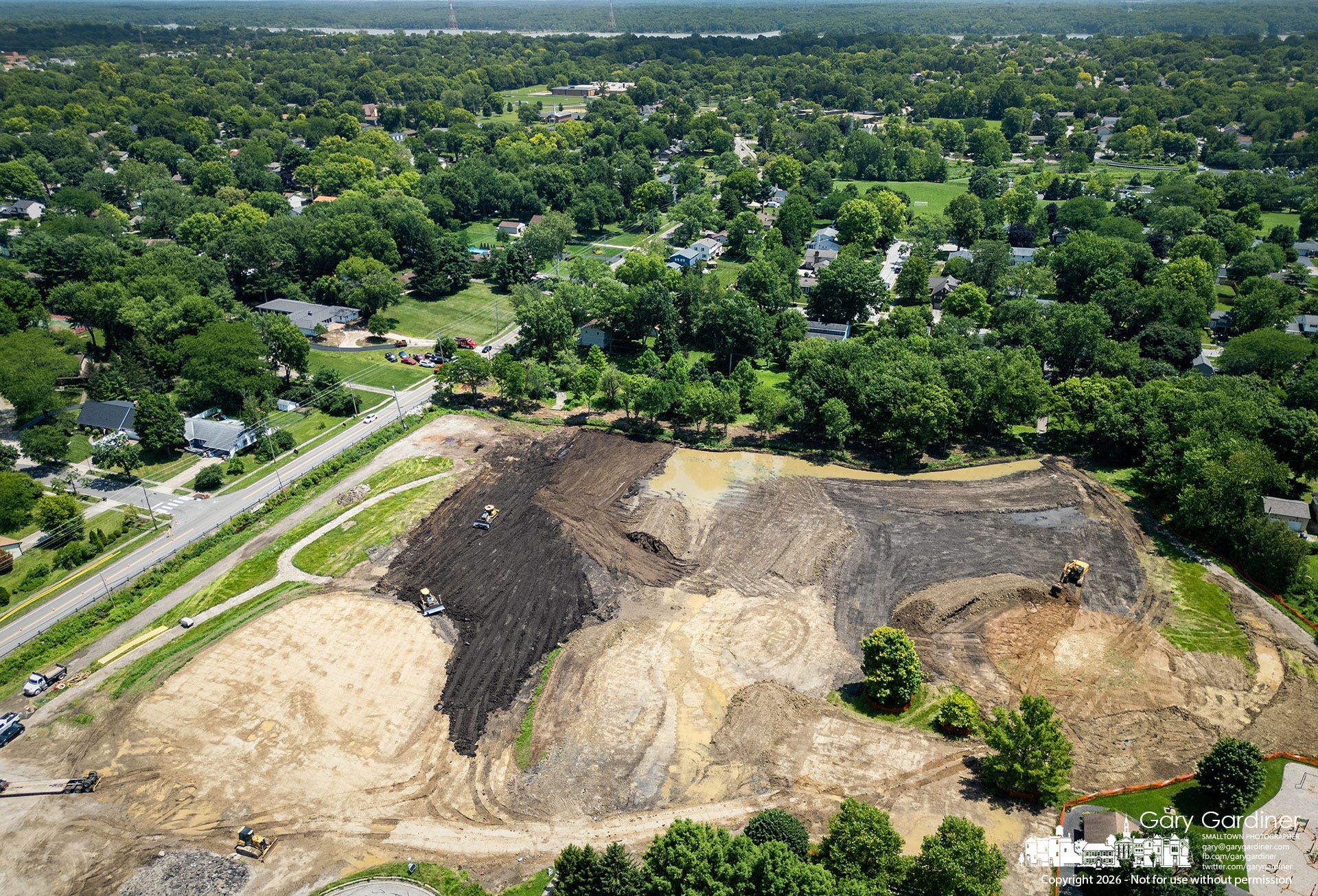
Heavy Equipment Reshapes Walnut Ridge Park for Flood-Control Project
Earthmovers and heavy equipment have reshaped Walnut Ridge Park as work begins to raise two ballfields where flooding sometimes forced games to be canceled and convert another section into wetlands designed to redirect and slow stormwater.
Large portions of the park along East Walnut Street have been stripped of grass and graded as crews prepare the site for new fields, trails, wetlands and a relocated creek channel. The work is part of a long-planned redevelopment intended to make the park more usable during wet weather while restoring natural areas around the stream.
The project stalled after its first phase when a partial federal government shutdown delayed permits from agencies required to approve the next stage. While awaiting those approvals, the contractor reassigned crews to other projects.
After the permits were issued, the contractor returned and is now working on the project full time, according to Laura Ball, Westerville’s parks and facilities development administrator.
Plans call for two of the park’s three ballfields to be rebuilt above the 100-year floodplain. Flooding in the outfield of one field had sometimes become severe enough to force game cancellations.
The third ballfield will not be rebuilt. Its infield material was removed and reused to help elevate the two new infields, according to the contractor. Those raised infields will be covered with new clay to create the finished playing surfaces. The area where the third field stood will instead become part of a larger floodplain and wetland planted with native grasses and wildflowers.
The creek running through the park will also be realigned into a wider, more natural channel. The new route is intended to give stormwater more room to spread through the park and direct it away from the ballfields.
Wetlands and bioretention areas will temporarily collect and filter runoff. Boardwalks will carry pedestrians over low-lying sections while allowing water to pass underneath during storms.
The changes follow a 2019 Parks and Recreation study that documented recurring flooding on trails and ballfields, winter icing on paths, and problems along the East Walnut Street embankment. The study recommended relocating the stream, creating wetlands, and rebuilding trails to improve drainage and make the park more reliable for year-round use.
The city later applied for a Clean Ohio grant to help pay for the project, but did not receive the award. Funding instead came from a combination of Planning and Development and Parks and Recreation funds, Ball said.
In addition to the flood-control work, the project will reconstruct park trails and create new connections between Apache Street and the regional bicycle path. Observation decks are planned near the wetland areas.
The parking lot will be redesigned with 59 spaces, new asphalt drives, concrete walkways, and areas of pervious pavement. The porous pavement will allow some rainwater to soak into the ground rather than run directly across the site.
The two remaining ballfields will receive new fencing, dugouts, and backstops. The basketball courts will be resurfaced, and plans include new benches, tables, grills, bicycle racks, and signs.
The existing playground and shelter building will remain.
Landscaping plans show extensive plantings of trees, shrubs, meadows, and wetlands throughout the park. More than 20 tree species are expected to be used, along with native grasses and wildflowers, in areas where conventional turf has struggled due to repeated flooding. The plans divide the park into several naturalized planting zones around the new stream, wetlands, ballfields, and trails.
A salvaged black locust tree removed during another city development project has also been considered for use in the wetland area. Because black locust wood decays slowly, it could be incorporated as a natural feature within the restored landscape.
Earlier concepts included pickleball courts, but those were removed after a public open house in late 2024. The final design placed greater emphasis on flood management, habitat, and open natural areas.
Walnut Ridge Park has seen few major changes since the early 1970s. The renovation will preserve its primary recreational uses while reshaping the grounds to better manage heavy rain and recurring flooding.
The redesigned park will channel floodwater away from the ballfields and trails and into the expanded creek corridor, wetlands, and floodplain.
The construction contract listed Oct. 23, 2026, as the expected completion date.
Because this post is public, you’re encouraged to share it on social media.
The Westerville News is a reader-supported publication by Gary Gardiner, a lifelong journalist who believes hyper-local reporting is the future of news. This publication focuses exclusively on Westerville—its local news, influence on Central Ohio, and how surrounding areas shape the community.
Reader funding, including subscribers, protects editorial independence, so coverage is guided by journalists rather than owners or corporate profit goals. It also reduces pressure to chase clicks, letting the newsroom focus on stories worth readers’ time. And it helps keep the site accessible to everyone, including people who can’t pay or live in places where a free press is under threat.
Explore more hyper-local reporting by subscribing to The Hilliard Beacon, Civic Capacity, Marysville Matters, The Ohio Roundtable, Shelby News Reporter, This Week in Toledo, and Into the Morning by Krista Steele.


