
Heritage White Oak Removed After Storm
Westerville removes fallen ‘Codger’ oak as readers help identify early caretaker
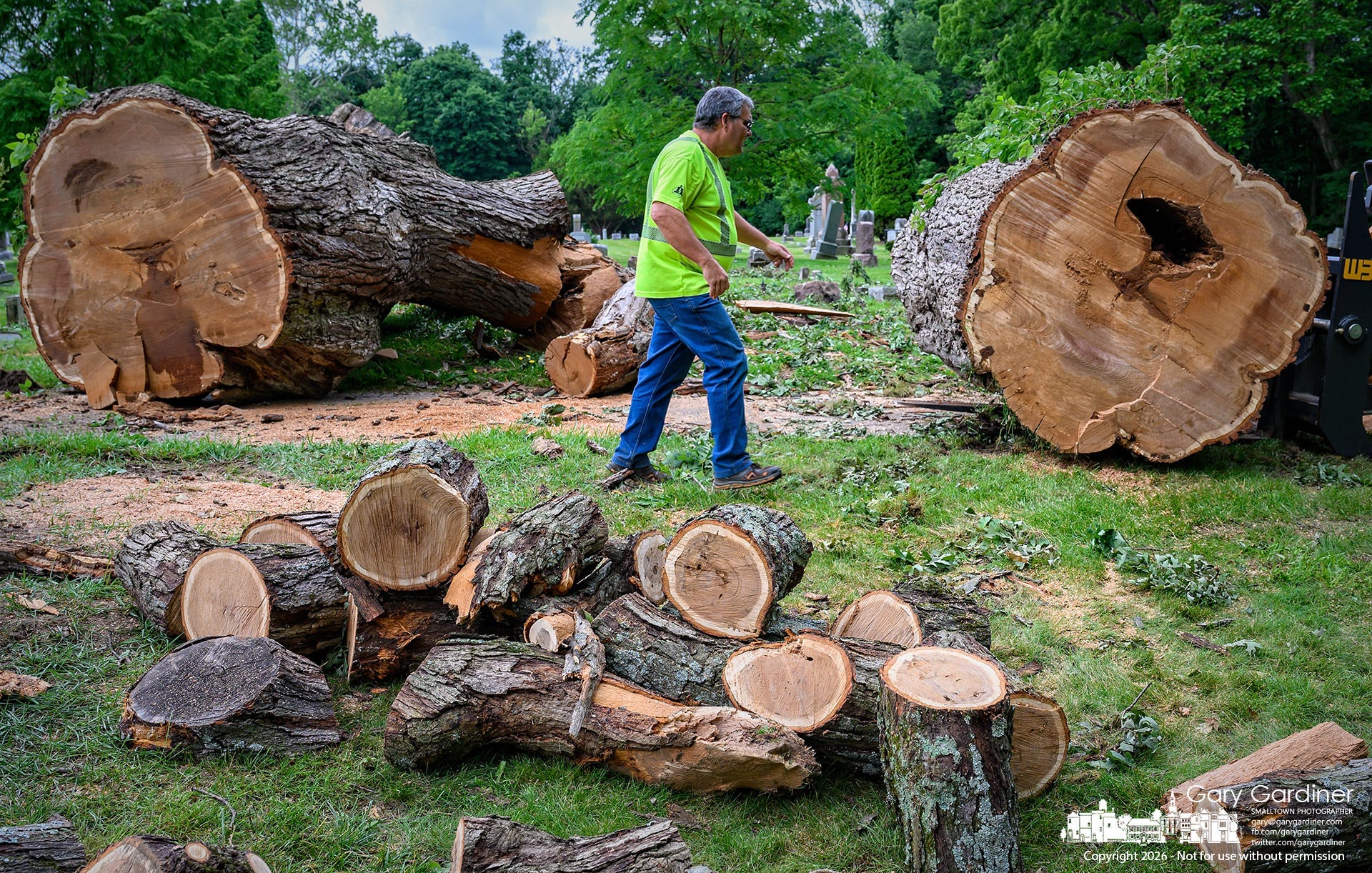
The city placed the largest sections of the centuries-old white oak in storage for possible future use. Smaller pieces will be available to residents beginning Thursday.
The remains of Westerville’s oldest known tree were removed from Otterbein Cemetery on Tuesday, while new research may have identified the tree surgeon whose name was found inside its trunk.
Crews from the city’s electric division spent the day cutting apart the massive white oak, known to some residents as “Codger,” after storm winds brought it down.
The largest sections were loaded onto hauling equipment and taken to the city service department, where they will remain while officials consider whether the wood can be preserved for a memorial, artwork, or another public use.
Smaller pieces were left at the cemetery for residents.
The city said hand-sized pieces will be available at Otterbein Cemetery, 175 S. Knox St., from Thursday, June 11, through Thursday, June 18. Quantities are limited, and no city employee will be present to distribute the wood or help with loading.
City Arborist Adam Williams previously said officials wanted residents to have access to pieces of the tree without trying to move dangerously large logs.
“We just don’t want to encourage people to go in there and try to break their back getting a big log in the back of their truck,” Williams said.
Tuesday’s work exposed cavities, decay and irregular growth inside the trunk. It also provided a closer look at a concrete repair that had been hidden inside the tree for decades.
Scratched into the concrete was a name and address:
“Thomas Seymour, 158 East Goodale St., Columbus, Ohio.”
Readers of The Westerville News began searching historical records after the inscription was reported.
Mary Price of Westerville found a death certificate for a Thomas Seymour who was born in Chillicothe and died in Columbus in 1949. His occupation was listed as “tree surgeon.”
“I am assuming this is the same Mr. Seymour,” Price wrote.
Kermit Lancaster found federal census records for a Thomas G. Seymour who lived in Columbus and worked in landscaping and tree surgery during the early 20th century.
The records do not establish conclusively that he was the man whose name appears in the concrete. They do, however, identify a Columbus tree surgeon with the same name who worked during the period when filling tree cavities with concrete was a common repair practice.
One census record also lists Seymour on Goodale Street in 1910, but at a different house number than the address written on the tree.
The inscription would document an effort to preserve the oak decades before it was formally recognized as a Westerville Heritage Tree.
Lori Bailey Sorth also shared research on Facebook tracing Seymour through census and military records. She found a Thomas Seymour, born in 1876, listed as a laborer living on Goodale Street in 1910. By 1917, his draft registration listed him on High Street and working independently as a forester.
The 1920 census continued to place him on High Street and described his occupation as “surgical” in the landscaping industry. By 1930, he was listed as a tree surgeon living on Fourth Street. Sorth said Seymour died in 1949 and was buried at Union Cemetery.
Her findings add to the evidence that the name in the concrete belonged to a Columbus-area tree professional, though the connection has not been conclusively established.
A tree older than the cemetery
A plaque at the site identifies the oak as a Heritage Tree and says the Westerville Heritage Tree Project named it a Grand Champion in 1992. The plaque lists 1674 as its estimated planting year, while other accounts place its age closer to 400 years.
The exposed growth rings suggest the tree was at least 300 years old and may have approached 400. An exact count is difficult because parts of the trunk had decayed and several stems appear to have merged as the tree matured. A formal dendrochronology study would be needed to verify its age.
“They say it’s about 400 years old,” City Arborist Adam Williams said previously. “We’ll be able to confirm that once we start to get cross sections of it.”
Even at the lower estimate, the oak was already more than a century old when Otterbein Cemetery was established in 1856. A 1992 description listed it at about 114 inches in circumference and 106 feet tall.
Williams, who has worked for the city for 24 years, said the oak had defined the cemetery landscape throughout his career.
“It’s been here as long as I’ve been here,” he said. “It’s a big loss for us, for sure.”
Gravestones damaged
The falling tree damaged gravestones in the cemetery, and crews worked Tuesday among toppled and displaced markers.
The city has not released the names associated with the damaged stones, the extent of the damage, or a timetable for repairs.
Officials also have not announced what will become of the largest sections of the tree. Their condition, including cracking and decay, will help determine whether they can be dried and preserved.
Residents Lois Szudy and Candy Canzoneri previously said they hoped the city would hold what Szudy called a “celebration of life” for the oak.
For now, the largest pieces remain in city storage, while smaller sections are being offered to residents.
The tree no longer stands over Otterbein Cemetery, but parts of it may remain in Westerville for years to come.
Because this post is public, you’re encouraged to share it on social media.
The Westerville News is a reader-supported publication by Gary Gardiner, a lifelong journalist who believes hyper-local reporting is the future of news. This publication focuses exclusively on Westerville—its local news, influence on Central Ohio, and how surrounding areas shape the community.
Reader funding, including subscribers, protects editorial independence, so coverage is guided by journalists rather than owners or corporate profit goals. It also reduces pressure to chase clicks, letting the newsroom focus on stories worth readers’ time. And it helps keep the site accessible to everyone, including people who can’t pay or live in places where a free press is under threat.
Explore more hyper-local reporting by subscribing to The Hilliard Beacon, Civic Capacity, Marysville Matters, The Ohio Roundtable, Shelby News Reporter, This Week in Toledo, and Into the Morning by Krista Steele.


