
How Westerville Nearly Lost and Finally Reclaimed the Anti-Saloon League Archive
Westerville nearly lost its most important Anti-Saloon League collection to another state, a close call recounted Friday night at the Westerville Public Library.
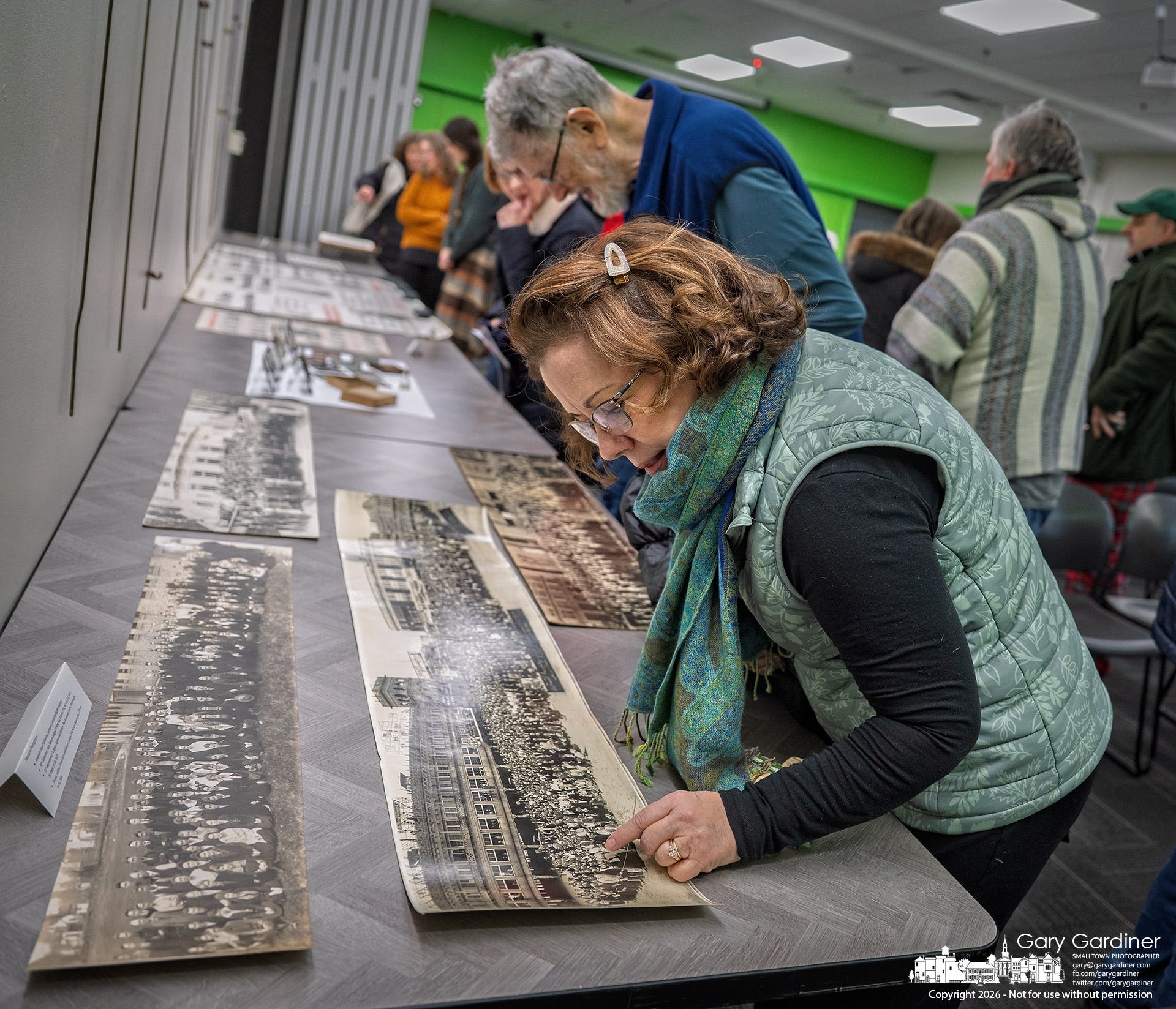
Despite temperatures dipping into the single digits outside, the crowd was large enough to fill the meeting room. On tables along the wall were selections from the Anti-Saloon League collection itself, including large panoramic photographs showing hundreds of members gathered for annual conventions in Washington and Atlantic City, New Jersey, as well as temperance posters, books, and pamphlets once used to promote Prohibition.
Also arranged on the tables were oversized lantern slides depicting unnamed people, paired with temperance slogans and illustrated scenes, offering a glimpse into the movement's visual strategies for spreading its message.
As Westerville History Museum Manager Jackie Barton began her lecture, the artifacts surrounding the audience quietly underscored the point she would soon make. Westerville nearly lost all of it.
In the early months of 1974, the Anti-Saloon League’s vast archive, created and used in Westerville during the height of the national temperance movement, was on the verge of leaving Ohio altogether.
“It absolutely could have left Ohio and gone to the University of Michigan,” Barton said.
The near loss followed the collapse of the Temperance Education Foundation, the organization that had inherited much of the Anti-Saloon League’s material after the end of Prohibition. By 1973, the foundation was barely operating. Only two trustees remained, the Rev. Edward H. Dailey and Paul L. Selby, both in failing health. That year, the Westerville Public Library began acquiring the foundation’s assets, inheriting not only historic buildings but also a massive, disorganized archive that had suffered years of neglect.
An assessment conducted that fall by an Ohio Historical Society archivist described the collection as one of the richest historical research archives in the country, while also concluding that a small public library lacked the space, staffing, and environmental controls needed to care for it. The situation was further complicated by insect infestations, rodents, and structural issues within the building itself.
As library director, Jane Bradford worked to determine the collection’s future, and she acknowledged the toll the situation had taken. In a 1973 letter, she wrote of experiencing “feelings of despair at certain moments.”
Against that backdrop, the University of Michigan emerged as a practical alternative. Michigan had newly built archival facilities, professionally trained staff, and an existing temperance and Prohibition collection that would complement the Westerville materials. Representatives from Michigan visited Westerville twice, while Bradford traveled to Ann Arbor in early 1974 to tour the facilities and discuss a possible transfer.
By March of that year, Barton said, the discussions had progressed to the point where a transfer appeared imminent.
Concern soon grew, however, that Ohio was about to lose a collection central to its own history. Fritz Milligan Sr., who had long ties to the Ohio Historical Society, alerted members of the Westerville Public Library board that the archive was on the verge of leaving the state. Conversations quickly shifted toward an alternative. That alternative was keeping the materials in Ohio through a permanent loan arrangement with the Ohio Historical Society.
In April 1974, Bradford wrote to Michigan to formally reverse course. “It is with deep regret, personally,” she wrote, explaining that the board had negotiated a formal loan agreement transferring custody of the materials to the Ohio Historical Center. She added that “public pressure demanded that the materials remain within Ohio.”
The agreement was finalized the following month, and in June 1974, the collection was moved, not north to Ann Arbor, but south to Columbus.
The decision resolved the immediate crisis but shaped the collection's history for the next half-century. Ownership remained with Westerville, while the Ohio Historical Society, now the Ohio History Connection, assumed responsibility for preserving and managing the materials. The arrangement ensured professional care at a time when Westerville lacked the capacity to house the archive.
In 1975, Ohio History secured a 109,000 dollar federal grant to microfilm large portions of the collection. During a question-and-answer period following the lecture, Barton explained that once the materials were successfully microfilmed, the original documents were destroyed.
“They destroyed stuff,” Barton said. She noted the practice reflected archival standards of the time and added that “it was a decision of its time.”
Over the decades that followed, Ohio History cataloged the remaining materials and made them available to researchers. Much of the collection, however, remained out of public view, stored in archival facilities, while Westerville continued to define itself through its Prohibition-era legacy.
When the Westerville History Museum opened in 1989, it was originally named the Local History Resource Center and the Anti-Saloon League Museum, underscoring the organization’s central role in the city’s identity. Yet the original posters, pamphlets, manuscripts, and publications remained miles away.

That changed in 2025.
After years of planning and coordination, the Ohio History Connection began transferring the collection back to Westerville. The return includes 639 oversized posters and photographs, 3,792 temperance pamphlets and related materials, approximately 300 linear feet of manuscripts, 700 linear feet of periodicals, and more than 10,000 books on temperance history dating from 1890 to 1970.
A grant from the J. Terry Hayman Fund at the Columbus Foundation supported the transfer, allowing the Westerville History Museum to install appropriate shelving and flat files. Barton and museum specialist Kathryn Kaslow spent weeks unpacking, sorting, stabilizing, and inventorying fragile materials, some more than a century old.
The materials provide a direct view into how the Westerville-based Anti-Saloon League communicated its message and mobilized support nationwide. Posters and pamphlets once used as tools of advocacy now offer historians and visitors rare insight into the strategies that shaped public opinion and federal alcohol policy.
“Travel writers, researchers, school groups, and visitors come to the museum to learn about prohibition and its role in the Progressive Era,” Barton said in a news release announcing the collection’s return. “Bringing the collection home will enable us to serve these audiences better and to make this collection more accessible by cataloging, processing, and even digitizing those portions that have not been prioritized in the past.”
Barton emphasized that the return reflects decades of stewardship rather than a reversal of past decisions. “Reuniting the real stuff of history with the authentic place where history took place is an exciting moment for our community,” she said, crediting more than 50 years of care by the Ohio History Connection.
For Barton, the collection’s return marks the end of a long and uncertain journey. Nearly lost to another state, preserved for decades in storage and now back in Westerville, the Anti-Saloon League archive stands as a reminder that history does not always disappear when it leaves public view, but it matters deeply when it comes home.
The Westerville News is a reader-supported publication by Gary Gardiner, a lifelong journalist who believes hyper-local reporting is the future of news. This publication focuses exclusively on Westerville—its local news, influence on Central Ohio, and how surrounding areas shape the community.
Reader funding, including subscribers, protects editorial independence, so coverage is guided by journalists rather than owners or corporate profit goals. It also reduces pressure to chase clicks, letting the newsroom focus on stories worth readers’ time. And it helps keep the site accessible to everyone, including people who can’t pay or live in places where a free press is under threat.
Explore more hyper-local reporting by subscribing to The Hilliard Beacon, Civic Capacity, Marysville Matters, The Ohio Roundtable, Shelby News Reporter, This Week in Toledo, and Into the Morning by Krista Steele.


Gary,
As a retired librarian, I really appreciated this article on the anti-saloon league. I guess I did not realize that it had almost gone out of the state and I’m glad that it’s back. I’m assuming that there will be a lot of need for volunteers to help with it so I’m going to look into that.
thank you.
What a fascinating story! So happy to know that the treasure trove of artifacts is safely back home in Westerville.