New Century Club Marks 125 Years In Westerville - Begin Cafe Liquor Approved - Kohl's Remains Open

The New Century Club is half as old as the country.
That point gave Monday night’s 125th anniversary meeting a wider frame, as members of Westerville’s oldest women’s literary club gathered in the same year the United States prepares to celebrate its 250th birthday.
Founded in 1900 by women seeking intellectual life beyond the limits often placed on them, the club marked the milestone in a meeting room at Church of the Master with a mayoral proclamation, a history of its early years, memories from longtime members, and a donation to the Westerville Public Library.
After the meeting, members moved into the adjacent dining room for a congratulatory cake and a meal of tea sandwiches, pickles and relishes, fruit, and conversation.
Mayor David Grimes presented a proclamation recognizing the club’s 125 years in Westerville and declared Monday, May 4, 2026, New Century Club Day in the city. Grimes said the club has shown “remarkable dedication” to Westerville by promoting lifelong learning and encouraging members to read and share books and ideas.
Club historian Linda Stutz used handwritten note cards to guide members through the club’s beginnings, asking them first to picture Westerville at the turn of the 20th century: a village of 1,462 residents, with homes clustered around a four-block business district along State Street, no paved streets or sidewalks, and no public sewer or water system.
Otterbein had four buildings west of Uptown. Vine Street School had opened only a few years earlier with six rooms, but no electricity or indoor plumbing, and the town’s residents were known for their interest in education, culture, and a saloon-free community.
Stutz said the club emerged at a time when most women were expected to prepare for lives as homemakers, even as more women were earning college degrees and looking for intellectual stimulation beyond school, college, or church groups. Lecturers came to town, and literary societies existed, but some were closed to women, and others were tied to individual churches.
The idea for New Century Club grew from conversations among women who knew of similar organizations elsewhere. Mrs. T.J. Sanders had belonged to a women’s club in Warsaw, Indiana, and Mrs. J.A. Weinland was familiar with Chautauqua Circles. Their organizational meeting was held at Weinland’s home at 63 W. College Ave., where members agreed to limit the club to 30 members, charge dues of 50 cents, meet every two weeks in members’ homes, and rotate hosting alphabetically.
The first formal meeting was held Oct. 8, 1900, with “Our Country” chosen as the club’s first program theme for 1900-01. Two weeks later, the first program included papers on “The Mound Builders” and “The Cliff Dwellers,” a presentation on women’s clubs, and members singing “America.” By then, Stutz said, the club had chosen green and white as its colors, the white carnation as its flower, and “The Standard Dictionary” as its authority.
In the years that followed, New Century Club became both a literary society and a civic presence. Meetings included papers, discussions of current events, music, plays, pantomimes, debates, guest speakers, pronunciation contests, and parliamentary drills. Members were expected to answer roll call with a quote, poem, current event, or comment related to the evening’s topic.
Stutz said the club also discussed community concerns in its early decades, including trash in public places, curfew enforcement, wastebaskets, pig pens, public drinking fountains, garbage disposal, and house flies. Beginning in 1904, members occasionally discussed and debated women’s suffrage, with speakers.
The club also had a role in Westerville’s early cultural life. In 1914, the owner of the Winter Garden Theater, then a new movie theater in town, asked the club to appoint a committee to help select movies suitable for showing in Westerville. Stutz said the committee remained active for at least 10 years.
The club’s long connection to the Westerville Public Library also began early. Before Westerville had a public library, Stutz said, New Century appointed a librarian to obtain books from the State Library in Columbus so members could research their papers. In 1919 and 1920, a club committee met with the Board of Trade and helped start a library association with $1 donations from members. When the community library was formed in 1930, the club purchased a shelf of books that included biographies of Abraham Lincoln, Charles Eliot, and Napoleon, as well as poems by Paul Laurence Dunbar.
The club later continued donating books in memory of members, and Stutz said one or more New Century members served on the library board from 1930 to 1997. As part of Monday’s anniversary program, the club presented a $125 donation to the Westerville Public Library.
Stutz also traced the club’s changing customs. Early members faced fines for absences or failing to present assigned papers. Prospective members once were voted on with white and black wooden balls. The club also had a critic, an officer who evaluated presentations, grammar, pronunciation, posture, and whether a paper was too long or too short. By the mid-1940s, Stutz said, critics made only positive comments, and the position was eliminated in 1946.
Some customs faded. Others remained. Members now choose their own books or topics, critique and time their own reports, and attend meetings without fines or formal judgment of their reasons for absence. At refreshment time, the club president still pours the tea or coffee.
Associate member Flo Amy shared memories of joining New Century after returning to Westerville in the 1990s. She said she was first invited years earlier, soon after moving to the city in 1962, when she had three young children and evening meetings and written papers were not practical. When she later returned to Westerville, rejoined the choir, and found herself discussing books after Mary Kay Wells invited her to a New Century dinner meeting.
Amy said the club gave her a place to read seriously, write again, and listen to women who brought discipline and enthusiasm to difficult subjects. She recalled programs spanning architecture and geography to literature and art, and said the club helped her find friends and a place to belong in Westerville.
The anniversary program also included recognition of associate members and installation of new officers. Leslie Wasson was installed as president, with Kelly Maxwell as vice president, Mary Pedigo as secretary, Lynne Karla as treasurer, Linda Stutz as historian, Linda Maxwell as parliamentarian, and Janice Eddey as chair of the courtesy committee.
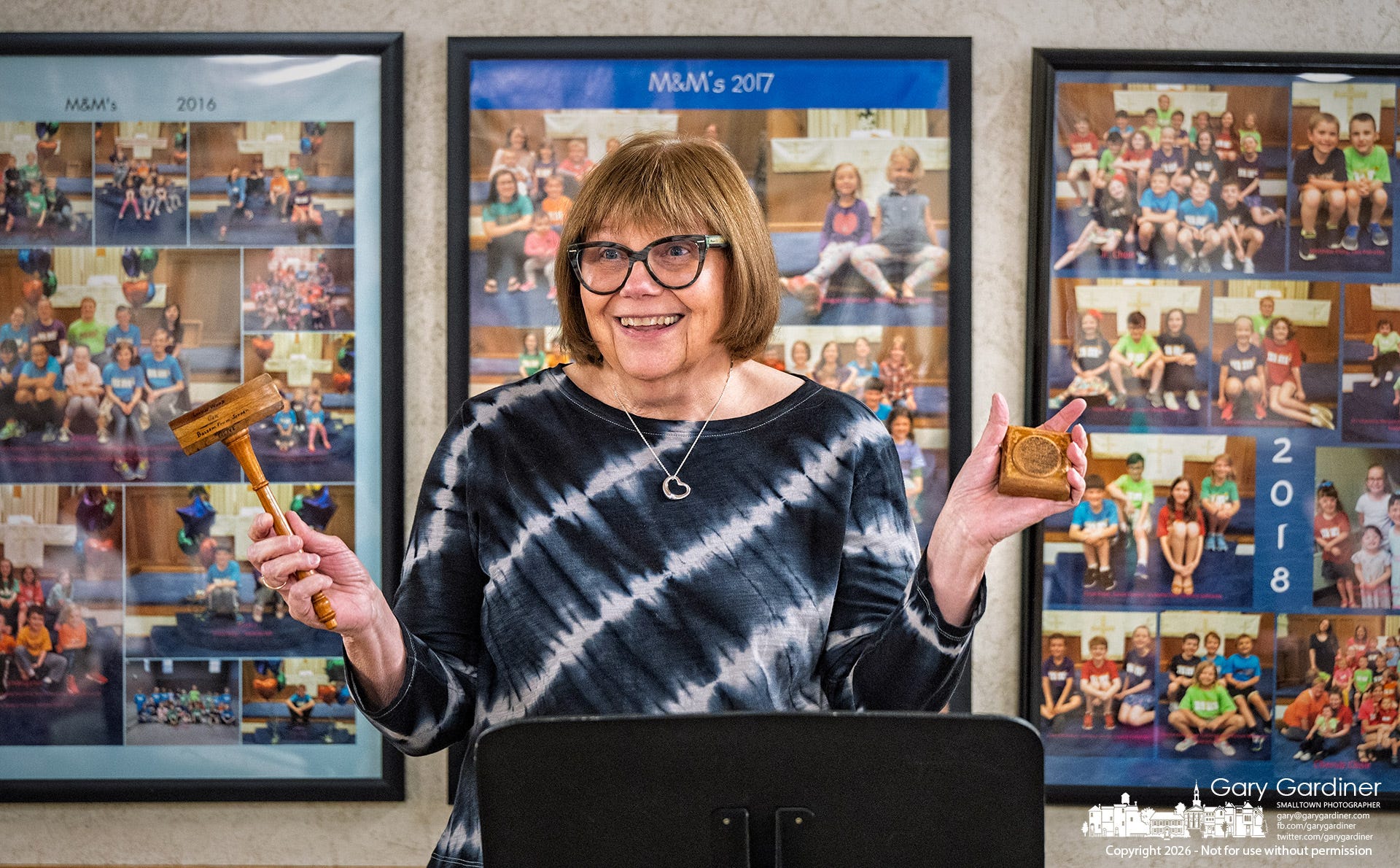
For Stutz, the club’s strongest tradition is not a rule from 1900, a gavel from Jerusalem, or the careful order of its meetings. It is the continued effort of members to encourage one another’s curiosity, prepare thoughtful papers, and form friendships with women committed to lifelong learning.
That tradition, begun in a small Westerville home at the opening of the 20th century, carried the New Century Club into its 125th year.
Begin Café Alcohol Approved
What began at Begin with pastries and coffee may soon include cabernet and piña coladas after Westerville voters approved ballot issues allowing the café to sell alcohol.
Voters in Westerville Precinct 1-A approved two local liquor options Tuesday for Begin Café, 8 E. Main St., in Uptown Westerville.
The weekday sales option passed with 148 votes in favor (80%) and 37 votes against (20%). The Sunday sales option also passed, with 143 yes votes (77%) and 42 no votes (23%).
The weekday option allows the café to sell beer, wine, mixed beverages, and spirituous liquor. The Sunday option allows sales of wine, mixed beverages, and spirituous liquor.
Begin Café is planned by performer Mike Tompkins, known for his a cappella video of Katy Perry’s “Teenage Dream,” and his wife, Kayla Tompkins.
Westerville Kohl’s property heads to auction, but store remains open under lease through 2031
The Westerville building occupied by Kohl’s is headed to auction, but the department store itself is not closing.
Kohl’s remains open and has a lease on the property that runs through Oct. 31, 2031, according to auction materials. The nearly 100,000-square-foot retail property is being marketed as a net-leased investment with a starting bid of $2.75 million. Bidding is scheduled for May 4 through May 6.
The lease abstract included in the offering materials lists current annual rent at $625,000, or $6.29 per square foot. The lease also includes two five-year renewal options, which could extend Kohl’s occupancy beyond the current expiration date.
The auction comes as Kohl’s continues trying to stabilize its business. The company reported that fiscal 2025 net sales fell 4% and comparable sales declined 3.1%. For the fourth quarter, net sales were down 3.9% and comparable sales fell 2.8%.
Kohl’s also has been trimming its footprint. The company closed 27 underperforming stores in 2025, though executives have said they are not pursuing a broad store-closure plan. CEO Michael Bender has said the company is focused on improving productivity across its existing store base, and more than 90% of Kohl’s stores remain profitable.
For Westerville shoppers, the practical takeaway is that the real estate may change hands, but Kohl’s remains open and under lease for several more years.
Because this post is public, you’re encouraged to share it on social media.
The Westerville News is a reader-supported publication by Gary Gardiner, a lifelong journalist who believes hyper-local reporting is the future of news. This publication focuses exclusively on Westerville—its local news, influence on Central Ohio, and how surrounding areas shape the community.
Reader funding, including subscribers, protects editorial independence, so coverage is guided by journalists rather than owners or corporate profit goals. It also reduces pressure to chase clicks, letting the newsroom focus on stories worth readers’ time. And it helps keep the site accessible to everyone, including people who can’t pay or live in places where a free press is under threat.
Explore more hyper-local reporting by subscribing to The Hilliard Beacon, Civic Capacity, Marysville Matters, The Ohio Roundtable, Shelby News Reporter, This Week in Toledo, and Into the Morning by Krista Steele.


