

New D-Day film brings Westerville veteran Ernie Ernsberger’s hidden wartime work back into focus - EMWTTSFM Breakfast Croissant

A new World War II film is bringing renewed attention to one of the most consequential decisions of D-Day: whether the weather would hold long enough for Allied forces to cross the English Channel and begin the invasion of Normandy.
The film, Pressure, focuses on the tense 72 hours before D-Day, when Allied leaders had to decide whether to launch the largest seaborne invasion in history or delay and risk losing their narrow window. The drama centers on Gen. Dwight D. Eisenhower, British meteorologist Capt. James Stagg and the enormous pressure surrounding a decision that could determine the outcome of the war.
For longtime Westerville resident Warren W. “Ernie” Ernsberger, that world of weather reports, aerial photographs, tides, cloud cover and invasion maps was not just history. It was part of his life.
Ernsberger, who died Sept. 5, 2014, was born Oct. 11, 1921, in New Dover, Ohio, to Beunah Demorest Lawrence and Roland P. Ernsberger. He was educated in Sunbury and Westerville schools and graduated from Otterbein College in 1943, where he was a member of Sigma Delta Phi, according to his obituary.
He later attended UCLA, earning a professional meteorologist degree, and also attended Franklin Law School. During World War II, his meteorology training became part of his military service.
According to earlier accounts, Ernsberger served in the military from 1942 to 1952, rising to captain in the U.S. Air Force. His service included time in England on detached duty with the Royal Air Force, occupation duty in Germany and service in the Reserve Officers Corps, according to his obituary. A previous local profile reported that he served with the 2nd Photo Intelligence Squadron, attached to the RAF at Medmenham British Intelligence General Headquarters, about 40 miles outside London.
In an oral history interview, Ernsberger recalled that one of his first major assignments in England involved the Normandy invasion beaches. He said he was assigned to a section working on the Omaha Beach project, using aerial photographs and maps to study German defenses inland from the landing area.
The work was painstaking. Ernsberger described mapping a corridor about 15 miles inland and roughly seven miles wide, assembling information on enemy defenses and preparing intelligence reports for commanders responsible for different invasion sectors. He said he and others then briefed American and British officers on what the photographs and maps showed.
That kind of work sits just outside the frame of most D-Day stories. The names remembered most often are generals, commanders and men who stormed the beaches. But the invasion also depended on thousands of lesser-known people who studied weather systems, tides, moonlight, aircraft routes, terrain, German positions and landing conditions before the first soldiers reached shore.
Ernsberger’s own story intersected with that same planning environment. A previous newspaper profile described him as a young lieutenant whose meteorology background brought him into D-Day planning. He later recalled being called to London for a meeting involving Eisenhower and other senior Allied officers, where weather, cloud cover and tides were part of the discussion over when the invasion could take place.
The best documented portions of Ernsberger’s service place him in intelligence, photographic interpretation, mapping and weather-related analysis. The more dramatic details, including his recollection of being present in high-level meetings, come from his own memories and earlier newspaper accounts.
Still, the larger truth of his story is clear. D-Day was made possible not only by the men who landed on the beaches, but by young officers and specialists working behind the scenes to turn incomplete information into decisions commanders could act on.
Once the invasion began, Ernsberger’s role shifted from preparation to witness.
Earlier accounts say he was assigned to take aerial photographs from about 8,000 feet above the invasion area. From that height, he later said, he saw the scale of the assault and the terrible human cost below.
“I think I aged 20 years that day,” he told a reporter decades later.
The memories did not leave him. Ernsberger said he tried not to think about D-Day, but whenever it was mentioned, “it all comes back.”
After the war, Ernsberger returned to Westerville, where he built a life deeply tied to the community.
He became sales manager for Benn Blinn/White Advertising Company, where he worked for 30 years, according to his obituary. He also owned or co-owned several local businesses, including Ernsberger Florist, Westerville Taxi Company, Magic Marketing, Williams Grill and Ernsberger Builders.
He and his wife, Patricia “Patsy” Ernsberger, were especially connected to Williams Grill, the iconic Uptown Westerville diner that had served the community since the 1920s.
That part of Ernsberger’s local legacy recently resurfaced through the Westerville History Museum, which had mounted an exhibit on Williams Grill. In a Facebook post, the museum noted that Ernsberger’s shirt from his time owning Williams Grill with Pat in 1969 had “walked in the door.”
The museum described Williams Grill as a Westerville institution. The Ernsbergers bought the diner after it already had decades of community history behind it, and although they owned it for only a few years, they worked to preserve its memory and place in Uptown Westerville.
According to the museum’s post, Ernsberger later wrote by hand that when Williams Grill closed in 1975, “uptown Westerville will never be the same.”
That small piece of local history offers another view of Ernsberger’s life after the war. He had seen history from the air over Normandy, but he also understood the value of everyday places at home: a diner counter, a work shirt, a storefront, a room full of regulars.
Ernsberger’s community life stretched across decades. He served four terms on Westerville City Council, including service from 1955 to 1972, according to earlier accounts and his obituary. He was a charter member of the Westerville Jaycees, a co-founder of the Old Westerville Civic Society and was active with the Westerville Historical Society, Westerville Sertoma Club, Young Budd Post 171 of the American Legion and the Six Rivers Chapter of the Ohio Archaeological Society.
He was named local and district Sertoman of the Year in 2009. He was also involved with the Westerville Symphony and Westerville Community Band.
Sports remained part of his life, too. His obituary notes that he played semi-pro baseball in the Heart of Ohio League, belonged to Otterbein’s Varsity O Club and Leather Helmet Club, and was a founding member and coach of Westerville Little League.
Now, with Pressure bringing renewed attention to the decisions made before D-Day, Ernsberger’s story offers Westerville a reminder of how many people stood behind the famous names of history.
He was not a general. He is not one of the central figures in the film. But he was part of the vast Allied effort that made June 6, 1944, possible: a young officer reading photographs, studying weather and terrain, preparing reports and helping commanders understand what waited on the far side of the English Channel.
And when the war was over, he came home to Westerville, where he spent the rest of his life helping shape the community that remembered him simply as Ernie.

Eating My Way Through The Saturday Farmers Market: The Breakfast Croissant Sandwich
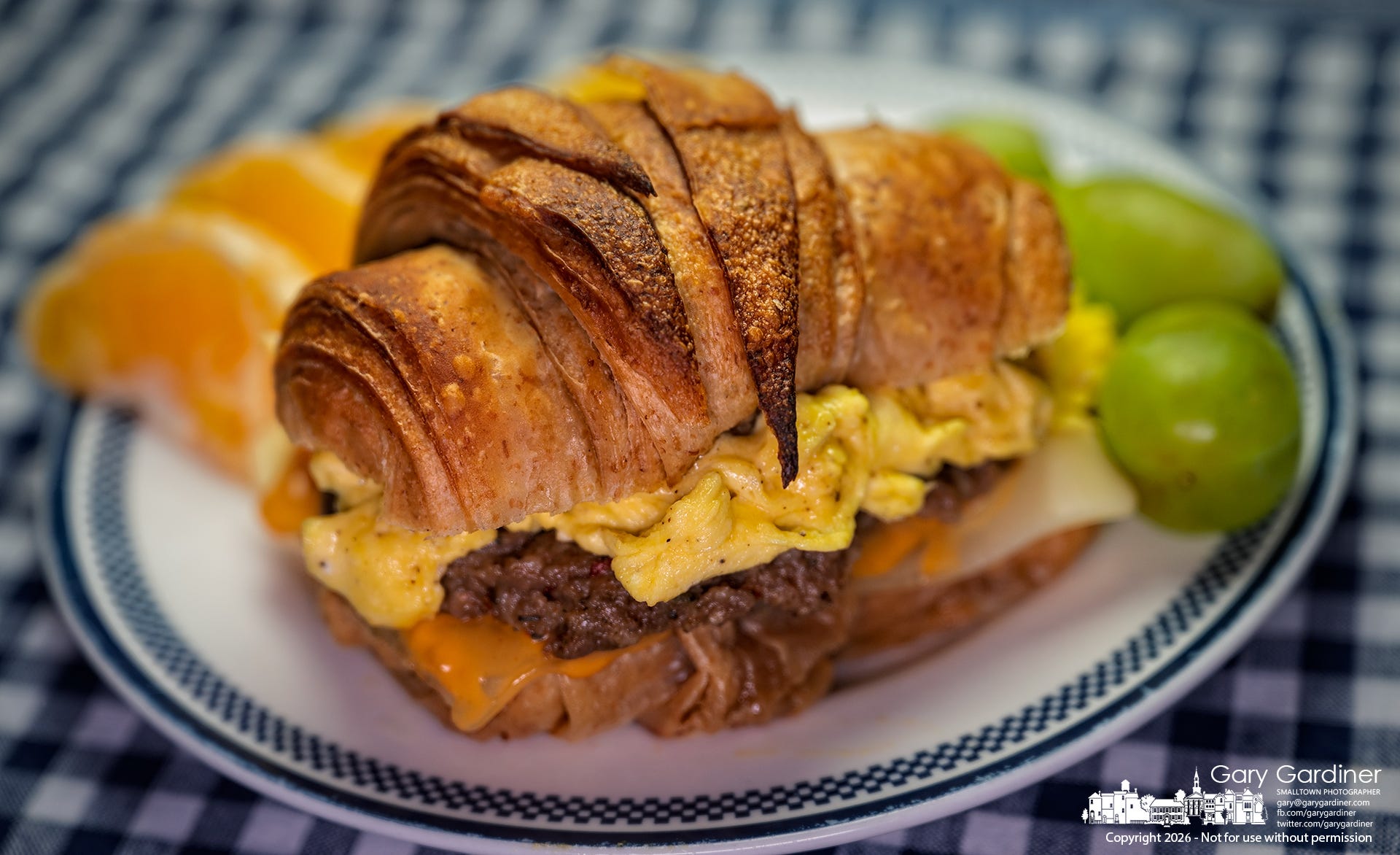
The breakfast croissant sandwich began with a croissant from Drift Hills Farm, chosen from among their Saturday Farmers Market bakery offerings. The table held other temptations, including handsome sourdough loaves, but the croissant made the decision for me. I could see the breakfast almost at once: scrambled eggs, sausage, melted cheese, and chipotle aioli tucked inside the pastry, with orange slices and green grapes brightening the plate. It belonged to breakfast now, not because it came from the same world I grew up in, but because time has a way of widening what comfort can taste like.
Drift Hills baked the croissant. I made the sandwich.
That distinction matters. The croissant itself was a reinvention of flour and butter, folded and baked into something delicate, flaky, and rich. But the sandwich was my reinvention of breakfast, a way to transform the Southern staples of my youth into something else. The eggs, sausage, and cheese were part of the breakfasts I knew. The chipotle aioli was not, but it added a little heat and smoke without disrupting the overall comfort. The ingredients were familiar. The setting was not.
The pastry had the burnished shell a croissant should have: crisp at the edges, tender underneath, and rich enough to feel like a small extravagance. It cracked slightly when handled, then softened where the eggs, cheese, and aioli met the inner folds. That is the pleasure of a good croissant sandwich. It is both delicate and sturdy, buttery but still willing to do the honest work of holding breakfast together.
It is also a long way from the breakfast sandwiches of my Southern youth.
Back then, breakfast did not arrive in layers of laminated dough. It came from my mother’s skillet or my grandmother’s table. The best sandwiches were often bologna or scrambled eggs on white bread. Biscuits appeared too, of course, though they were not always the cloudlike, flaky things people like to remember when they talk about Southern cooking. Some were tender and split open with ease. Others were more practical than poetic, better suited for catching sausage grease, egg yolk, or a smear of butter than for winning praise.
But those breakfasts had no pretense, and that was part of their worth. They were made from what was in the kitchen, served hot when possible, and eaten before the day started making demands. White bread was soft, plain, and dependable. Toast came from an electric toaster that required close attention. It did not toast both sides at once, and it did not pop up when it was done. Bologna browned in a skillet could seem like a luxury. Scrambled eggs, if cooked just right, needed little more than salt, pepper, and two slices of bread to become a meal. But a scrambled egg and fried bologna sandwich with a layer of mayonnaise was the king’s riches of breakfast for me.
I don’t remember croissants being a regular offering until the late 1970s. Even then, they carried a little mystery. They were French, buttery, delicate, and not quite part of an ordinary breakfast. By the 1980s, that had changed. Burger King’s Croissan’wich helped move the croissant from the bakery case to the drive-through lane, turning what had once felt refined into a fast-food vehicle for egg, cheese, and meat.
My croissant sandwich lands somewhere between those worlds.
It has the same basic promise as the breakfasts I grew up with: eggs, meat, bread, and enough richness to carry you through the morning. But the croissant changes the conversation. It gives the sandwich lift. It turns a familiar combination into something more indulgent without losing the comfort of the original idea. The sausage brings it back down to earth. The eggs soften it. The cheese binds everything together. The chipotle aioli adds a little heat and smoke. The croissant makes it feel like Saturday.
The fruit on the plate matters too.
The orange slices are not from the Saturday Farmers Market, but they belong to the story. Having been raised in Florida, oranges were not an occasional treat. They were a staple, part of the landscape and part of the table. On this plate, they are not garnish. They are geography. They pull the breakfast back toward Florida, toward mornings when citrus was ordinary, expected, and always within reach.
The green grapes do similar work. They are less about novelty than continuity, bringing a familiar sweetness to the plate. Besides the rich croissant sandwich, the grapes and oranges brighten the meal, but they also deepen it. They remind me that not everything on the plate has to come from the market to belong in the review.
That may be the real point of Eating My Way Through The Saturday Farmers Market. The food I buy there is never just measured against itself. It is measured against my mother’s kitchen, my grandmother’s table, Florida oranges, green grapes, white bread, skillet bologna, and biscuits that may or may not have been flaky.
This breakfast croissant sandwich isn’t my childhood breakfast. It’s richer, flakier, more polished. But it understands comfort. On a Saturday morning, with fruit and memory close by, that is enough.
Because this post is public, you’re encouraged to share it on social media.
The Westerville News is a reader-supported publication by Gary Gardiner, a lifelong journalist who believes hyper-local reporting is the future of news. This publication focuses exclusively on Westerville—its local news, influence on Central Ohio, and how surrounding areas shape the community.
Reader funding, including subscribers, protects editorial independence, so coverage is guided by journalists rather than owners or corporate profit goals. It also reduces pressure to chase clicks, letting the newsroom focus on stories worth readers’ time. And it helps keep the site accessible to everyone, including people who can’t pay or live in places where a free press is under threat.
Explore more hyper-local reporting by subscribing to The Hilliard Beacon, Civic Capacity, Marysville Matters, The Ohio Roundtable, Shelby News Reporter, This Week in Toledo, and Into the Morning by Krista Steele.
