
Sharp House Restoration Begins
A restoration crew began work Thursday at the Sharp House on Africa Road, launching the first phase of repairs to the historic brick structure. The house is listed on the National Register of Historic Places for its role in the Underground Railroad.
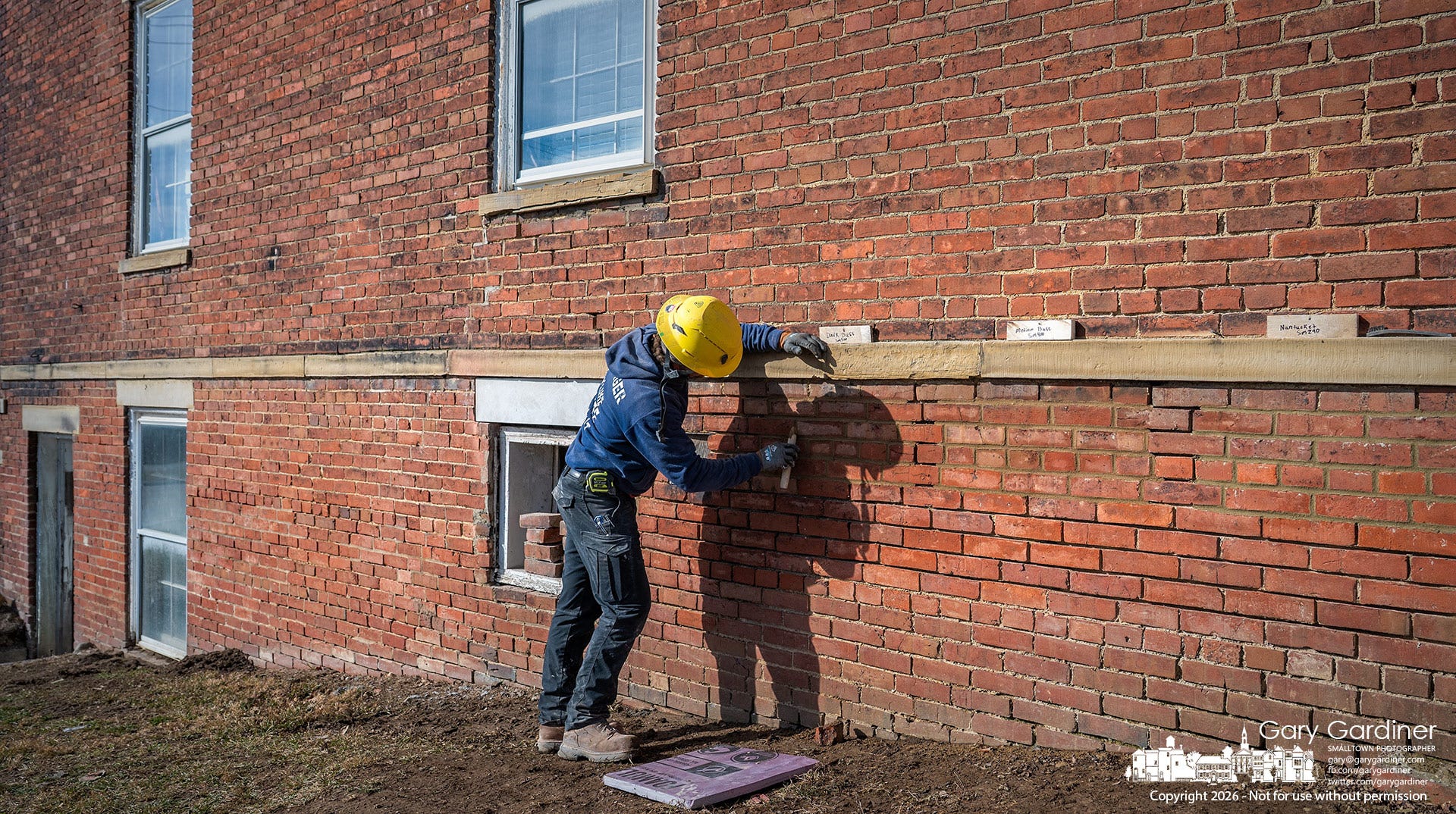
Along the exterior wall, masons chipped out deteriorating joints and pressed fresh mortar into the 168-year-old brickwork. Above each test strip, small wooden blocks labeled with the mortar’s name and color rested on the stone ledge, marking the sample inlaid directly beneath it. The first three colors laid Thursday were Nantucket, Medium Buff, and Dark Buff, with a fourth shade, White Oak, scheduled to be added Friday.
The tones vary not only to match the original mortar but also to account for decades of uneven weathering. The north-facing walls, which show less flaking and color change, require a different match than the more exposed sides. Beyond color, the team must also replicate the original mortar’s granularity so the repaired sections blend in both tone and texture once the work is complete.
The stabilization work is part of a $131,247 first phase funded by the City of Westerville. Plans call for masonry cleaning and repairs, asbestos and lead abatement, roof and gutter replacement, pest control and sanitation, and structural work in the basement.
The Sharp House sits on a one-acre parcel preserved within the city’s 88-acre East of Africa development area, where more than $30 million in infrastructure improvements are underway to extend the Westar business corridor.
The broader East of Africa development project is expected to be completed later this year, with developers preparing plans for individual portions of the property. City leaders have said preserving the Sharp House remains part of the overall vision for the site.
Built between 1857 and 1858 by Stephen Alfred Sharp, the home is one of the few remaining structures in Westerville directly tied to the Underground Railroad. The Sharp family was an early settler and outspoken abolitionist, and several family homes along Africa Road formed a small network of safe houses guiding freedom seekers north toward Alum Creek and Quaker communities in Morrow County.
For now, the focus is on careful preservation. Each mortar test patch will dry and be evaluated before a final selection is made, ensuring that the repairs honor both the structure’s history and the craftsmanship of its original builders.
Chardonnay and Calligraphy
Good Vibes Winery hosted an evening calligraphy class titled “Sip and Sign,” where over a glass of their favored wine, students learned the narrow results of the up stroke and with broader lines of the down stroke during the evening.
The instructor told the crowd that the class wouldn’t make them overnight experts but would give them the necessary skills for the important personal notes on greeting cards and gift tags.
The Westerville News is a reader-supported publication by Gary Gardiner, a lifelong journalist who believes hyper-local reporting is the future of news. This publication focuses exclusively on Westerville—its local news, influence on Central Ohio, and how surrounding areas shape the community.
Reader funding, including subscribers, protects editorial independence, so coverage is guided by journalists rather than owners or corporate profit goals. It also reduces pressure to chase clicks, letting the newsroom focus on stories worth readers’ time. And it helps keep the site accessible to everyone, including people who can’t pay or live in places where a free press is under threat.
Explore more hyper-local reporting by subscribing to The Hilliard Beacon, Civic Capacity, Marysville Matters, The Ohio Roundtable, Shelby News Reporter, This Week in Toledo, and Into the Morning by Krista Steele.


