
Sharp House Update At East of Africa - Yarnell Farm Planted In Soybeans
Sharp House Restoration Continues
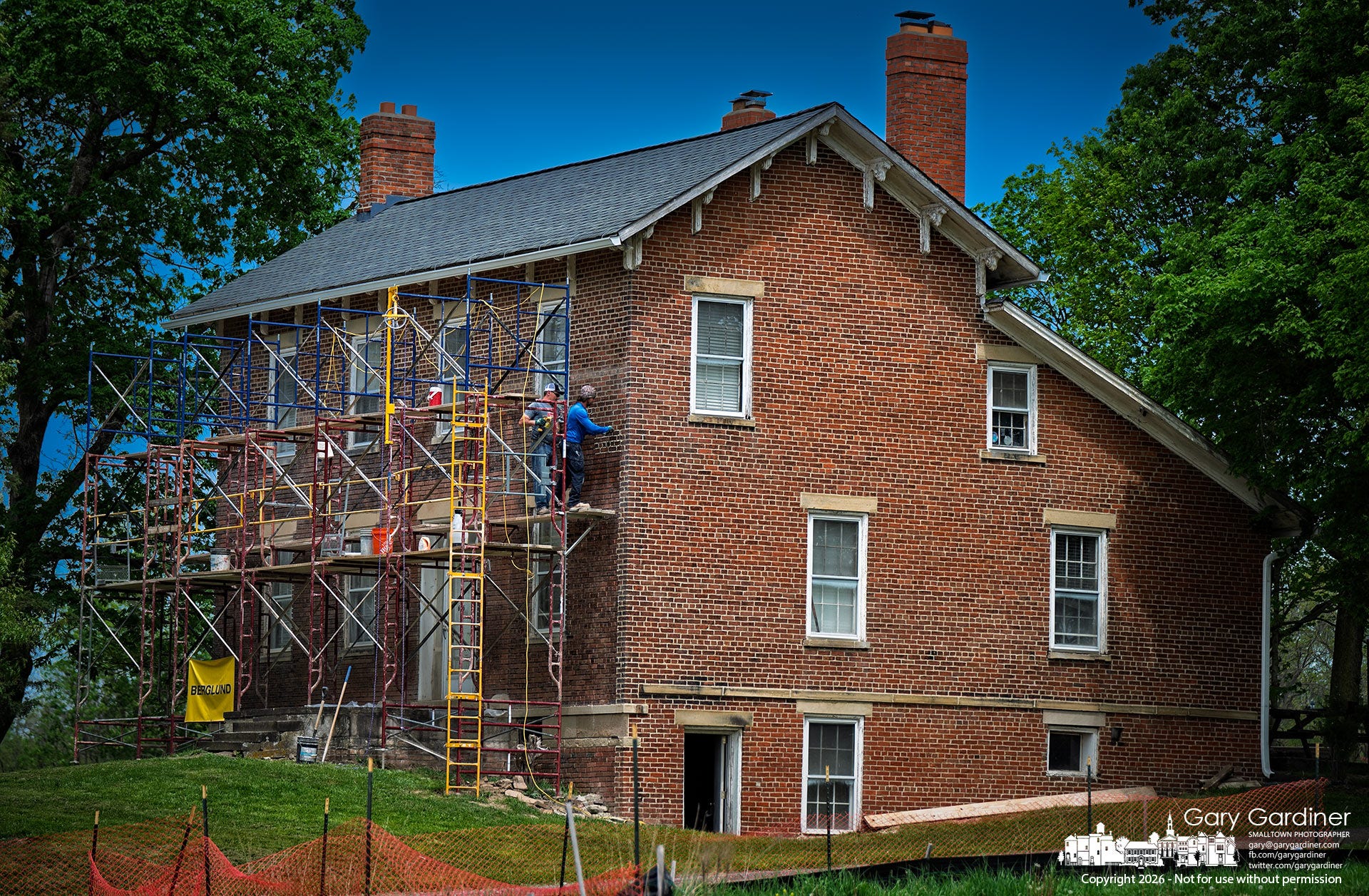
Restoration crews have finished tuckpointing the southern exposure of the Sharp House on Africa Road and have shifted their work to the western side of the historic brick home, continuing the first phase of repairs to one of Westerville’s few remaining structures directly tied to the Underground Railroad.
Listed on the National Register of Historic Places, the mid-19th-century house was built between 1857 and 1858 by Stephen Alfred Sharp and served as a sanctuary for freedom seekers traveling north through central Ohio.
The stabilization work is part of a $131,247 first phase funded by the City of Westerville. Plans call for masonry cleaning and repairs, asbestos and lead abatement, roof and gutter replacement, pest control and sanitation, HVAC inspection and repair, and structural work in the basement.
For now, the work is focused on stabilizing the house and protecting it from further deterioration.
The Sharp family was among the area’s earliest settlers. Stephen’s father, Garrit Sharp, was one of the first settlers in what was then known as Sharp’s Settlement in the early 1800s. A dedicated Methodist and outspoken abolitionist, he helped establish the community’s first church and contributed to the founding of what became Otterbein University.
His anti-slavery beliefs were more than words. They were values he and his sons acted on.
Several Sharp family homes along Africa Road and North State Street formed a small but important network of safe houses. From these homes, freedom seekers were guided north toward Alum Creek and Quaker communities in Morrow County.
Inside the Africa Road house, that history is part of the building itself. A stone-and-brick fireplace concealed a crawl space that led to a dugout, a hidden space that reflects the risks the family was willing to take.
Today, the Sharp House stands within the area of one of Westerville’s largest economic development projects.
In 2023, the city purchased 88 acres east of Africa Road as part of its East of Africa development plan, an expansion of the Westar business area intended to attract new companies and jobs. The Sharp House remains protected on a one-acre parcel within the larger development area.
More than $30 million in infrastructure improvements are underway nearby, including new roads, utilities, and green spaces. The broader East of Africa project is expected to be completed later this year, with developers preparing plans for individual portions of the property.
For many in Westerville, the house represents more than architecture. At a recent Westerville Historical Society event, former Mayor Kathy Cocuzzi reflected on its importance.
“This home stands as a witness to the kind of courage and conviction that shaped Westerville’s early identity,” she said.
Now, the city is working to balance that identity with growth. The East of Africa project represents a major investment in Westerville’s economic future, while the preservation of the Sharp House signals an effort to keep the city’s history visible within that growth.
Standing on the one acre that remains from the Sharp family’s original 450-acre farm, the meaning of the place is hard to miss. The work may be slow and sometimes quiet, but it serves a larger purpose: keeping one of Westerville’s most important historic homes standing for future generations.
Soybeans Planted Before Rain
McNamara Farms returned to the Yarnell Farm on Monday morning to plant soybeans in the upper and lower fields, taking advantage of the brief dry window before overnight rain moved through the area.
The family crew loaded seed into the planter, worked the rows across the open ground, and finished the planting in time for the rain to help moisten and settle the freshly seeded soil.
From Monday’s The Westerville News
Because this post is public, you’re encouraged to share it on social media.
The Westerville News is a reader-supported publication by Gary Gardiner, a lifelong journalist who believes hyper-local reporting is the future of news. This publication focuses exclusively on Westerville—its local news, influence on Central Ohio, and how surrounding areas shape the community.
Reader funding, including subscribers, protects editorial independence, so coverage is guided by journalists rather than owners or corporate profit goals. It also reduces pressure to chase clicks, letting the newsroom focus on stories worth readers’ time. And it helps keep the site accessible to everyone, including people who can’t pay or live in places where a free press is under threat.
Explore more hyper-local reporting by subscribing to The Hilliard Beacon, Civic Capacity, Marysville Matters, The Ohio Roundtable, Shelby News Reporter, This Week in Toledo, and Into the Morning by Krista Steele.


