

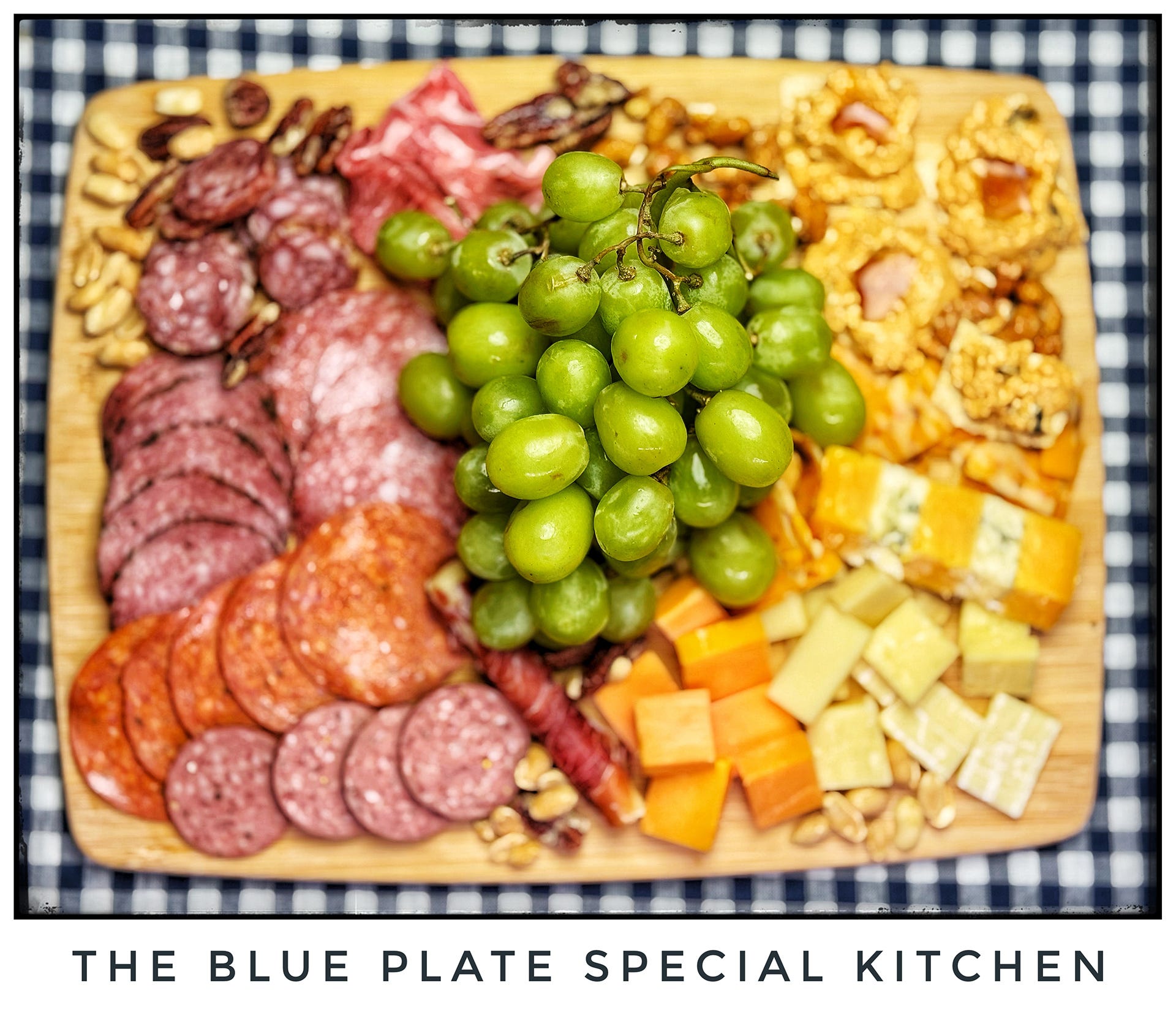
This week, fool that I am, I bought about eight pounds of grapes. I might have bought more, but Kroger didn’t have any on Wednesday or Thursday, even at $2.99 a pound. Aldi and Walmart were $1.29 a pound. Meijer and Market District were $1.49. Every bunch was super sweet, firm, and juicy, and at those prices, almost absurdly inexpensive. So inexpensive, in fact, that I splurged on everything else and built a hearty charcuterie board.
The Green Grape Report readers now stop me on the street and in grocery store aisles to ask where the best grapes are that day or simply to talk about grapes and my fascination with them. I’ve begun explaining the report this way: It’s silly. Plain silly. Monty Python was silly, too, which, according to me, puts me in excellent company.
Silliness, of course, is no reason not to take the grapes seriously. Lately, there hasn’t been much to complain about. The green grapes from California have been consistently sweet, firm and juicy, so the usual question of whether to buy them has largely disappeared. The question now is how much to pay. At $1.29 a pound, apparently I’m willing to buy eight pounds.
I’m not alone in this foolishness anymore. That has been one of the unexpected pleasures of writing The Green Grape Report. Grapes have given people a reason to stop me and start a conversation. Some of those conversations last two minutes in the produce department. Others have continued for months. People tell me where they found a bargain. They report on sweetness and crispness as if they were filing dispatches from the field.
They disagree with me. They tease me for buying too many grapes. Some have confessed that, because of The Green Grape Report, they are now eating too many grapes themselves. One reader told me this week that he’s already anticipating the arrival of inexpensive Autumn Crisp grapes. I completely understand. Autumn Crisp is one of those varieties that doesn’t need a few weeks to find its footing. From the first week it arrives, it usually goes straight to the top of the heap.
And now someone else is waiting for them. This is how foolishness spreads, and apparently it makes friends.
I thought about those friends this week as I looked at the charcuterie board I’d assembled, partly because I’d spent so little on the grapes. The grapes were piled extravagantly in the center. Around them, I arranged meats, cheeses, nuts, crackers, and other items that cost considerably more per pound than $1.29. I stepped back and looked at it. It looked strangely familiar.
Here was a gathering of things with very little in common. Some were salty. Some were sweet. Some were sharp, and some were mild. Some were hard, and some were soft. Some were spicy. And some were nuts. Every group of friends has a few of those. If you don’t think yours does, there is an uncomfortable possibility you should consider.
A charcuterie board works precisely because the things on it aren’t alike. A sharp cheese, like Huntsman with its layered Double Gloucester and Stilton, becomes more interesting when something sweet follows it. Rich, fatty salami and jalapeño pepperoni practically ask for something crisp and fresh. Nuts like the pineapple and habanero-coated cashews add crunch. These crackers had poblano cheddar cheese, with the center reserved for hot honey. Some things on the board naturally pair off.
Put a piece of spicy three-pepper cheddar cheese on a cracker. Try some herb-seasoned salami with it. Eat a salted, roasted pecan. Go back for another piece of cheese. Then, after all that salt, fat, and richness, reach for the grapes. The green grapes. Cold. Sweet. Crisp. Juicy. Everything starts over. And you want it to.
It occurred to me that this isn’t so different from the assortment of people we collect over the years. Our friends aren’t all alike, or at least I hope they aren’t. Some are sharp. Some are sweet. Some bring a little salt. Some are quiet and dependable. Others announce themselves the moment they walk into the room. We see some people constantly and others only occasionally, but we’re always glad when they show up.
Not everyone on the board has to pair perfectly with everyone else. They just need to bring something worthwhile to the gathering.
I never expected writing about grocery-store grapes to add people to my life. The premise was deliberately ridiculous: Buy green grapes every week, pay attention to their cost and whether they’re any good, and tell people about it. Yet people started paying attention. Then they started buying grapes. Then they started telling me about their grapes.
Now they’re stopping me in stores to ask where to buy them. They’re telling me when I’m wrong. They’re warning me about disappointing batches and alerting me to bargains. At least one of them is waiting impatiently for Autumn Crisp season. Somewhere along the way, the grapes stopped being about grapes alone.
Maybe that’s why they looked right in the center of that board. Green grapes get along with almost everybody. They don’t have to overpower the cheese or compete with the salami. They don’t demand much attention. They’re simply there when you need something sweet after something salty, something crisp after something soft, or something cool and juicy after something rich. That isn’t a bad quality in a friend.
And perhaps that’s the lesson from this week’s The Green Grape Report, assuming a report devoted to buying supermarket grapes should be permitted to have lessons. Different is good. A charcuterie board would be awfully dull if everything on it tasted the same. So would a group of friends.
Bring together the sharp ones, the sweet ones, the salty ones, the mild ones and, absolutely, the nuts. Give everybody a place on the board. And keep plenty of grapes in the middle, especially when they’re $1.29 a pound.

Because this post is public, you’re encouraged to share it on social media.
The Westerville News is a reader-supported publication by Gary Gardiner, a lifelong journalist who believes hyper-local reporting is the future of news. This publication focuses exclusively on Westerville—its local news, its influence on Central Ohio, and how surrounding areas shape the community.
Reader funding, including subscribers, protects editorial independence, so coverage is guided by journalists rather than owners or corporate profit goals. It also reduces pressure to chase clicks, letting the newsroom focus on stories worth readers’ time. And it helps keep the site accessible to everyone, including people who can’t pay or live in places where a free press is under threat.
Explore more hyper-local reporting by subscribing to The Hilliard Beacon, Civic Capacity, Marysville Matters, The Ohio Roundtable, Shelby News Reporter, This Week in Toledo, and Into the Morning by Krista Steele.
