
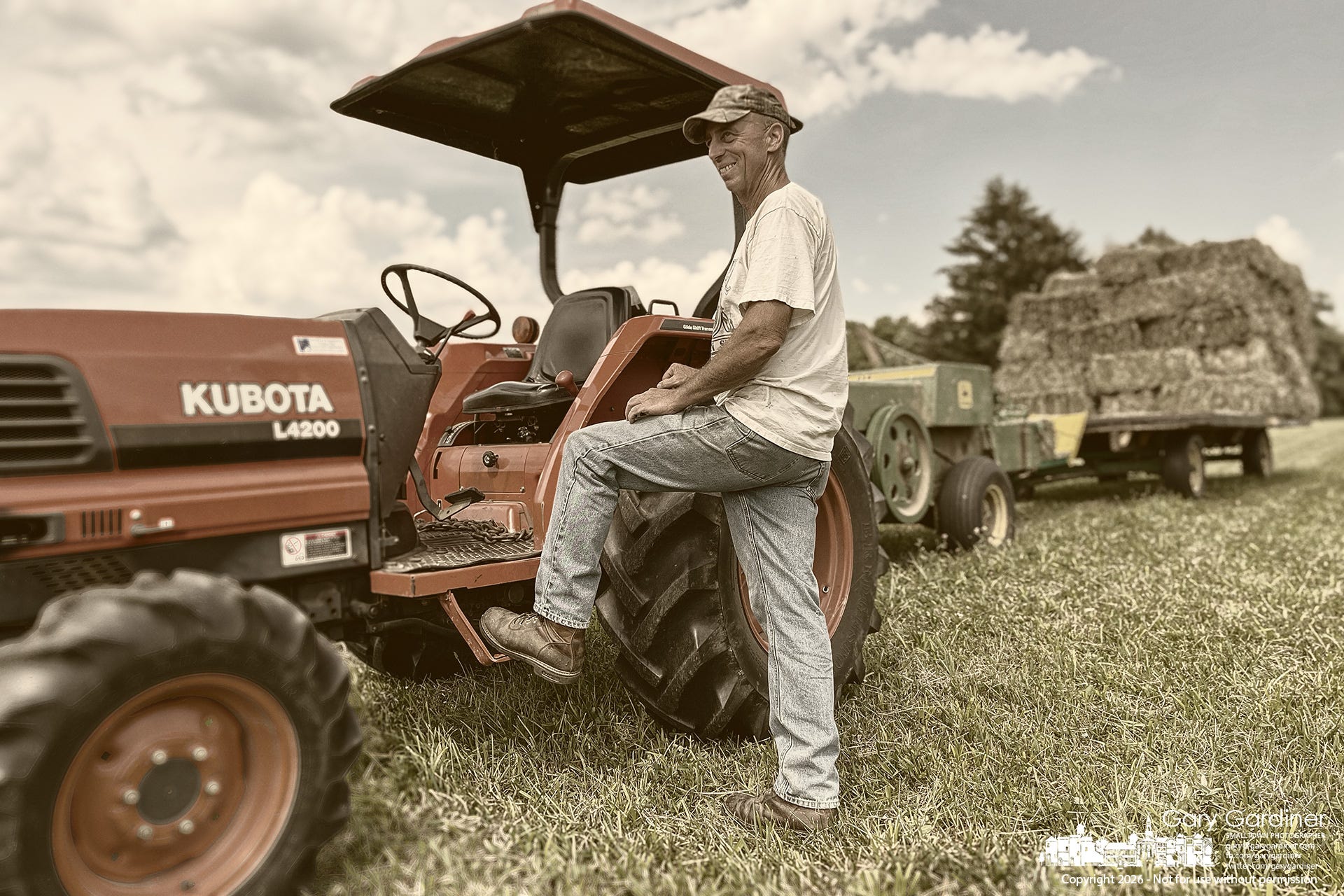
At the corner of Africa and County Line roads, Westerville’s past is cut, dried, baled, loaded by hand, and hauled away in a hay wagon.
That work belongs to Duane Yarnell, who still farms a small field bordered by traffic, pavement, and the steady push of development. Twice a year, perhaps three times if the weather cooperates, he climbs onto the tractor, hooks up the baler, and follows the practiced rhythm of work that once covered much of the city.
The work is slow. He works the field alone. Every 100 feet or so, he steps down from the tractor to load and arrange bales on the wagon. His movements are deliberate, shaped by years of knowing hay by feel: the weight of each bale, the dryness of the stems, the way a field tells him when it is ready.
The smell is something else. Fresh-cut hay has a clean sweetness that briefly rises above the pavement and traffic. It carries the memory of days when the farm was more than a patch of land beside a five-lane highway.
Yarnell remembers his grandfather keeping 100 head of cattle in the field and 65 dairy cows on an adjacent piece of land. Back then, the dairy cows were brought across Africa Road to the milking barn, a weathered building that still stands, though its working days are long past. The spring that once supplied the milking barn with cold water is gone now, covered by asphalt.
Behind Yarnell’s house, the original barns still stand as some of the clearest reminders of the farm’s long history. The lower walls of the main barn were built from street pavers recycled after the Great Flood of 1913 in Columbus. His grandfather bought the bricks for 10 cents each, delivered.


The hayfield at Africa and County Line roads is the most visible part of Yarnell’s farming today, but it is not the only field he tends. Behind the barns, the land slopes toward the old bottomland along Alum Creek, where he tends a smaller field largely hidden from public view.
Few motorists ever see it. The work there draws little attention, but Yarnell maintains it for the same reason he still cuts hay at the roadside field: because he understands the value of the land and believes it should be cared for.
His family owns about 50 acres of farmland within the city, most of which is leased to another farmer who grows corn and soybeans. Yarnell still lives on the farm in one of the Sharp family homes built in the mid-1880s, near his mother, who lives at the top of the hill beside a pond built for the cattle that once grazed in the fenced fields. The pond served the farm, storing water for livestock and feeding a stream that leads to Alum Creek.
Their homes overlook what were once open farm fields stretching from 3C Highway to the rich bottomland along Alum Creek and up the rise on the other side. Today, much of that land has been replaced by homes, offices, businesses, a large hotel, restaurants, and doctors’ offices. Africa Road, once a single-lane gravel country road, now carries three asphalt lanes, bordered by concrete gutters, sidewalks, and a bike path.
Duane and his family once ran tractors over several hundred acres. Their farmers’ market, featuring a pumpkin patch, games, hayrides, and school tours, became a destination for residents not only from Westerville but also from neighborhoods on the other side of I-270.
Behind the pond stands a building now used to store old, unused farm equipment. It once hosted weddings, receptions, graduation parties, and other gatherings. Yarnell calls it the party barn, a reminder that the farm was once a place where people came not only to work but also to celebrate.
Across Alum Creek, Sam and Connie Bigham once farmed in a small pocket of Sharon Township, surrounded by the Westerville city limits.
Sam Bigham’s farm sat west of Hanawalt Road, not far from Cleveland Avenue and the dead end that now leads to a neighborhood connector to the new five-lane County Line Road and Polaris Blvd. He and Connie cut hay there and raised corn and cattle, working the land that would eventually become something else.
In 2013, Sam sold the farm. By 2016, the land had been converted into a housing development named Bigham Ridge.
Before the houses, garages, backyards, and curving streets, there was a final crop.
Connie ran the baler across the field as Sam loaded the wagon. Sam was not especially pleased to have his last hay crop photographed. He said it was poor hay, not as good as he had hoped. It was not the crop he would have chosen to be remembered for.
But that is often how farming ends. Not with a ceremony, not with a marker, not with a perfect harvest. A field is cut for the last time. Corn is picked for the last time. Hay is baled for the last time. Then the land is surveyed, graded, divided, named, and sold in pieces.
Today, families that live in Bigham Ridge never knew Sam or Connie. They may not know that the pond was once part of a farm, or that the farm family lived at the top of the ridge, overlooking Alum Creek’s bottomland and the farm fields that spread east. That cattle once roamed across their backyards and across their driveways. They may not know that Sam once said he and his friends would get snacks after school and sit on the hill, looking down toward a nudist colony below the farm.
They know the neighborhood. They may not know the field.
Recently, a resident at Bigham Ridge called Animal Control after a fawn became trapped in the netting of a backyard swing. The swing sat in the backyard of a house near the place where Sam Bigham harvested his last bale of hay.
It was a small incident, the kind that happens where houses meet the remnants of fields and creek bottom. But it carried an accidental kind of memory. A young deer, caught in a backyard playset, struggled on land where hay once grew and where Sam and Connie Bigham made their final harvest.
That is how much of Westerville’s farming history has disappeared. Not all at once, but field by field, road by road, subdivision by subdivision.
The Bigham farm is no longer farmland. The Braun Farm fields on Cleveland Avenue may be next. The city owns the 88-acre East of Africa development site now named Westar Park. At Africa Road and Polaris Parkway, a roadside market preserves the appearance of farming, though the produce is grown elsewhere. In many places, fields are leased, held for future development, or kept in crops to maintain agricultural tax status.
From the road, it can still look like farmland.
Yarnell’s hayfields are different.
They are not just a tax strategy, a roadside market image, or an interim crop on land awaiting construction. They are working fields, tended by the man whose family still owns them, cut and baled because hay is still hay and farming is still work.
Along with the barns and fields he still tends, Yarnell’s farm remains one of the last visible remnants of Westerville’s agricultural past. The operation is smaller now, but it remains productive. The bales often sell so quickly that they are spoken for before he can haul his wagons back to the barn.
Yarnell is not the only one with fields still in crops, but he is the last farmer in Westerville: the last person still growing and harvesting crops on his family’s land.
Westerville changed around farms like Yarnell’s and Bigham’s. What began as a small village became a suburban city, with neighborhoods replacing apple orchards and hayfields, log cabins giving way to subdivisions, and farmers becoming so rare they seemed out of place on land their families once worked.
The five-lane road beside Yarnell’s hayfield was built on Yarnell family land taken through eminent domain in the late 1990s. Across the pavement, a small remnant of that land remains, smaller than many suburban home lots, cut off from the farm but not from its history.
For now, Yarnell still returns to the field at Africa and County Line Roads. Traffic moves past the hay. The city moves around him, along roads, into offices, through subdivisions, and across land that once fed cattle and grew crops.
In that field, beside pavement laid across part of the farm, Westerville’s agricultural past is not preserved as a display.
It is still being worked.
The farm is smaller now, but the work remains real.
Bigham Farm Remembrance
Because this post is public, you’re encouraged to share it on social media.
The Westerville News is a reader-supported publication by Gary Gardiner, a lifelong journalist who believes hyper-local reporting is the future of news. This publication focuses exclusively on Westerville—its local news, influence on Central Ohio, and how surrounding areas shape the community.
Reader funding, including subscribers, protects editorial independence, so coverage is guided by journalists rather than owners or corporate profit goals. It also reduces pressure to chase clicks, letting the newsroom focus on stories worth readers’ time. And it helps keep the site accessible to everyone, including people who can’t pay or live in places where a free press is under threat.
Explore more hyper-local reporting by subscribing to The Hilliard Beacon, Civic Capacity, Marysville Matters, The Ohio Roundtable, Shelby News Reporter, This Week in Toledo, and Into the Morning by Krista Steele.


