
The Meaty Time Of the Year
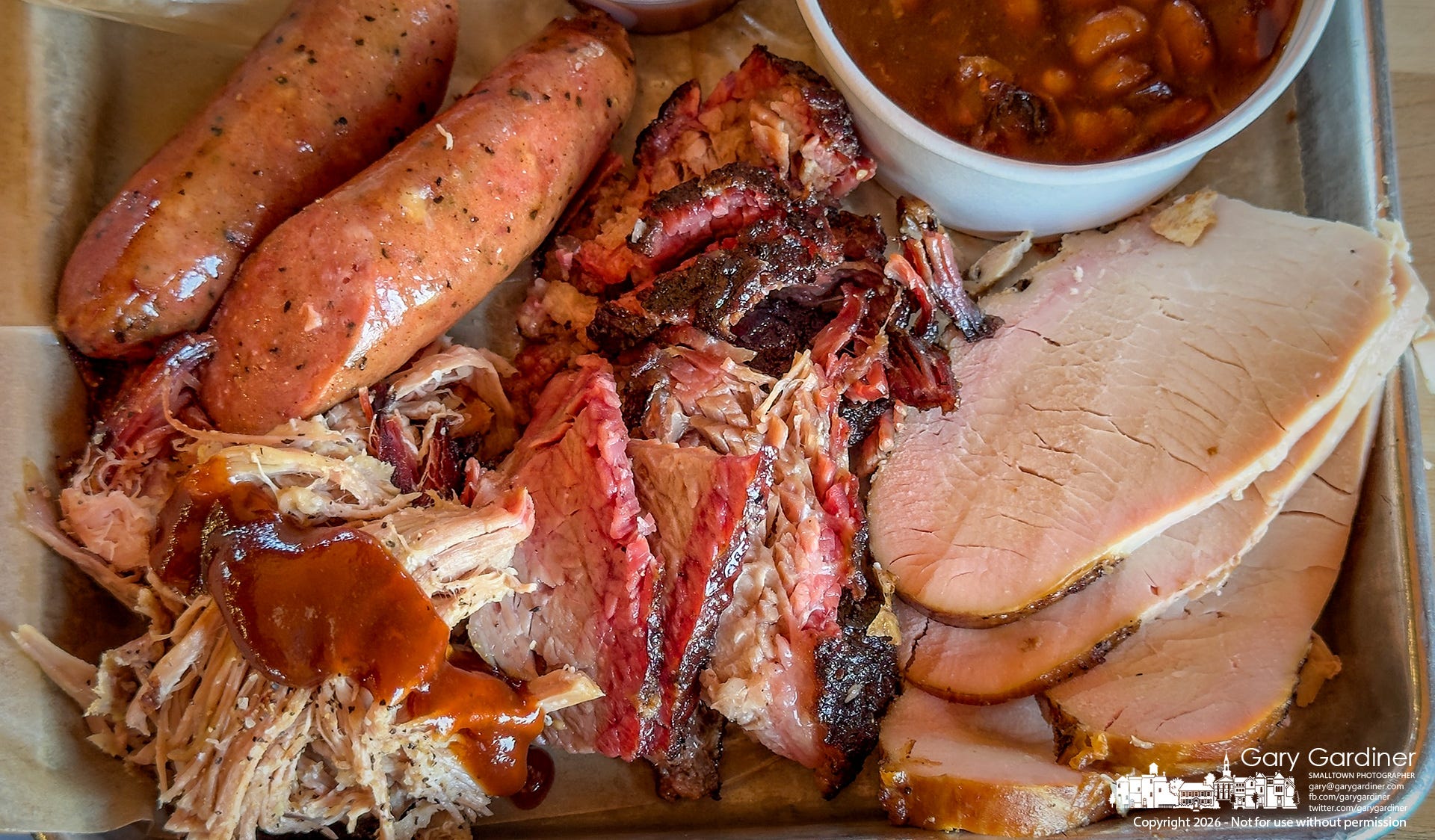
City Barbecue’s City Sampler
Restaurant Review by Gary Gardiner
The end of Lent is always a relief for me, though my trouble with it began long before Friday night fish dinners. I was raised in a family that took meat seriously. My father built a red-brick barbecue pit beneath a large pine tree just off the back porch, and that was where the family gathered. The kids got hamburgers, hot dogs, and chicken wings. The adults had steaks and rosin-baked potatoes. Even the dog got steak bones. In a setting like that, it would have been hard not to become a red-meat person.
And I did. Maybe it was rooted as much in my genes as in my upbringing. My father loved hamburgers; my grandfather was a butcher; my great-uncle raised cattle; and my grandmother could fry bacon to a perfect crisp. At some point, devotion to meat stopped being a preference and became family tradition.
That probably explains why my standard for barbecue was set early and set high by Sonny’s in Gainesville, Florida, my hometown and still my favorite barbecue anywhere. When Floyd “Sonny” Tillman died last December, the Christmas season felt less like a celebration than a mourning, almost like its own 40 days of Lent. He opened the restaurant in 1968. I had just come home from military service with a wife, a child, and a strong need for something better than chow hall food. For me, Sonny’s was never just a restaurant. It was part of coming home, of starting adult life, and of learning what real barbecue ought to taste like.
I have always had a strange relationship with barbecue pork, and Sonny’s is the reason. In 1968, Sonny offered sliced pork. Pink all the way through. Pink from edge to edge, without barbecue sauce slathered over it. On Tuesdays, it was all-you-can-eat. The first plate of that pork—moist, smoky, tender, perfect—disappeared so fast that I ordered a second before the first had fully settled. Sometimes I ate the second plate without any sauce at all, while the third got the barbecue-sauce treatment and was tucked between slices of toast.
So when Lent ended, I celebrated the way I had been imagining for weeks: with the City Sampler at City Barbeque on South State Street. The tray arrived loaded with beef brisket, pulled pork, Texas-style sausage, turkey breast, two sides, Texas toast, BBQ beans, and fries. It was not a meal built around restraint. It was a meal built around reward.
The brisket was the star for me, tender and smoky, with that beautiful pink edge that promises real time in the smoker. Each bite had the kind of rich, beefy depth that makes you slow down and appreciate it. The sausage had that satisfying snap when you bit into it, was well seasoned, and moist. The turkey was adequate. Not the kind of meat I would order on its own at a barbecue joint, but an interesting digression from the heavier choices on the tray. It became more distinctive after a dip in the hot barbecue sauce, which gave it a depth it lacked on its own.
The pulled pork was fairly tasty, but it also reminded me why I never took to modern barbecue pork the way I did Sonny’s sliced version. At City, the hint of a smoke ring had disappeared into the tearing and shredding. The meat was good enough, but it lacked the deep smoke flavor I still associate with real barbecue pork. I suspect shredded pork became popular because it lets restaurant owners serve less expensive cuts that would not look as impressive sliced. Once the meat was pulled apart, appearance mattered less. As long as it carried some smoky flavor, that was enough for many people, because the barbecue sauce would become the dominant taste anyway.
One of my tests at any new barbecue joint is the beans. Every pot gets measured against Sonny’s beans, which remain the standard. They had pinto beans, brown sugar, ketchup, yellow mustard, molasses, and smoked bacon, blended in a way that seemed to shift throughout the meal. The taste changed after a swallow of sweet tea, after a bite of naked pink pork, and again after a garlic-toast pork sandwich. Sonny’s beans were never just a side dish. They were part of the meal’s rhythm.
That is one reason I keep going back to City Barbeque. It’s beans come close. Not equal, at least not for me, but a very respectable second. They bring that same sweet, smoky, savory pull that makes you go back for another bite even when you meant to save room for the meat. If you get two sides with your meal, make them both beans.
After eating all the meat and beans, I noticed that most of the fries and toast were still untouched. But my hunger for meat had been largely satisfied, and that was the point of the evening. After a long stretch of Friday fish dinners, this platter tasted like freedom, like celebration, like the kind of meal my family would have understood completely.
Next year, when Lent ends, I may go bigger and order the Judge’s Sampler: brisket, pulled pork, a half slab of ribs, chicken breast, two sides, and Texas toast. Then again, maybe I will not wait for Lent. Maybe I will go on the anniversary of Sonny’s death, as a memorial of sorts.
The Westerville News is a reader-supported publication by Gary Gardiner, a lifelong journalist who believes hyper-local reporting is the future of news. This publication focuses exclusively on Westerville—its local news, influence on Central Ohio, and how surrounding areas shape the community.
Reader funding, including subscribers, protects editorial independence, so coverage is guided by journalists rather than owners or corporate profit goals. It also reduces pressure to chase clicks, letting the newsroom focus on stories worth readers’ time. And it helps keep the site accessible to everyone, including people who can’t pay or live in places where a free press is under threat.
Explore more hyper-local reporting by subscribing to The Hilliard Beacon, Civic Capacity, Marysville Matters, The Ohio Roundtable, Shelby News Reporter, This Week in Toledo, and Into the Morning by Krista Steele.


