
The Peach Tree That Wasn’t There - EMWTTSFM
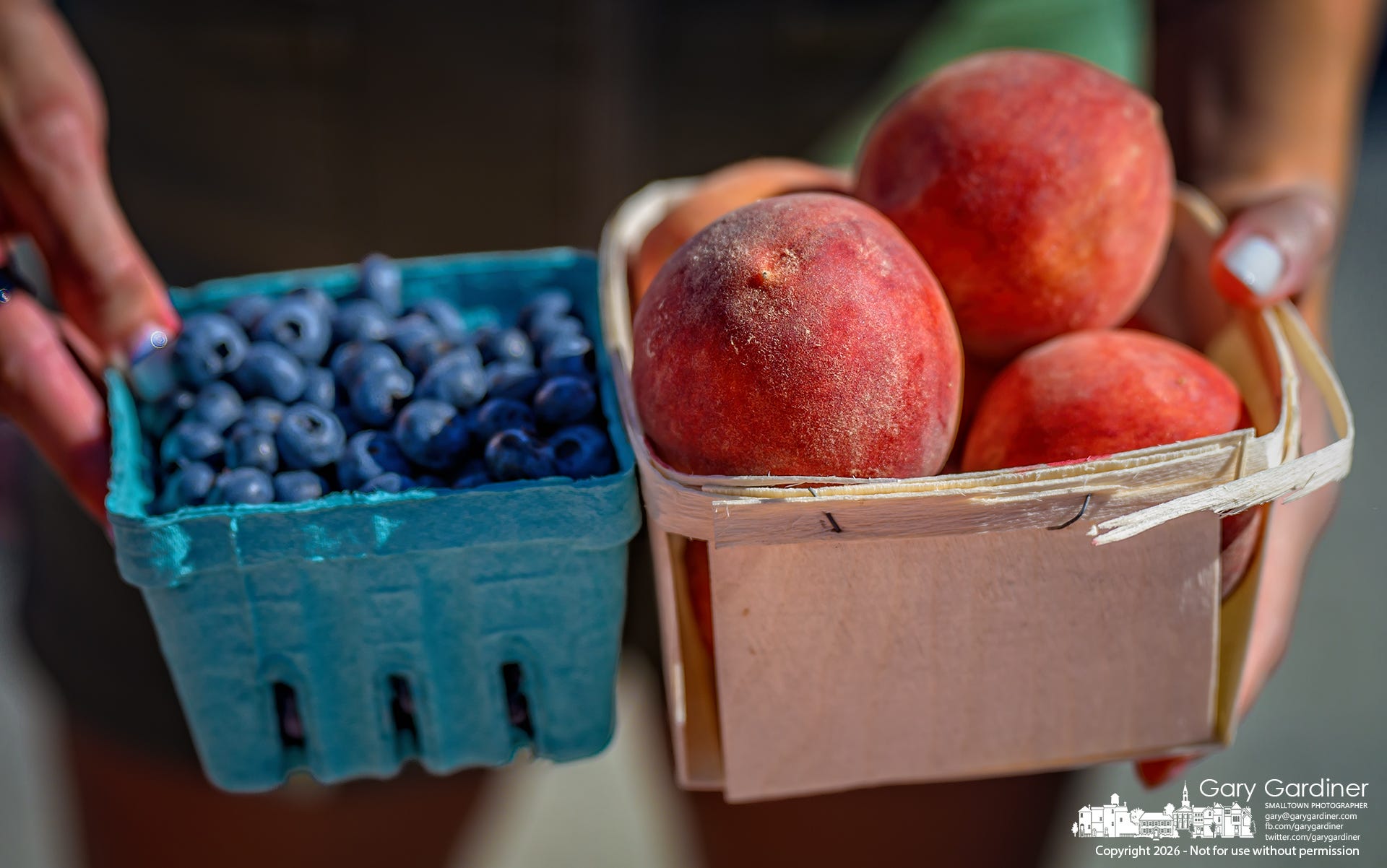
There are only a few Saturdays each summer when peaches become a primary reason to visit the Saturday Farmers Market. I missed one of them last week.
Instead, I spent the morning at the 75th anniversary celebration of the Ohio News Photographers Association. The speakers were excellent, their stories compelling, and I took notes on how their experiences might make me a better photographer.
Still, at about 9:45, just before the first speaker began discussing the transition from still photography to video, I found myself thinking about what I could have had in front of me from the market: a ripe Rhoads peach, a knife and a napkin for the juicy mess.
Instead, I had catered pastries, coffee, and reconstituted orange juice.
None of the pastries were peach.
That was the problem. Peach season at the market lasts only a few Saturdays, and missing one feels less like skipping breakfast than losing part of the summer.
Rhoads Farm brings freestone peaches from orchards near Circleville early in the season. This year, they arrived juicy, sweet and ready to eat, just as the Georgia Peach truck pulled in with 12-pound cardboard boxes of fruit that sometimes needed a few days to soften and develop the same texture and flavor as Rhoads.
For those willing to tolerate a few soft spots on a very ripe peach, Rhoads also had seconds. A slight twist separates each one into two domes of deliciousness and joy.
The market offers more than peaches, of course. There are tomatoes and blueberries, horseradish pickles, greens and coffee, along with the familiar faces, smiles and small joys that come with this weekly ritual.
But for a few Saturdays, there are peaches.
At the ONPA celebration, one speaker described leaving newspaper photography to pursue multimedia work and building a career many in the audience envied. Another, who began her career in Columbus and went on to travel the world and win two Pulitzer Prizes, spoke of the joy of working in so many places with so many talented people.
A third explained how her newspaper covered recent tragedies and unrest in its community—work that earned the staff a Pulitzer Prize. She said the coverage required a shared sense of purpose, along with the talent and dedication of a united newsroom.
I listened, took notes and considered how what I was hearing might make me a better photographer.
Then I thought of peaches.
Peaches have a way of carrying me backward.
I remember explaining to my children how I was disciplined when I was their age. This was a time when corporal punishment—a belt or a switch—was considered the preferred and most effective way to correct the attitude or actions of a wild child.
In my family, I was that child: the oldest, forever testing the boundaries of acceptable behavior, often at the expense of my younger sister and brother. They took particular joy in watching me strip the leaves from the long hedge switch I had been ordered to choose for its lashing power.
I also told them about the time I was paddled at school for an offense I can no longer remember. Stretching the truth, I said that shortly afterward I had been transferred to another school, as though the authorities had decided to remove me from an environment where I could not stop breaking the rules.
What I did not tell them was that the school, just built, was within walking distance of my house. Still, the idea that their father had been such a miscreant that he had to be moved elsewhere gave me a faint air of danger.
Then, to add another layer to the story of my misbehavior, I told them about the times when a belt or hedge switch was considered too light a punishment and I was sent to cut a branch from the peach tree in the backyard.
At that point, they interrupted to correct me, stopping just short of calling me a liar.
They had never seen a peach tree in the backyard.
Smiling, I leaned toward them and said, “That was probably because I cut off too many of its limbs for it to survive.”
In truth, the tree’s disappearance probably had more to do with Florida’s weather, sandy soil, and it being the only peach tree in the neighborhood, than with my misbehavior.
Back at the ONPA celebration, I won nothing in the raffle.
Then I began to wonder how old I had been when the organization was founded 75 years earlier.
I would have been six, in the first grade at Sidney Lanier Elementary, just before I was transferred to Stephen Foster Elementary.
About the time the peach tree died.
I love peaches. And the Saturday Farmers Market.
Because this post is public, you’re encouraged to share it on social media.
The Westerville News is a reader-supported publication by Gary Gardiner, a lifelong journalist who believes hyper-local reporting is the future of news. This publication focuses exclusively on Westerville—its local news, influence on Central Ohio, and how surrounding areas shape the community.
Reader funding, including subscribers, protects editorial independence, so coverage is guided by journalists rather than owners or corporate profit goals. It also reduces pressure to chase clicks, letting the newsroom focus on stories worth readers’ time. And it helps keep the site accessible to everyone, including people who can’t pay or live in places where a free press is under threat.
Explore more hyper-local reporting by subscribing to The Hilliard Beacon, Civic Capacity, Marysville Matters, The Ohio Roundtable, Shelby News Reporter, This Week in Toledo, and Into the Morning by Krista Steele.


