

Time, Entropy, and the Living Story of Westerville - An Editorial
64 East Walnut Failure Was Never About Development
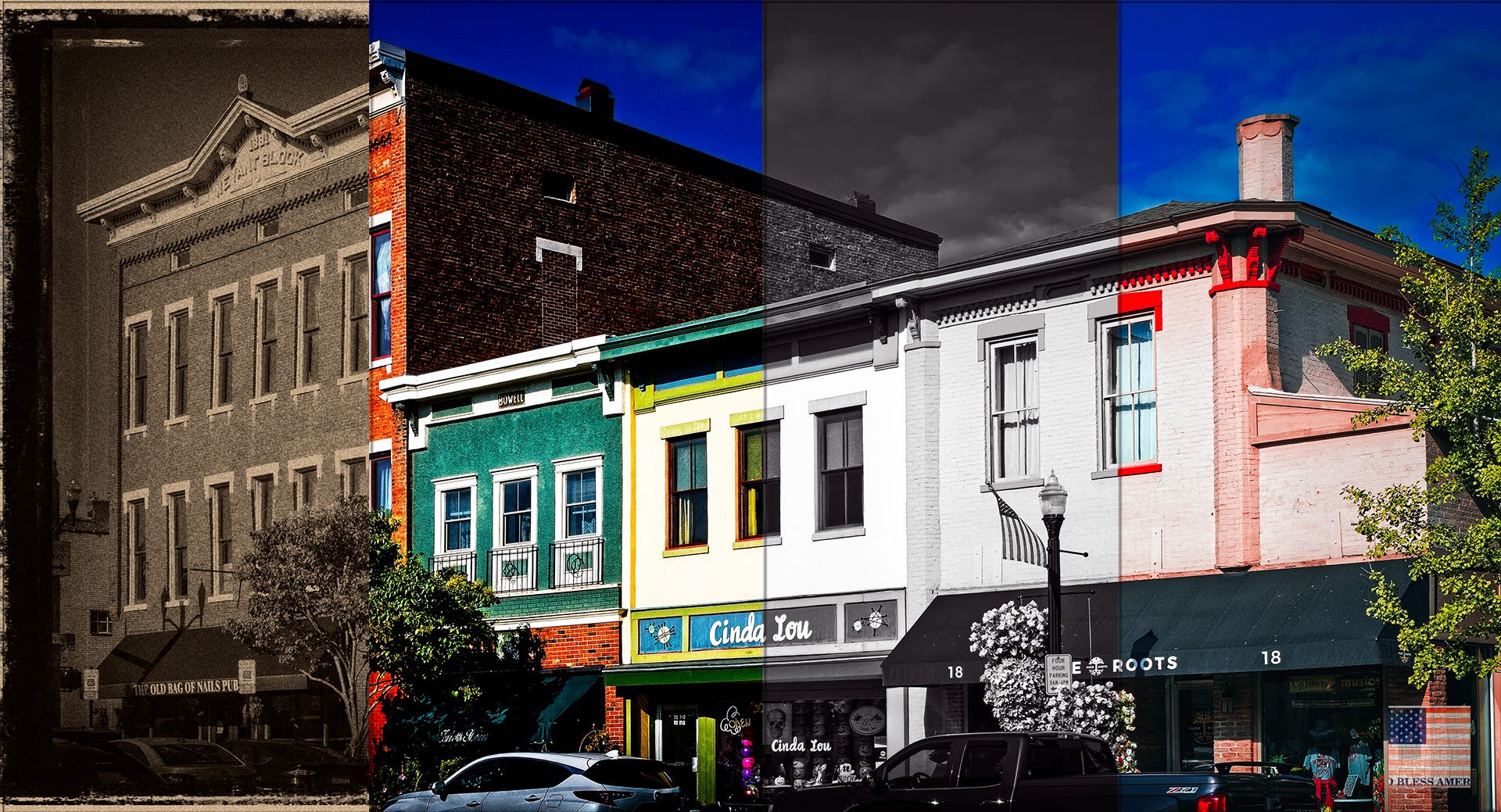
The debate over 64 East Walnut was never really about development.
It was not about building height, traffic patterns, parking ratios, or architectural renderings. Those were the visible arguments, the language through which the disagreement was expressed. The real debate was deeper and more unsettling:
What does Westerville think it is?
For decades, Westerville has occupied an unusual space in the imagination of its residents. It is a city by population, budget, and infrastructure, yet many residents continue to understand it as a village—a place where history matters, where relationships matter, and where growth is accepted so long as it remains subordinate to the character of the community.
This understanding did not emerge by accident. The city itself helped create it.
For generations, Westerville and its residents developed a kind of symbiotic relationship. Residents supported annexation, commercial development, and economic expansion because the city delivered tangible benefits in return: reliable roads, efficient snow removal, dependable electric service, safe neighborhoods, strong schools, and public services that consistently ranked among the best in the region. The city prospered, and so did the people who lived there.
Over time, this success produced an assumption that may have gone largely unexamined: that the city and its residents shared the same idea of what Westerville was becoming.
The controversy surrounding 64 East Walnut challenged that assumption.
Many residents who otherwise accept development found themselves opposing this project not because they opposed growth, but because they believed this particular proposal violated something more important than economic opportunity. They believed it threatened the understanding they had inherited about Westerville itself: that it remained, despite its size and prosperity, a community rooted in human scale, historical continuity, and shared civic culture.
The city’s willingness to entertain the proposal suggested a different understanding. It suggested that the primary responsibility of the modern city may not be to preserve a particular lifestyle or cultural identity, but to ensure its own continued vitality through growth, investment, and economic resilience.
This realization was shocking precisely because the city had become so successful at fulfilling its traditional responsibilities. Residents had come to trust the city as a benefactor of their quality of life. They expected that trust to extend naturally to questions of culture, history, and the character of place.
Instead, 64 East Walnut revealed a possibility that many had not previously considered: that Westerville may no longer understand itself primarily as a village protecting a way of life, but as a complex civic organism responsible for sustaining itself.
If cities develop priorities through the collective necessity of sustaining themselves, then they also develop a relationship with time that differs from the relationship experienced by individual residents.
People experience time through memory. They remember the road before it was widened, the farm before it became an office park, the family whose name once defined a neighborhood, and the storefront that stood where a national chain now operates. Their understanding of a place is not measured in budgets or development plans, but in accumulated experience. For individuals, time gives meaning because it creates memory.
Cities, however, experience time differently. Cities cannot afford nostalgia in the same way individuals can. Their obligations exist in the present and extend into the future. Roads must be maintained. Electric grids must remain reliable. Police and fire services must be funded. Debt must be managed. Economic vitality must be sustained. Where residents often look backward to understand what a place means, cities are compelled to look forward to ensure that place continues to function.
For many years in Westerville, these two experiences of time appeared to align. Residents supported growth because growth improved their daily lives. The city expanded its boundaries, transformed farmland into commercial corridors, attracted major employers, and increased its tax base. In return, residents received the benefits of a prosperous municipality: strong public services, stable neighborhoods, and a quality of life that became part of Westerville’s identity.
This relationship produced more than prosperity. It produced trust.
That trust created a powerful assumption: that the city and its residents were working toward the same future.
The reaction to 64 East Walnut suggested that this assumption may no longer be sufficient.
Perhaps this is an inevitable consequence of success. As cities grow, they acquire obligations that demand continued growth. Infrastructure creates maintenance costs. Public services create expectations. Economic success creates the need for continued economic success. Over time, preserving the city itself becomes one of its primary responsibilities.
In this sense, cities begin to resemble living systems. They adapt to changing conditions. They seek resources necessary for survival. They redirect energy toward what sustains them. They shed what no longer contributes to their continued existence.
They are not sentient in the biological sense. Yet they behave as though they possess a collective instinct for survival.
This instinct can produce a subtle inversion of priorities.
There is an old maxim: do what you love, and the money will follow. Communities often imagine their own development in similar terms. Preserve the character of the place, nurture its culture, maintain its identity, and prosperity will emerge naturally from those commitments.
But institutions frequently reverse this logic. Revenue becomes the prerequisite for culture. Economic stability becomes the condition under which art, history, and identity may be considered.
This inversion becomes especially visible when considering the place of the arts in civic life.
Westerville is not without an arts community. Artists, musicians, performers, educators, and cultural organizations have long contributed to the city’s identity, even if their impact is not measured as easily as income tax receipts or development projections. Yet the arts often seem to occupy a secondary place in the city’s public imagination: appreciated, occasionally celebrated, but seldom treated as essential to Westerville’s future.
That is why the suggestion that 64 East Walnut could become an arts center or cultural space mattered. It was not merely an alternative use for a disputed property. It was a statement about what kind of value the city is willing to recognize. Neighboring communities have shown that arts centers can become civic anchors—places where memory, creativity, education, and public life meet. They do not simply decorate prosperity. They help define what prosperity is for.
When that possibility received little serious consideration, some residents saw more than a missed opportunity. They saw evidence that culture remains subordinate to revenue, and that the community’s own ideas about meaning, place, and identity had become secondary to the city’s operational priorities.
That may be the deeper wound left by 64 East Walnut. Residents did not simply object to a building. Many felt they had been reduced from partners in shaping Westerville’s future to observers of a decision already moving without them. Whether that perception was intended matters less than the fact that it took hold. In civic life, trust depends not only on outcomes but on whether people believe their voices can still alter the direction of events.
This is where entropy becomes visible.
Entropy is often understood as physical decay: peeling paint, collapsing roofs, abandoned storefronts. But civic entropy begins earlier. It begins when a community loses confidence that prosperity, identity, and purpose still belong to the same conversation. It appears when residents and institutions no longer agree about what should endure, what should change, and who gets to decide.
Westerville will continue to grow. The question is whether that growth can remain connected to memory, culture, and community.
The city’s responsibility to maintain infrastructure, public safety, utilities, and economic vitality is real. But residents’ concerns about history, scale, art, and identity are equally real. They are not obstacles to progress. They are expressions of what residents believe progress should preserve.
The challenge is not choosing between prosperity and identity. It is deciding whether prosperity can remain in service of identity.
That decision cannot emerge only from public hearings, development proposals, or planning documents. It requires a renewed civic conversation—one in which city leaders and residents ask not simply what can be built, but what kind of community they wish to build together.
A city may be responsible for maintaining itself.
But a community remains responsible for deciding what that self is meant to become.
And if time, growth, and entropy teach us anything, it is that communities endure not because they avoid change, but because they continue to recognize themselves within it.

Because this post is public, you’re encouraged to share it on social media.
The Westerville News is a reader-supported publication by Gary Gardiner, a lifelong journalist who believes hyper-local reporting is the future of news. This publication focuses exclusively on Westerville—its local news, influence on Central Ohio, and how surrounding areas shape the community.
Reader funding, including subscribers, protects editorial independence, so coverage is guided by journalists rather than owners or corporate profit goals. It also reduces pressure to chase clicks, letting the newsroom focus on stories worth readers’ time. And it helps keep the site accessible to everyone, including people who can’t pay or live in places where a free press is under threat.
Explore more hyper-local reporting by subscribing to The Hilliard Beacon, Civic Capacity, Marysville Matters, The Ohio Roundtable, Shelby News Reporter, This Week in Toledo, and Into the Morning by Krista Steele.
