

Two years after Harlem Township ended talks on a proposed merger with Westerville, township trustees are moving toward a different kind of partnership, this time with the Village of Galena.
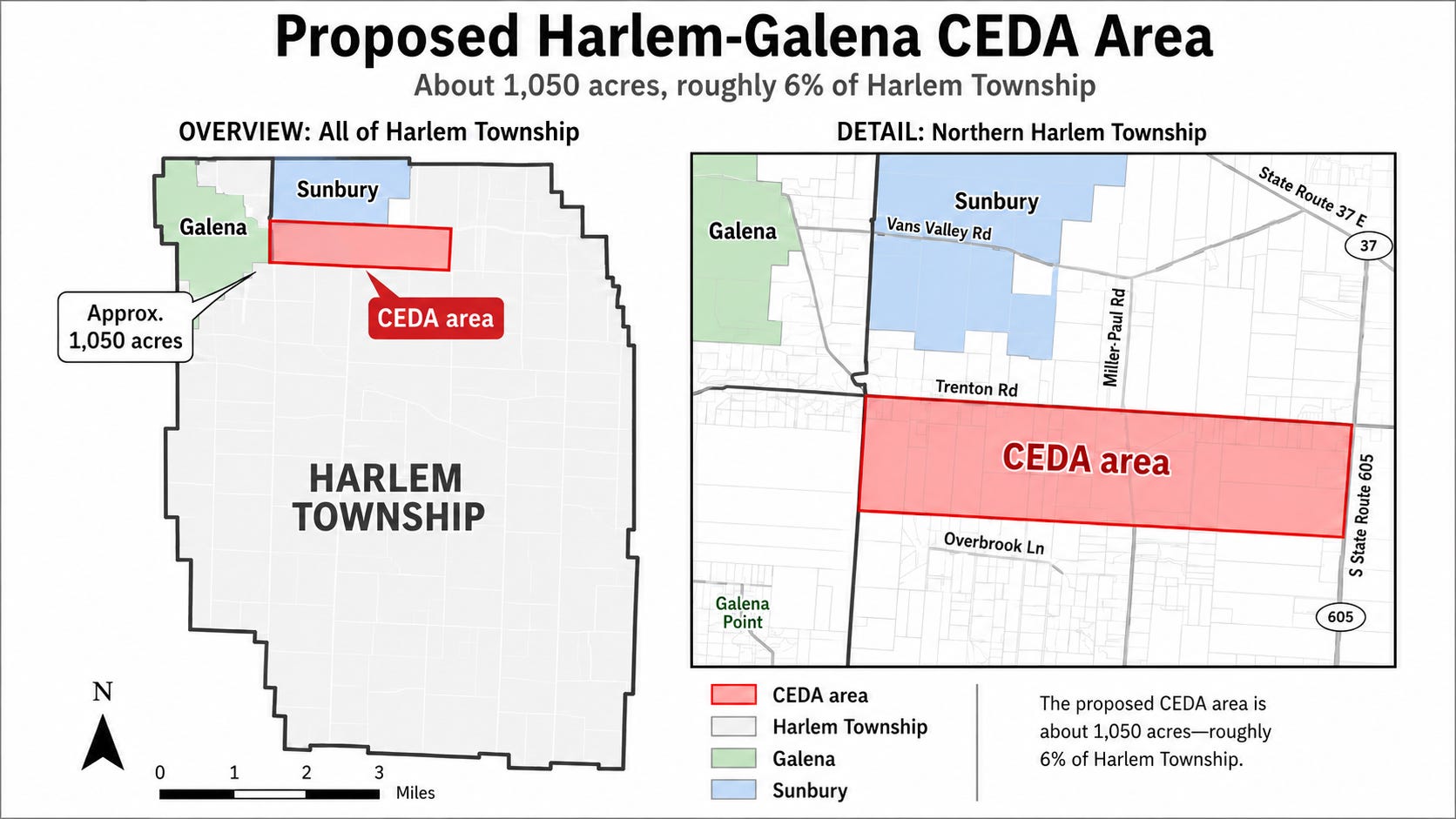
The proposed Cooperative Economic Development Agreement, or CEDA, would allow Harlem to remain a township while working with Galena on sewer service, future development and tax revenue across approximately 1,050 acres of northern Harlem Township.
Under the proposal, Galena could extend sewer service into the area without annexing the land, while Harlem would retain control of zoning and land use.
Harlem trustees and Galena Village Council held a joint public hearing Monday night on the proposal. Harlem expects to consider a resolution approving the agreement Sept. 9, while Galena gave its ordinance a second reading Monday and expects a final vote Sept. 21.
Officials said the agreement is not being proposed because a specific development is waiting to move into the CEDA area. But Harlem Township Trustee Adam Holliday said Amazon’s new data center development across the road helped prompt the township to begin planning now.
Holliday said township officials are concerned that related development, including gas stations, hotels and fast-food restaurants, could follow and want standards in place before that happens.
“We’re trying to replace the uncertainty with a plan,” Holliday said after the hearing. “I think it’s the first big step for us, but more to come.”
Rob McCarthy, an attorney representing Galena, said the agreement is intended to establish rules for future development before projects arrive rather than negotiate issues such as sewer service, utilities and annexation one property at a time.
“The idea here is to be proactive so that if growth comes, it’s not parcel by parcel negotiation,” McCarthy said.
The arrangement has similarities to the long-standing development partnership between Westerville and Blendon Township, where the two governments cooperate while remaining separate communities, though the agreements differ in structure and financial terms.
The proposed CEDA encompasses approximately 1,050 acres, according to Holly Mattei of Crossroads Community Planning, who is representing Harlem Township. That is about 6% of Harlem Township’s roughly 17,000 acres.
The area stretches across the northern part of the township south of Trenton Road. Miller-Paul Road runs through the territory, with State Route 605 along its eastern side.
The area was selected largely because Galena can provide sewer service there. The arrangement would allow that service to be extended without requiring the property to become part of Galena.
Harlem would retain control of planning and zoning within the CEDA area. Galena could comment on proposed land-use changes, but Harlem would make zoning decisions through its normal public process.
The agreement is also intended to reduce annexation pressure. While it remains in effect, Galena would agree not to annex property within the cooperative area, and Harlem would not facilitate annexation of that land by another municipality without Galena’s approval.
For property owners already living within the CEDA boundary, officials repeatedly emphasized that inclusion on the map would not by itself result in new taxes.
Existing homes, farms and home-based businesses would not be subjected to a new income tax or development charge simply because they fall within the CEDA boundary. The new financial provisions generally would come into play when property is redeveloped through a township development plan.
That distinction drew questions from Harlem Township resident Joanie Manson, who asked whether the agreement could affect home-based businesses or property owners who divide acreage so a son or daughter can build a house.
“The terms of the CEDA only apply if homeowners or property owners decide to sell and develop,” McCarthy said. “If you live in one of these properties, nothing’s changing in terms of taxes or revenue from your home or your property.”
Officials also said home occupations would not be affected and ordinary property splits would remain subject to county rules.
Future commercial and mixed-use developments could be placed in Joint Economic Development Districts, commonly called JEDDs. Those districts would allow Galena’s municipal income tax to apply to business activity within the developed areas even though the property remains in Harlem Township.
Revenue from the JEDDs would be divided equally between Galena and Harlem Township.
New residential development could be subject to a separate development charge through a New Community Authority to help pay for infrastructure and services. That charge would apply to qualifying new development, not existing homes simply because they fall within the CEDA boundary.
Harlem already has an overlay zoning district covering the same area. The zoning allows a mixture of housing and service-oriented commercial uses, including single-family homes, townhouses and multifamily housing at densities of as much as eight dwelling units per acre.
That potential density drew concern from township resident Bruce Harris, who said residents should understand what eight units per acre could mean in an area now characterized largely by single-family homes on larger lots.
Harris said protecting the township’s character remains important as development moves closer. Township officials said the overlay includes architectural standards, landscaping, buffers and other protections for neighboring properties.
Mattei also worked with Harlem Township during its earlier discussions with Westerville over a possible merger, but the Galena proposal takes a substantially different approach.
Rather than combining Harlem with a municipality, the CEDA would preserve township boundaries and Harlem’s zoning authority while providing access to municipal sewer service and allowing Harlem and Galena to share revenue generated by future development.
The proposed agreement would run for an initial 50 years and automatically renew for two additional 25-year periods unless either community takes action under its terms to end it.
If both governments approve the agreement in September, the approximately 1,050 acres would remain part of Harlem Township, with Harlem retaining zoning authority and Galena gaining a role in providing sewer service and sharing revenue from future development. Unlike the Westerville proposal two years ago, no merger would be required.

How Westerville and Blendon Share Growth Without Merging
For more than a decade, Westerville and Blendon Township have shared income-tax revenue from designated business areas while remaining separate governments.
The partnership uses a Cooperative Economic Development Agreement, or CEDA, and the Blendon-Westerville Joint Economic Development Zone, commonly called a JEDZ.
The arrangement offers a nearby comparison: Harlem Township and Galena are planning their own CEDA, although the two agreements differ in structure and financial terms.
The Blendon-Westerville zone covers selected commercial and employment properties in unincorporated Blendon Township. Township voters approved the arrangement in 2012, and its income tax took effect in February 2013.
The JEDZ is not one continuous district. It consists of designated properties in several parts of the township, including concentrations along Westerville Road and around Sunbury Road and Executive Parkway near State Route 161.
Employees working in the zone and businesses earning profits there generally pay a 2% local income tax. Westerville collects and administers the tax.
Blendon receives most of the revenue generated by the zone. Westerville receives a fee for collecting and administering the tax, as well as its share of the remaining revenue under the CEDA. Westerville reported about $2.5 million in JEDZ collections in 2024 from approximately 143 businesses.
The participating properties remain in Blendon Township. The township retains zoning authority and responsibility for township roads, snow removal, and general government services, and Blendon police continue to provide law enforcement.
Westerville provides fire and emergency medical services under a separate contract with Blendon Township.
The Westerville-Blendon system differs from what Harlem and Galena are proposing. Westerville and Blendon use a JEDZ, an older type of economic-development zone. Ohio law stopped allowing new JEDZs under that statute after 2014.
Harlem and Galena instead plan to create Joint Economic Development Districts, or JEDDs, as development occurs within their proposed cooperative area.
The underlying idea is much the same: A township and municipality can share revenue and coordinate development without merging their governments or annexing the participating land.

Because this post is public, you’re encouraged to share it on social media.
The Westerville News is a reader-supported publication by Gary Gardiner, a lifelong journalist who believes hyper-local reporting is the future of news. This publication focuses exclusively on Westerville—its local news, its influence on Central Ohio, and how surrounding areas shape the community.
Reader funding, including subscribers, protects editorial independence, so coverage is guided by journalists rather than owners or corporate profit goals. It also reduces pressure to chase clicks, letting the newsroom focus on stories worth readers’ time. And it helps keep the site accessible to everyone, including people who can’t pay or live in places where a free press is under threat.
Explore more hyper-local reporting by subscribing to The Hilliard Beacon, Civic Capacity, Marysville Matters, The Ohio Roundtable, Shelby News Reporter, This Week in Toledo, and Into the Morning by Krista Steele.
