
Uptown Code Enforcement Causes Local Businesses Difficulties They Say Aren't Necessary
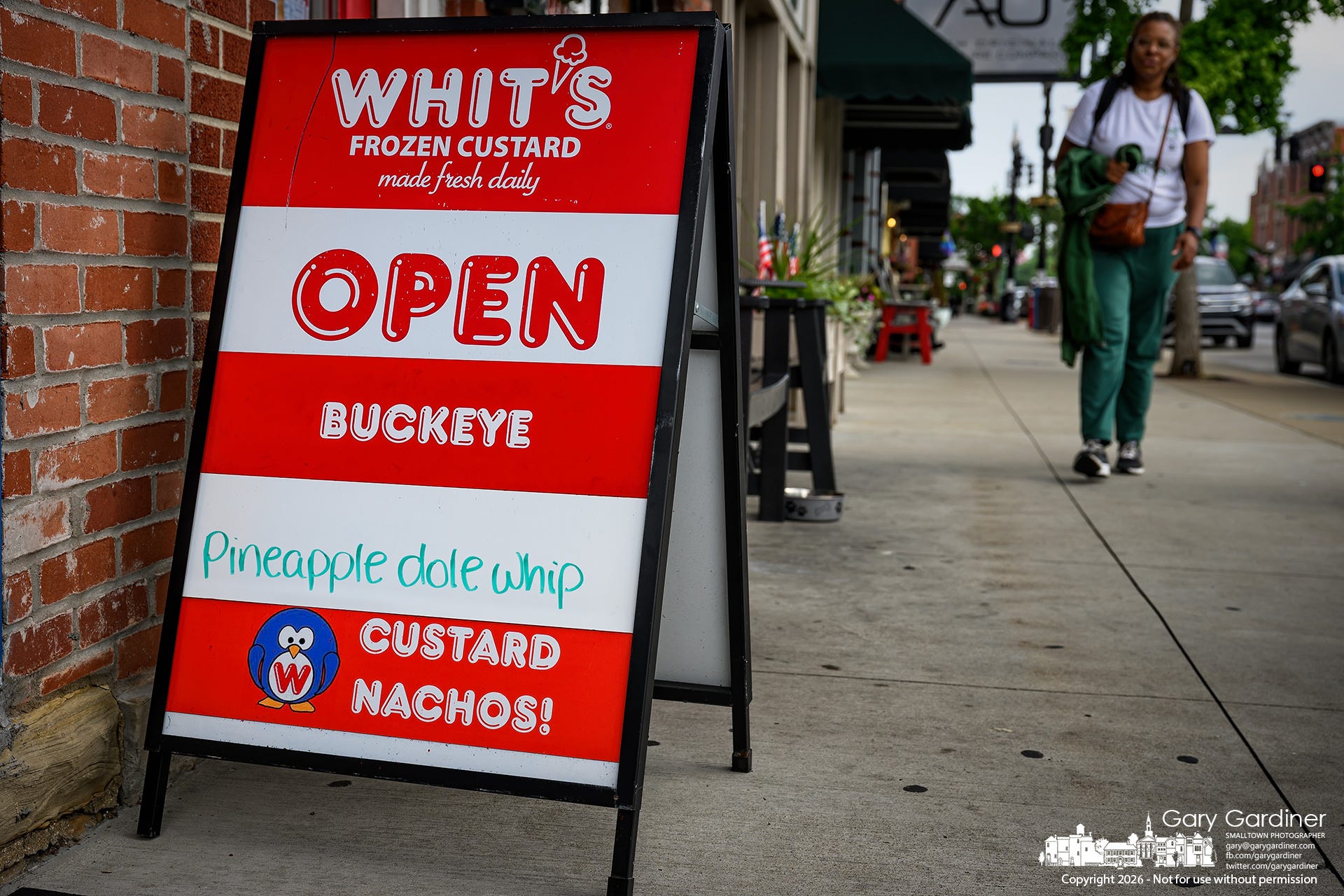
The Uptown Review Board eventually approved the rainbow-colored sandwich board outside Whit’s Frozen Custard, allowing a sign that exceeded Uptown guidelines limiting signs to four colors, including black and white. But owner Joe Schirtzinger’s Mayor’s Court case over the originally unapproved sign did not end there.
The case began after Westerville Zoning Code Inspector David Hays said in April that the sign violated city code. Schirtzinger was charged in Mayor’s Court with violating the city’s certificate-of-appropriateness requirements, a misdemeanor.
Court records show a certified letter sent to Schirtzinger in May went unclaimed. Schirtzinger said he never received it. He later appeared in Mayor’s Court and received a continuance while he pursued approval from the Uptown Review Board.
Once the board approved the sign, Schirtzinger said, he thought the issue was resolved. “They approved it. So I thought nothing of it,” he said. “I didn’t think I had to go back to court.”
After Schirtzinger missed a later hearing, held after the Uptown Review Board had approved the sign that prompted the court case, court records show he was ordered to appear on July 15 or risk an arrest warrant. Schirtzinger said he did not receive the notice because it was placed in the mailbox for the apartment above Whit’s, not in the store’s mailbox. When he later retrieved it, he said, “I guess I broke the law getting my own mail.” The record also lists a $564 bond and $245 in court costs.
Schirtzinger said he did not expect a sandwich board to become a legal issue. He said the business inherited a sidewalk sign when he bought the shop in 2022 and later replaced it with a new version. When the city objected, he said, he tried to work through the approval process.
That process, he said, sent him before the Uptown Review Board repeatedly.
“This is the fourth time I’ve been here for a sandwich board sign,” Schirtzinger told the board.
At the board meeting, city staff said sandwich board signs are usually approved administratively, but Schirtzinger’s sign required board review because it did not meet all the guideline recommendations. The issue centered partly on the number of colors and the use of interchangeable magnet panels.
Board members appeared to view the sign more favorably than the staff report suggested. Several said it looked professional and appropriate for the district. The board ultimately approved the sign with a compromise allowing seven colors, not counting white.
But the approval did not automatically end the Mayor’s Court case.
For Schirtzinger, that distinction is part of the problem. He said he believed the board’s approval addressed the violation. Instead, the case continued after the disputed sign had been approved, leading to the missed hearing and the court warning that an arrest warrant could be issued if he does not appear on July 15.
Schirtzinger said he supports keeping Uptown attractive. But he said the enforcement process has become too rigid for small businesses trying to operate there.
“It’s a sandwich board,” he said.
The rules at issue are part of Westerville’s Uptown Architectural Review District, which was created to protect the city’s historic core while allowing reinvestment in older buildings and storefronts.
The district was established when Uptown was still closer to a traditional small-town commercial center than the restaurant, retail, and entertainment destination it has become. Since then, Westerville has grown around it, including a major late-1990s expansion tied to the Westar area, and Uptown itself has become busier as alcohol sales, restaurants, and nightlife have brought more people into the district.
The review system is meant to preserve Uptown’s historic character while managing exterior changes visible from the street. In practice, that means the rules do not stop at building façades. They also affect signs, sidewalk displays, window graphics, landscaping, and other features businesses use to attract customers.
That balance is now at the center of complaints from Schirtzinger and other business owners. The question is not whether Uptown’s character should be protected, but whether enforcement has become too rigid for a district that is more active, more commercial and more competitive than it was when many of the rules were written.
Megan Ada’s restaurants are part of Uptown’s newer identity. Ada owns Asterisk Supper Club and Ampersand Restaurant, two businesses tied to the dining economy that has helped reshape the district since alcohol sales were allowed.
At Ampersand, 32 W. College Ave., Ada said visibility is a daily challenge. The restaurant sits off State Street, and she said small signs can make the difference between being noticed and being missed.
“You can’t see Ampersand at all, the whole building, from State Street,” Ada said. “You wouldn’t know we were there.”
The Uptown Review Board recently approved Ampersand’s small faux-neon window sign advertising bubble tea. That sign, Ada said, was not the problem. The conflict came later over flag signs placed outside the restaurant.
Ada said she had been emailing with the city about why the flag signs were not allowed, especially when other temporary signs were visible elsewhere in Uptown. She said she questioned why similar signs at the Westerville Public Library were permitted while hers were not.
Then, she said, the issue escalated without warning.
“All of a sudden, Tuesday, out of nowhere, my manager calls me and says, ' Some guy just drove up real quick, literally threw the sign, my $400 sign, into the back of a Westerville truck and sped off,” Ada said.
Ada said her manager ran outside and offered to take the sign down, but the city employee took it anyway.
For Ada, the frustration is not just about one sign. She said Ampersand is still building a customer base, and Asterisk is helping support it while the newer restaurant tries to grow.
“We’re not going to get busy if people don’t know where we are,” Ada said. “Something as simple as a flag sign is really important for us to have.”
Ada also described an earlier confrontation at Asterisk involving a city employee and trash near the restaurant’s dumpster. She said the employee arrived unannounced, confronted her chef, and cursed at him over trash that had fallen out near the dumpster. Ada said she called afterward to say the problem could have been addressed without treating staff that way.
“If there’s a problem, absolutely, I want to fix it,” Ada said. “But this should not have been handled this way.”
Ada said the city should be more focused on larger operational issues affecting Uptown restaurants, including missed dumpster pickups, trash, pests, and parking enforcement behind the businesses.
“I feel like we should all be on the same team,” Ada said. “The city should want us to be successful.”
The enforcement concerns are not limited to restaurant signs.
At BB Aesthetics, 91 S. State St., owners Terrell and Brittany Burnworth appeared before the Uptown Review Board in November over landscaping along their building. City staff said the property’s proposed landscape changes were insufficient and noted that Uptown sites still must comply with landscaping standards, even when older, narrow lots make those standards harder to meet.
Staff also acknowledged that landscaping can be difficult in Uptown because many sites were developed before zoning and modern landscape codes existed.
Terrell Burnworth told the board he had tried repeatedly to plant along the south side of the building, but the plants kept dying.
“I planted three times now this year in the last 12 months along that foundation,” Burnworth said. He said the latest planting was the fourth attempt and that the Japanese boxwoods then in place were surviving.
Burnworth said the area was difficult to plant because there was concrete and rock underneath, leaving little room for larger plants. He told the board he had tried hostas, burning bush, rhododendrons, and grasses, and at one point even temporarily put in artificial plants because everything else had died.
“I’ve wasted a lot of money on planting,” he said.
The Burnworths said they had invested heavily in the building and wanted it to look good. Terrell Burnworth described the property as having gone from “a dilapidated building in Uptown” to one of the nicest buildings in the district.
Still, he said, the dead landscaping had led to court.
“Now we’re in court, just so you know, for a misdemeanor because our plants died,” Burnworth told the board. “We were in court yesterday over this, and now we have to go back again in December, which is kind of absolutely ridiculous.”
The board discussed whether the owners should work with the city arborist on a new plan that better reflected the site’s current conditions. The board ultimately approved the landscape modification with conditions and gave the owners until before the June 2026 meeting to complete the work.
Mayor’s Court records show the case against Terrill D. Burnworth was filed Aug. 11 after an alleged certificate-of-appropriateness violation at 91 S. State St., with the Zoning Department and David Hays listed on the citation. The case was continued several times, and both misdemeanor charges were dismissed Dec. 17, one with costs. The financial summary shows $125 in costs, with no outstanding balance.
The concerns are not unfamiliar to groups that work with Uptown businesses.
Matt Lofy, president of the Westerville Area Chamber, said he could not comment on the specific cases because he has not been directly involved in them. But he said the broader issue is one that many historic business districts face.
“There is a balance to be struck between preserving the character and high standards that make Uptown Westerville such a special destination and ensuring we have business-friendly processes that support the entrepreneurs and property owners who continue to invest in our community,” Lofy said.
Lofy said he has heard from business owners in Westerville and elsewhere that navigating standards and review processes can be difficult for small businesses. He also said the city does a good job partnering with the business community, especially through its economic development team, and said he hopes to work with city leaders and business owners to maintain Uptown’s character while supporting businesses.
Lynn Aventino, executive director of Uptown Westerville Inc., said the district’s standards and processes should continue to evolve with Uptown.
“As Uptown continues to evolve, it’s important that our standards and processes evolve thoughtfully as well,” Aventino said. “Healthy communities preserve their history, support their businesses, and continuously improve the systems that serve both.”
The city said it has continued to make periodic updates to the Architectural Review District requirements, but it is not planning a broader rewrite.
“While the city continues to make strategic, periodic updates to the Architectural Review District requirements, such as recent adjustments to fence regulations in 2024, there are currently no plans for a comprehensive overhaul of the guidelines,” said Hillary Bates, the city’s consumer affairs manager.
For now, Schirtzinger is still waiting for the court case to be resolved. The sign has been approved. The court date remains.
Because this post is public, you’re encouraged to share it on social media.
The Westerville News is a reader-supported publication by Gary Gardiner, a lifelong journalist who believes hyper-local reporting is the future of news. This publication focuses exclusively on Westerville—its local news, influence on Central Ohio, and how surrounding areas shape the community.
Reader funding, including subscribers, protects editorial independence, so coverage is guided by journalists rather than owners or corporate profit goals. It also reduces pressure to chase clicks, letting the newsroom focus on stories worth readers’ time. And it helps keep the site accessible to everyone, including people who can’t pay or live in places where a free press is under threat.
Explore more hyper-local reporting by subscribing to The Hilliard Beacon, Civic Capacity, Marysville Matters, The Ohio Roundtable, Shelby News Reporter, This Week in Toledo, and Into the Morning by Krista Steele.


