
Weekend Storm Cleanup - Friday Fish Fry More Than Food - The Grape Report
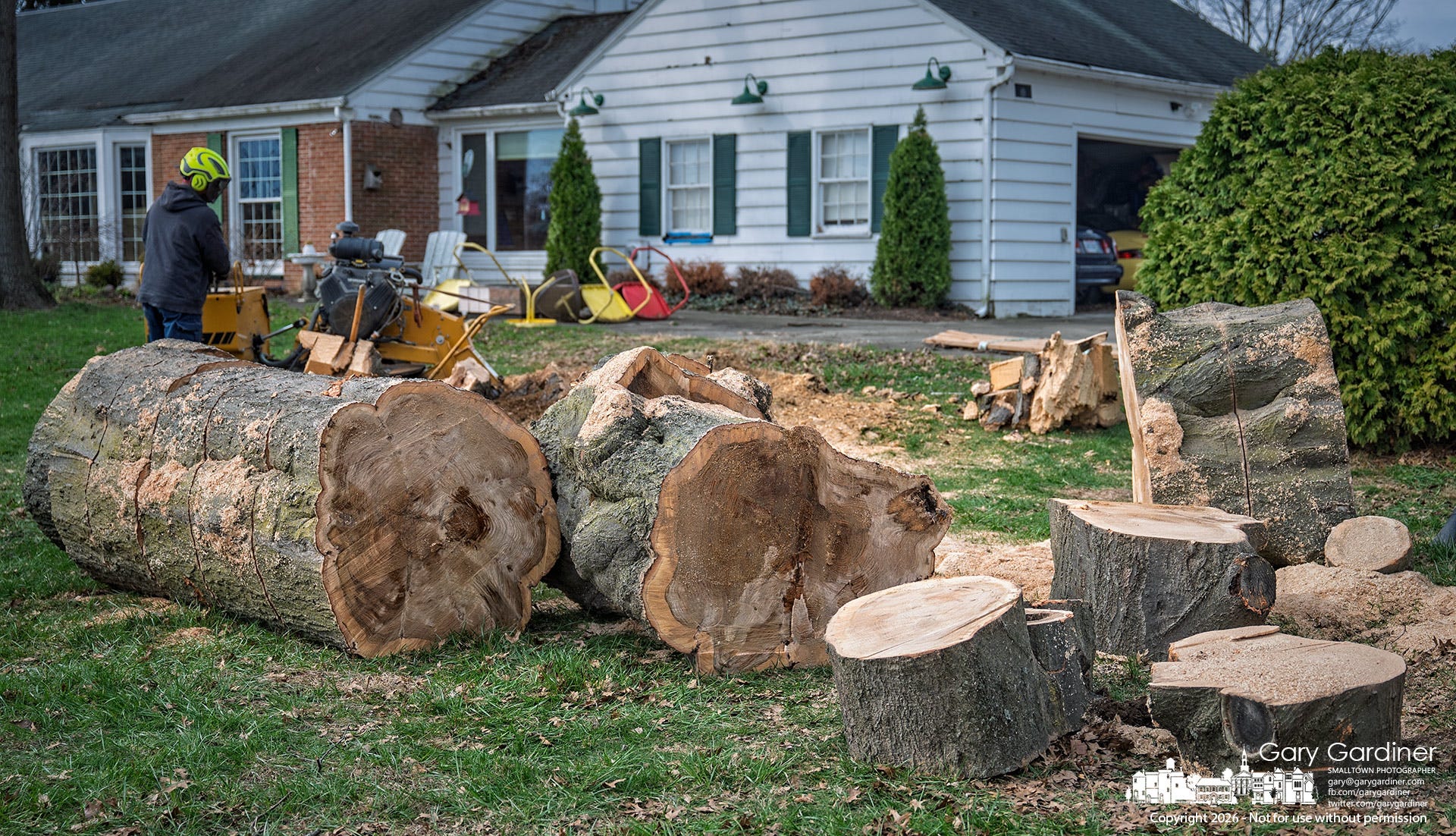
One of three 70-year-old trees in Tom Karshner’s yard on County Line Road was toppled during Friday’s windstorm. The two-foot-wide oak sat at the corner of a triangle with one tree in the backyard and two in the front. Karshner said the trees, planted around the same time he bought the house, once overlooked open fields with horse barns as the only structures.


One of the 14 broken cross arms on the power lines between Walnut and Schrock on Spring Road illustrates how the wind stressed the redwood structure, causing it to split. Although there were no labels on the arm or the ceramic insulator it held, the crew from Hamilton, Ohio, helping Westerville Electric, said the Chance saddle-top insulator was a style common in the 1950s. The crossarm was replaced with a fiberglass structure with a much different insulator.


Fish Friday’s Best Serving
No one attends a church fish dinner during Lent because of the food's quality. Instead, they go for something more meaningful. For a single price, you choose your fish along with sides like mac and cheese or fries, and coleslaw or applesauce. Each diner receives a ticket torn from a roll, a small ritual of entry before the meal starts. Accompanying it is a small orange traffic cone, which lets diners select their seats in the school dining room, where long tables are arranged in parallel rows for efficient seating. Once an order is taken, the cone is tilted onto its side, signaling that the meal is on its way and that the marker can be removed when the food is served.
The fish is hidden beneath a tempura-style coating so thick it makes the fillet appear twice its size. The fries are plentiful and ordinary. The mac and cheese glows with the bright artificial orange of a safety vest. The coleslaw is sweet, designed to please the broadest possible audience, not the sharper, more seasoned kind that might come from Grandma’s kitchen. Tartar sauce and lemon juice are provided in tear-open packets. The utensils are white plastic. The butter is cold, sealed in small single-serving tubs.
Drinks like lemonade, iced tea, and water are poured from large Igloo coolers. Hanging from each spigot is a gallon jug shaped to catch drips, an improvised solution refined over years of serving crowds. Desserts, supplied by a team of family bakers, mostly women, cost extra and often sell out before the evening ends. Some diners arrive early because they already have a favorite cook and a preferred dessert in mind, wanting to ensure their sweet tooth is satisfied before the best options disappear. In the corner, a small bar offers non-sacramental wine with dinner, for an additional charge, a small reminder that even penitence leaves room for indulgence.
There is an efficiency to the whole evening. Diners are expected to clear away their own trash, and almost at once, a fresh placemat, new cutlery, and a napkin appear for the next person. The room turns over quickly, but not harshly. It has the practiced rhythm of people who have done this many times before and know how to keep things moving without making the meal feel rushed.
But the meal isn't judged by culinary standards. It feels more like a large family covered-dish supper, simple food placed at the center of a shared tradition. Around the tables, the true essence of the evening emerges: older couples sitting together, comfortable in shared silence; parents across from preschool children, close enough for eye contact and gentle correction; three generations gathered, sharing memories already worn smooth by repetition and creating new ones that may last just as long. There’s an unspoken trust that others will follow, that a fourth and then a fifth generation will someday fill these same tables on future Friday nights. Church youth carry the plates out in a steady rhythm, guided by adults and amateur cooks who have learned over the years how to serve large crowds from a school kitchen. The process is orderly, almost like a church service.
And then, on this particular Friday, a heavy windstorm swept through the city, knocking down trees and toppling power lines, and the church was among the places affected. Just as dinner began, the church and kitchen lost power. Luckily, the kitchen operated on gas, and the fish was already being fried outside in a row of propane deep fryers. There was enough light coming through the cafeteria windows for diners to eat, but the kitchen sank into shadow, illuminated only by light spilling in from open doorways. Still, the meal continued. The serving went on. The tables stayed full. The pastor, as he had throughout the more than two-hour evening, thanked everyone for coming, for taking part in the Lenten observance, and reminded them of the prayer service that would close the night.
When the power finally came back just before dinner ended, the room responded with applause and prayers. For the diners, kitchen staff, and young servers, the blackout became part of the shared story — a tale that will be retold during future Friday fish fries when the lights stay on. Perhaps this is the clearest reminder of what the evening truly is. The food is simple, school cafeteria fare at best. It satisfies the stomach and aligns with Lenten discipline, but no one would call it a memorable meal. Its true purpose is different. It offers a reason for people to gather, sit side by side, see familiar faces, and welcome new ones. For a few hours on a Friday night, the parish transforms into something larger and more visible: an extended family, connected not by the quality of the food but by the simple act of sharing it.
The Green Grape Report
Food Review by Gary Gardiner
Kroger - Anywhere
Price – $4.99 for a three-pound clamshell. That’s $1.57 a pound.
PLU Code – NA
The Review
Another week, another Grape Report. On paper, this was another good week for South American grapes. Kroger’s clamshell did not identify the country of origin, and there was no PLU code to confirm it. Still, the grapes had the look of 4022, the standard green variety, not one of IFG’s specialty grapes.
The missing information does not affect the review. The grapes still get the same taste, size, sugar content, and crispness tests. Even so, after looking into how grapes travel from trellis to table, I find the omission hard to ignore. It leaves an obvious gap. Why not include the PLU or the country of origin? At what point does that information disappear? Does it happen when shipments are repacked at a port or warehouse? Are varieties and sources ever mixed together? Or is the omission simply a way to avoid the burden of more precise labeling?
This week’s crispness reading was noticeably lower than last week’s 55, but with only two weeks of sclerometer use, there is not yet enough data to make much of the change. The more informal bite test found the grapes firm, though not quite as sweet as last week’s.
This Week’s Grape Data
● Weight - 8.2 grams, lower than last week’s 8.5 grams from an average of 10.
● Size - 30x23mm, again from the average of 10 grapes
● Sugar - 13.1%
● Crispness - 44 on the sclerometer
The Westerville News is a reader-supported publication by Gary Gardiner, a lifelong journalist who believes hyper-local reporting is the future of news. This publication focuses exclusively on Westerville—its local news, influence on Central Ohio, and how surrounding areas shape the community.
Reader funding, including subscribers, protects editorial independence, so coverage is guided by journalists rather than owners or corporate profit goals. It also reduces pressure to chase clicks, letting the newsroom focus on stories worth readers’ time. And it helps keep the site accessible to everyone, including people who can’t pay or live in places where a free press is under threat.
Explore more hyper-local reporting by subscribing to The Hilliard Beacon, Civic Capacity, Marysville Matters, The Ohio Roundtable, Shelby News Reporter, This Week in Toledo, and Into the Morning by Krista Steele.


