
Westar Park sign plan approved, raising questions about site-specific zoning rules | Arby's building demolition begins
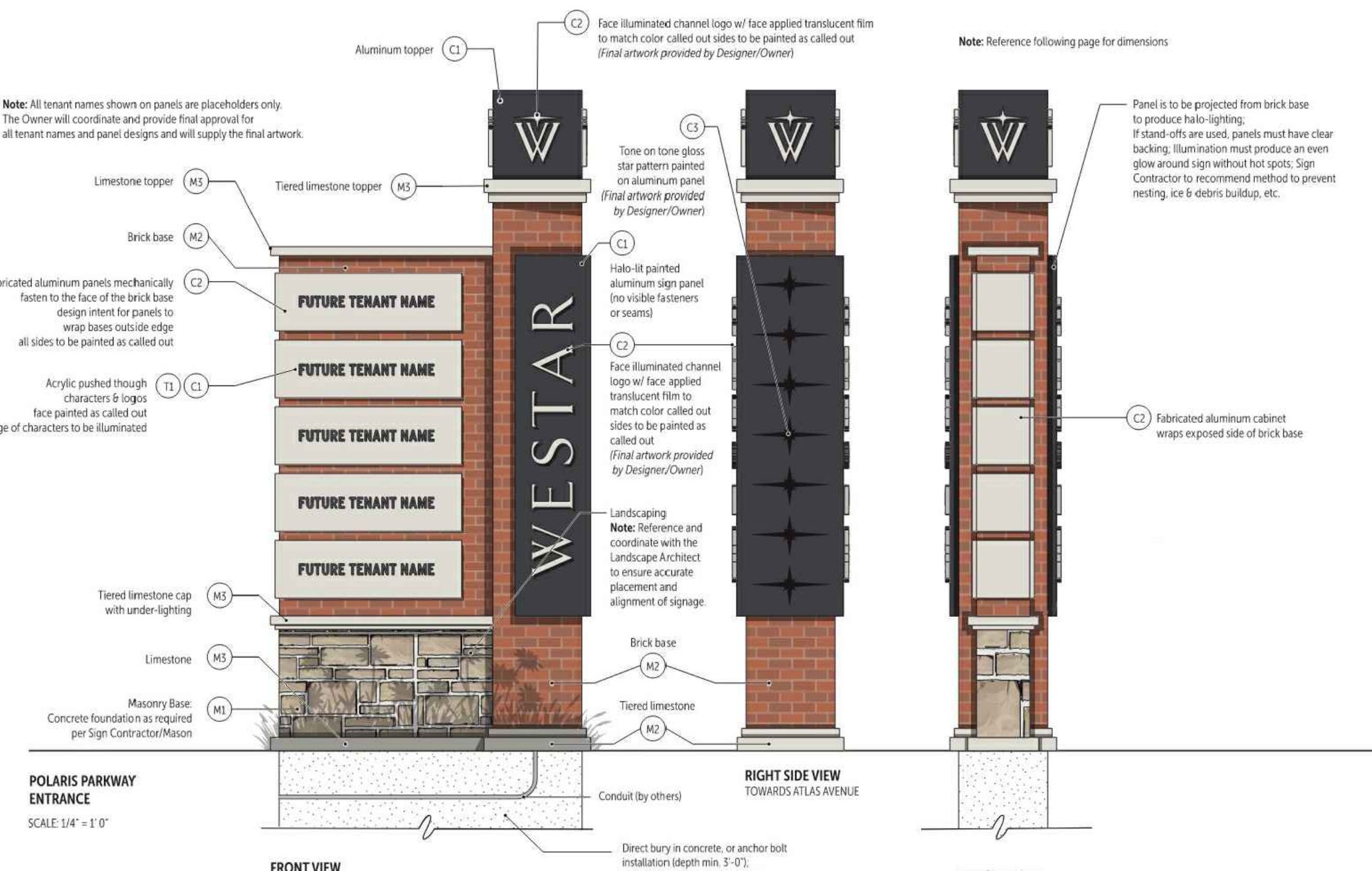
The Westerville Planning Commission approved a comprehensive sign program for Westar Park at its Wednesday meeting, establishing property-specific standards for entrance signs, tenant signs, directional signs and placemaking features within the 88-acre development east of Africa Road.
The commission approved the plan by a 4-1 vote, with Commissioner Murphy voting no and Council Member Glasgow abstaining. Commissioners Anderson, Gates, Munger and Chairman Zellner voted for the plan.
The development, previously known as the East of Africa project, is now called Westar Park. It should not be confused with Westar Place, the existing office, hotel and commercial district west of Africa Road. City staff said the Westar Place sign requirements were used as a starting point for the new plan.
The proposal was presented largely as a coordinated design and wayfinding system for a large employment campus. But the approval also has a broader zoning implication: The new sign text expressly allows its standards to take precedence over portions of Westerville’s existing sign code on the Westar Park property.
“This text is unique to Westar Park as it is a Planned District, and as such deviates from sections of the zoning code,” the approved standards state. “In the case that there are conflicts between this text and Chapter 1181 of the zoning code, this text shall rule.” When the Westar Park text does not address an issue, the regular zoning code continues to apply.
That makes the action different from a conventional amendment to the citywide zoning code. The existing zoning code itself was not rewritten, and the new rules do not apply throughout Westerville. Instead, the Planning Commission approved a separate regulatory layer for one Planned Development district.
The distinction became a central part of the commission’s discussion.
“I have a few questions on kind of this additional text that is saying it’s going on top of our already existing code,” Murphy said. “There’s been a lot of discussion in the community about signs and all of the requirements we already have for them.”
Murphy asked city staff to identify the specific departures from the existing sign code and explain why each was necessary. She said the Polaris Parkway entrance sign appeared to be a reasonable example because motorists would need to see it while traveling on a wider, faster roadway, but said she had not seen a complete accounting of the other differences.
“I think I would want to understand specifically what those other deviations are and why we need them for my understanding of why these are necessary,” Murphy said.
City staff explained that Planned Development zoning permits standards to be tailored to the conditions of a particular property. Staff pointed to the size of the proposed entrance signs as one example of something the base sign code would not currently allow.
“With this being a Planned District, this creates the zoning along with the development standards text and the preliminary development plan,” staff planner Elise Schellin told the commission. “So this all creates the zoning, so separate from our zoning code.”
“This allows us to do things like these entry feature signs, which wouldn’t be allowable per code written today for signs because of just the size and items like that,” Schellin said. She cited visibility from Polaris Parkway, the number of traffic lanes and the speed of passing vehicles as reasons for the departure.
The Westar Park plan includes one primary entrance sign near Polaris Parkway, two secondary entrance signs on Africa Road, internal directional signs, subarea signs for future businesses, a large “W” feature in the development’s roundabout and a potential art installation near the Polaris Parkway trail. The signs use a common family of brick, limestone and aluminum materials intended to extend the existing Westar identity into the new development.
David Efland, representing the Westerville Industry and Commerce Corporation, described the signs as part of the infrastructure needed to prepare the property for future users.
“This is really creating wayfinding infrastructure,” Efland said. “It’s part of the infrastructure.”
Efland also said the flexibility in the sign plan would be balanced by additional review of future development proposals. Under the zoning framework previously approved for the property, future final development plans are expected to go before both the Planning Commission and City Council.
“The other difference, and it’s a key difference here, is that with the initial zoning ... council took the additional step to be the final decision maker in final development plans on this site,” Efland said. “And that would include signage as well.”
“So with that flexibility comes that additional oversight as well to really view each one of these,” he said.
Murphy questioned whether requiring future property owners and developers to move through multiple levels of review could become burdensome.
“I understand it’s hard to make a one-size-fits-all” before agreements have been reached with developers, she said, “but it seems fairly burdensome in my mind and possibly deterrent.”
Commissioner Munger disagreed, saying special standards and multiple reviews are normal features of Planned Development zoning. He said the purpose is to maintain consistent design across several properties developed by different owners over time.
“In many respects, it allows consistency across the area that would not happen organically through the signage code or through the just base zoning code,” Munger said. “And that’s the whole point of a PUD, is to allow that consistency to develop across multiple developments and multiple times and have an overlay that hits a certain sub-area and creates a certain character to it.”
The approval does not create a binding rule requiring the city to grant similar sign standards elsewhere. Another property owner would still have to submit an application and justify any requested departures based on that property’s zoning and physical conditions.
It may, however, create a practical precedent. Future applicants could point to Westar Park as an example of the city allowing a site-specific development text to control over the generally applicable sign code. The city would then need to explain why a similar regulatory layer is or is not appropriate in a different location.
That risk is less about one group of signs than about how frequently the process is used. Site-specific standards can help address unusual topography, road access, visibility and development patterns. Repeated across the city without a clear comparison to the underlying code, however, they could produce a collection of separate zoning rules that becomes difficult for residents, businesses and city officials to track and apply consistently.
City Council was not removed entirely from the process. Council approved the property’s original Preliminary Development Plan through Ordinance 2024-18, which required the comprehensive sign program to return later for Planning Commission approval. Future tenant development plans may also require Council action. But the detailed sign text that now overrides portions of Chapter 1181 on this property was approved by the Planning Commission rather than through a new citywide zoning ordinance.
That procedural difference, and whether it should become a model for other locations, is the larger issue left by the Westar Park decision.
Dine-in and Drive-Thru Demolished
After more than a two-week delay waiting for the natural gas connection to be removed, demolition began Thursday morning on the Arby’s restaurant on South State Street. A new Arby’s resembling the one at North State and Maxtown will be built in its place.
Arby’s Archive at The Westerville News.
Because this post is public, you’re encouraged to share it on social media.
The Westerville News is a reader-supported publication by Gary Gardiner, a lifelong journalist who believes hyper-local reporting is the future of news. This publication focuses exclusively on Westerville—its local news, its influence on Central Ohio, and how surrounding areas shape the community.
Reader funding, including subscribers, protects editorial independence, so coverage is guided by journalists rather than owners or corporate profit goals. It also reduces pressure to chase clicks, letting the newsroom focus on stories worth readers’ time. And it helps keep the site accessible to everyone, including people who can’t pay or live in places where a free press is under threat.
Explore more hyper-local reporting by subscribing to The Hilliard Beacon, Civic Capacity, Marysville Matters, The Ohio Roundtable, Shelby News Reporter, This Week in Toledo, and Into the Morning by Krista Steele.


