

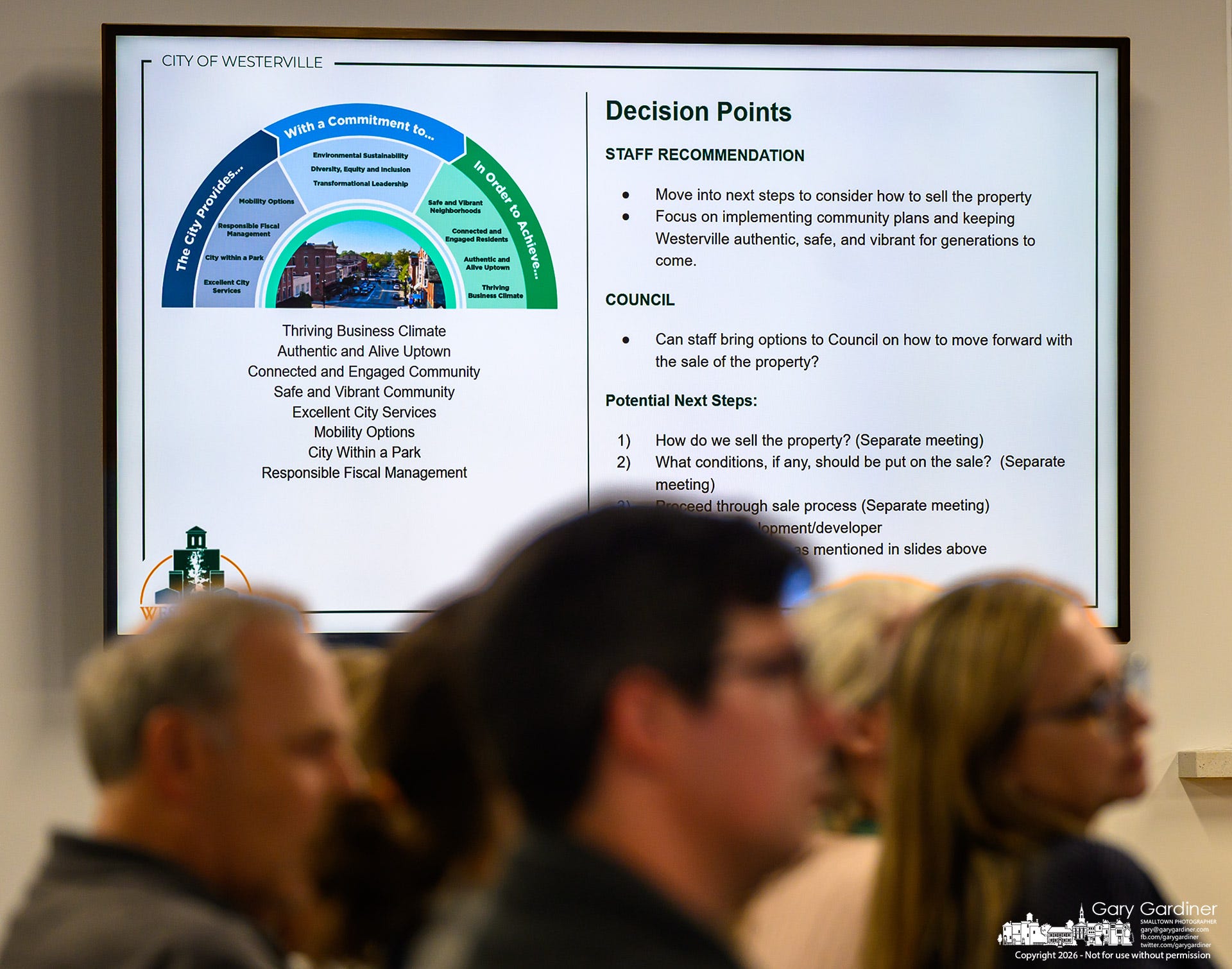
Westerville City Council directed staff Tuesday to return with options for how the city could sell 64 E. Walnut St., keeping a potential sale of the five-acre property alive despite public feedback favoring continued city ownership and opposing several elements of a redevelopment plan the council rejected in June.
All seven council members gave the administration an informal go-ahead after a 2-hour, 21-minute work session. Council did not vote to sell the property, choose a developer, or approve a new development proposal.
“This does not mean we’re saying we’re selling or not selling,” council Chair Megan Czako said after polling her colleagues. “We are just saying let’s understand the process and go from there.”
City officials spent much of the session tracing staff’s recommendation to sell the property to more than a decade of council-approved plans and policies. Economic Development Director Rachel Ray called the presentation “a master class in comprehensive planning and city administration and policy governance.”
City Manager Monica Dupee and Planning and Development Director David Efland said the 2016 Imagine Westerville Community Plan provides the clearest direction. It calls for selling the building at 64 E. Walnut for private redevelopment after city departments moved elsewhere.
A 2018 campaign video and fact sheet for the Justice Center bond issue also said 64 E. Walnut and two other city properties would be sold. However, Dupee acknowledged the sale was not included in the ballot language itself.
Other city plans recommend higher-density mixed-use development, housing, a boutique hotel, additional parking and trail connections in or around Uptown. No single plan requires all of those uses at 64 E. Walnut.
Dupee said staff combined those ideas at Walnut Street because the city owns the property and few other five-acre sites are available near Uptown. Asked whether selling the property was the clearest instruction contained in the plans, Dupee replied, “One hundred percent.”
She also emphasized that council could change that policy.
“There are no right or wrong answers on Council,” Dupee said. “There are only consequences.”
The discussion followed council’s June 2 rejection of a purchase contract with Continental Real Estate Cos. The proposed development included 247 apartments, an 81-room boutique hotel, a restaurant and commercial space, and a parking structure.
The proposal prompted heavy public opposition, packed council meetings and a petition the city said collected more than 1,600 signatures in less than two days.
After rejecting the contract, council directed the administration to return with the city’s goals for the property, the sources behind those goals, an explanation of the sale and development process, opportunities for public participation and information about traffic studies, potential sale prices and tax revenue.
Public feedback collected since then has pointed away from several elements of the Continental proposal.
Traffic was the most frequently cited concern. Participants also repeatedly raised school and child safety, parking, building height, density, and compatibility with the surrounding neighborhood.
Opposition to a hotel appeared at nearly every workshop table, according to the city’s written report, which described the final round of comments as showing “a strong, near-universal ‘no hotel’ sentiment.”
The report also recorded frequent opposition to large or dense development and recurring interest in reusing the existing building, leasing the property or pursuing a public-private arrangement that would allow the city to retain control. A performing arts or cultural center was the leading workshop response when participants were asked to suggest a revenue-generating use.
The presentation shown to council Tuesday did not include the written report’s characterization of hotel opposition as nearly universal or its references to leasing the property as an alternative to a sale.
A separate Uptown United survey showed similar opposition to the rejected proposal. Among 792 unique responses, about 80% opposed a boutique hotel, 75% opposed apartments, and 84% favored continued city ownership of the property.
Neither survey was scientific, and the two used different methods and questions. Participation was voluntary; the city did not ask respondents whether they lived in Westerville, while Uptown United relied on self-reported residency.
Even with those differences, both reports identified substantial concern about traffic, safety, scale, parking and neighborhood character, along with strong opposition to a hotel — positions at odds with major elements of the rejected Continental proposal.
City staff emphasized areas where public preferences were less unified, including interest in arts space, a market, housing and open space.
The differences between the two surveys became part of council’s discussion near the end of Tuesday’s session.
Dupee described Uptown United as a special-interest group and recommended that council not invite it to present. Czako deferred further discussion until a later meeting.
Dupee also addressed suggestions that the city retain the building for an arts center or lease it to another organization. She said the city legally could own and lease such a facility but recommended against doing so without a partner capable of raising millions of dollars and operating it.
Staff continued to argue that private redevelopment would return the land to the property-tax rolls and generate recurring revenue. Dupee said the property’s eventual use and annual tax production were more important than its one-time sale price.
The administration will next return with possible methods for selling the property, including a direct sale, auction, or request for proposals with conditions. If council decides to pursue one of those methods, it would discuss restrictions on a potential sale at another meeting.
Czako said no sale would appear on a council agenda until those preliminary discussions were completed.
“There’s no movement going to be happening on this property,” she said.
For now, 64 E. Walnut remains city-owned. The Continental proposal remains rejected, no replacement project has been submitted, and council has not voted to sell the property.

Because this post is public, you’re encouraged to share it on social media.
The Westerville News is a reader-supported publication by Gary Gardiner, a lifelong journalist who believes hyper-local reporting is the future of news. This publication focuses exclusively on Westerville—its local news, its influence on Central Ohio, and how surrounding areas shape the community.
Reader funding, including subscribers, protects editorial independence, so coverage is guided by journalists rather than owners or corporate profit goals. It also reduces pressure to chase clicks, letting the newsroom focus on stories worth readers’ time. And it helps keep the site accessible to everyone, including people who can’t pay or live in places where a free press is under threat.
Explore more hyper-local reporting by subscribing to The Hilliard Beacon, Civic Capacity, Marysville Matters, The Ohio Roundtable, Shelby News Reporter, This Week in Toledo, and Into the Morning by Krista Steele.
