

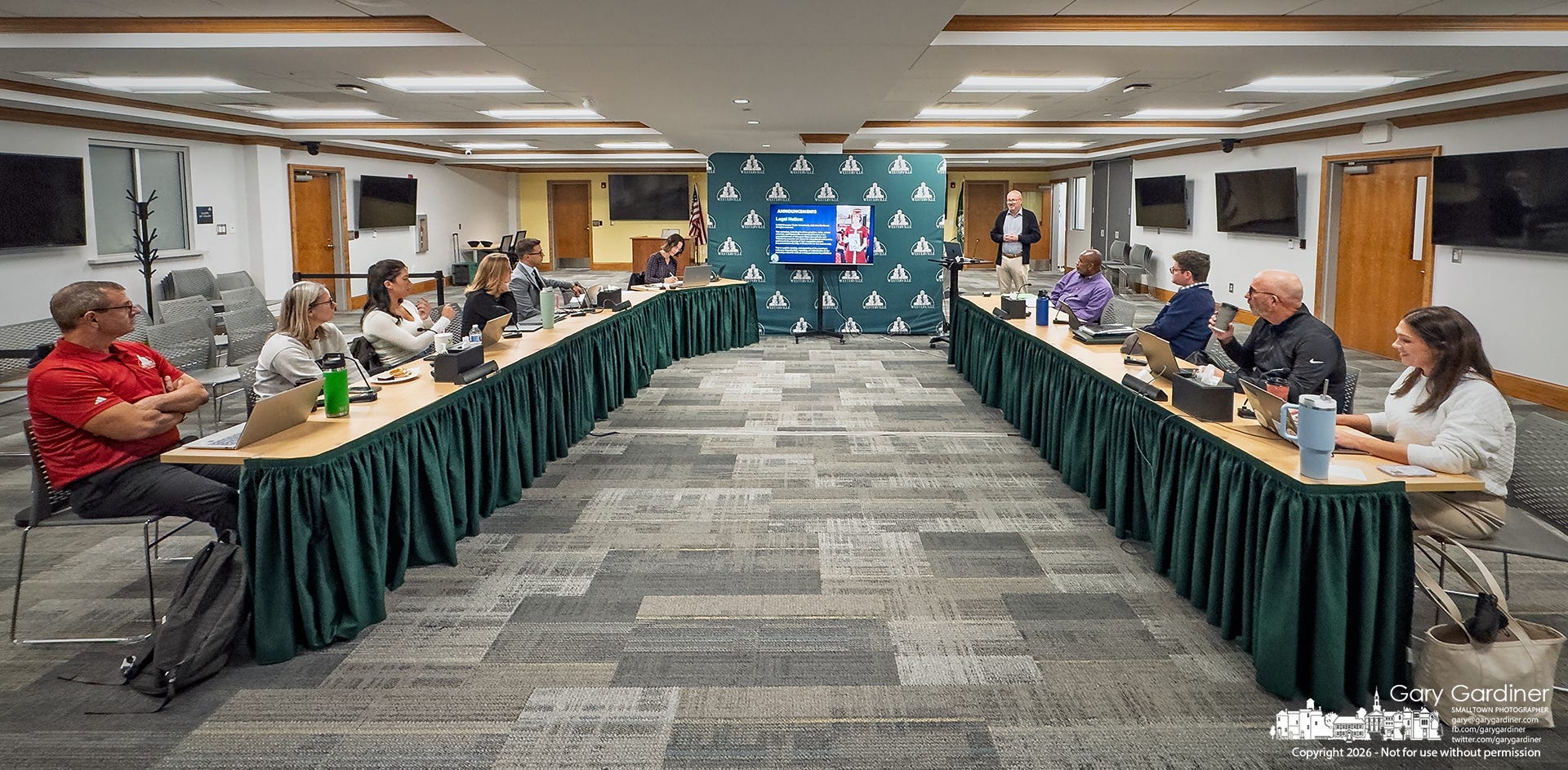
Westerville City Council members could help residents understand city government by showing more of its work and speaking in their own voices online, a social media consultant told them Tuesday. The city’s communications staff would remain responsible for official content, while members could continue to express their individual views on personal accounts.
Sam Toles, founder of Civi Social and a former California city council member, spent more than two hours discussing how video and a less formal presentation could help Westerville reach residents who do not regularly follow city meetings or official announcements. He encouraged council members to consider appearing in videos with city employees to explain projects and answer questions residents have raised.
The work session continued a discussion council began in March about the legal responsibilities elected officials face on social media. That earlier session covered public records, First Amendment protections, blocking critics and the difficulty of separating personal and official accounts. Chief of Staff Christa Dickey said afterward that Tuesday’s presentation was part of the city’s continuing effort to improve its communications. Westerville also hired Austin Graham Dunn as a public relations specialist in digital storytelling after the March session.
Toles suggested that a council member interested in parks, for example, could interview a city employee about an improvement project. City communications staff could produce and publish the video on an official account, and the member could share it personally. Similar videos could introduce residents to employees repairing streets, maintaining parks or providing other services.
“I want you guys to think of yourself as a character in an ensemble, not the headliner act,” Toles told council members.
Council Chair Megan Czako said members have generally appeared in city communications through photographs at official events, rather than helping explain projects or decisions. She praised the quality of Westerville’s communications but questioned whether an increasingly polished presentation sometimes makes government seem less approachable. More individual participation, she suggested, could also help residents understand the distinct roles of council and city staff.
Toles said the city’s communications staff should continue to direct its official accounts. On personal accounts, council members could speak from their own perspectives, including when they disagree with a city decision. He said content featuring employees and explaining the city’s work should be coordinated with staff.
Choosing where to post matters as much as choosing what to say, Toles said. A casual video may be received differently on Instagram or TikTok than it is on Facebook, where the audience may have different expectations.
“We have to think strategically about the where,” he said. “The language is different on each platform.”
The discussion also touched on the criticism elected officials can face when they show more of their personalities online. Czako said she had been told that her posts made her appear to be having too much fun to be taken seriously. Council member Daniella Beckett observed that Toles’ examples of elected officials using informal videos featured only men. Toles apologized for overlooking the different scrutiny women can face and said he would use examples featuring women in future presentations.
Toles cautioned members against treating frequent commenters as a measure of the entire community’s views. He encouraged them to answer legitimate questions but avoid prolonged online arguments, suggesting that a video explaining the facts may do more good than a series of replies to disputed claims.
“The act of creating a video is not the act of publishing a video,” he said.
Council adopted no new social media rules during the work session. The presentation gave members and city staff approaches to consider as Westerville expands its online communications and works out how individual council voices can take part.

Because this post is public, you’re encouraged to share it on social media.
The Westerville News is a reader-supported publication by Gary Gardiner, a lifelong journalist who believes hyper-local reporting is the future of news. This publication focuses exclusively on Westerville—its local news, its influence on Central Ohio, and how surrounding areas shape the community.
Reader funding, including subscribers, protects editorial independence, so coverage is guided by journalists rather than owners or corporate profit goals. It also reduces pressure to chase clicks, letting the newsroom focus on stories worth readers’ time. And it helps keep the site accessible to everyone, including people who can’t pay or live in places where a free press is under threat.
Explore more hyper-local reporting by subscribing to The Hilliard Beacon, Civic Capacity, Marysville Matters, The Ohio Roundtable, Shelby News Reporter, This Week in Toledo, and Into the Morning by Krista Steele.
