
Westerville Has Been Asking for a Steakhouse
Maybe Westerville’s Steakhouse Was Here All Along
The Blue Plate Special Special Kitchen
Restaurant Review by Gary Gardiner
For years, Westerville diners have said the city needs a steakhouse.
That complaint has lingered through openings, closings, changing menus, and the steady expansion of places to eat around Polaris and across the city. Usually, when people say they want a steakhouse, they are not asking for beef alone. They are asking for a certain kind of evening. They mean a place that feels set apart from an ordinary dinner. A room with some gravity to it. Service that slows the meal down in the right way. A plate that arrives with the confidence of a restaurant that knows exactly why you came.
If Westerville says it wants a steakhouse, it makes sense to start with the place that may already be making its case.
The Two-One, inside the Renaissance Hotel, enters this review series carrying a burden few restaurants would volunteer to carry. It may be the city’s best claim to a steakhouse, but it must make that case from inside a hotel, which for many diners is still an awkward address for a serious meal.
That is the question that brought me there.
The room matters in a restaurant like this, maybe even more than the food. The Two-One has one clear advantage. Its best seats look south through a wall of glass toward Guitar Lake, the pond between the Renaissance and DHL headquarters, giving the room a calmer, more open feel than the hotel address might suggest. It is not dark-paneled or clubby in the old steakhouse sense, but it does offer something important: a view that lets the meal feel removed from the day's pace.
Tables sit near the bar, where several televisions show sports. On the day I visited, a large screen carried the Kentucky Derby. I could hear it, but the sound never rose to the level of a sports bar. That balance matters. A steakhouse does not have to be silent, but it does need to protect the feeling that dinner is the main event.
The menu matters too, but not in the broad way some restaurants imagine. A steakhouse does not need endless options. In fact, too many can weaken the point. It needs clarity, and The Two-One keeps its steak section to three choices: a 12-ounce strip-cut sirloin for $45, an 8-ounce filet mignon for $52, and a 16-ounce boneless ribeye for $57, each served with seasonal sides.
That is a short list, but not an unreasonable one. It suggests a kitchen that understands what its customer expects from a steak dinner and is willing to make its case without apology or distraction.
I began with the Chop Salad, a mix of romaine, tomato, cucumber, red onion, bleu cheese, and bacon tossed in a house-made apple cider vinaigrette. It was the kind of opening a steak dinner benefits from: crisp, salty, sharp, and slightly sweet, with enough contrast to wake up the palate without stealing attention from the main course. The bleu cheese and bacon gave the salad its steakhouse credentials, while the vinaigrette kept it from feeling too heavy too soon.
The Two-One offers a full menu for diners who prefer fish, pork, or chicken. I was there to answer the steakhouse question, so from the restaurant’s three steak choices, I ordered the filet.
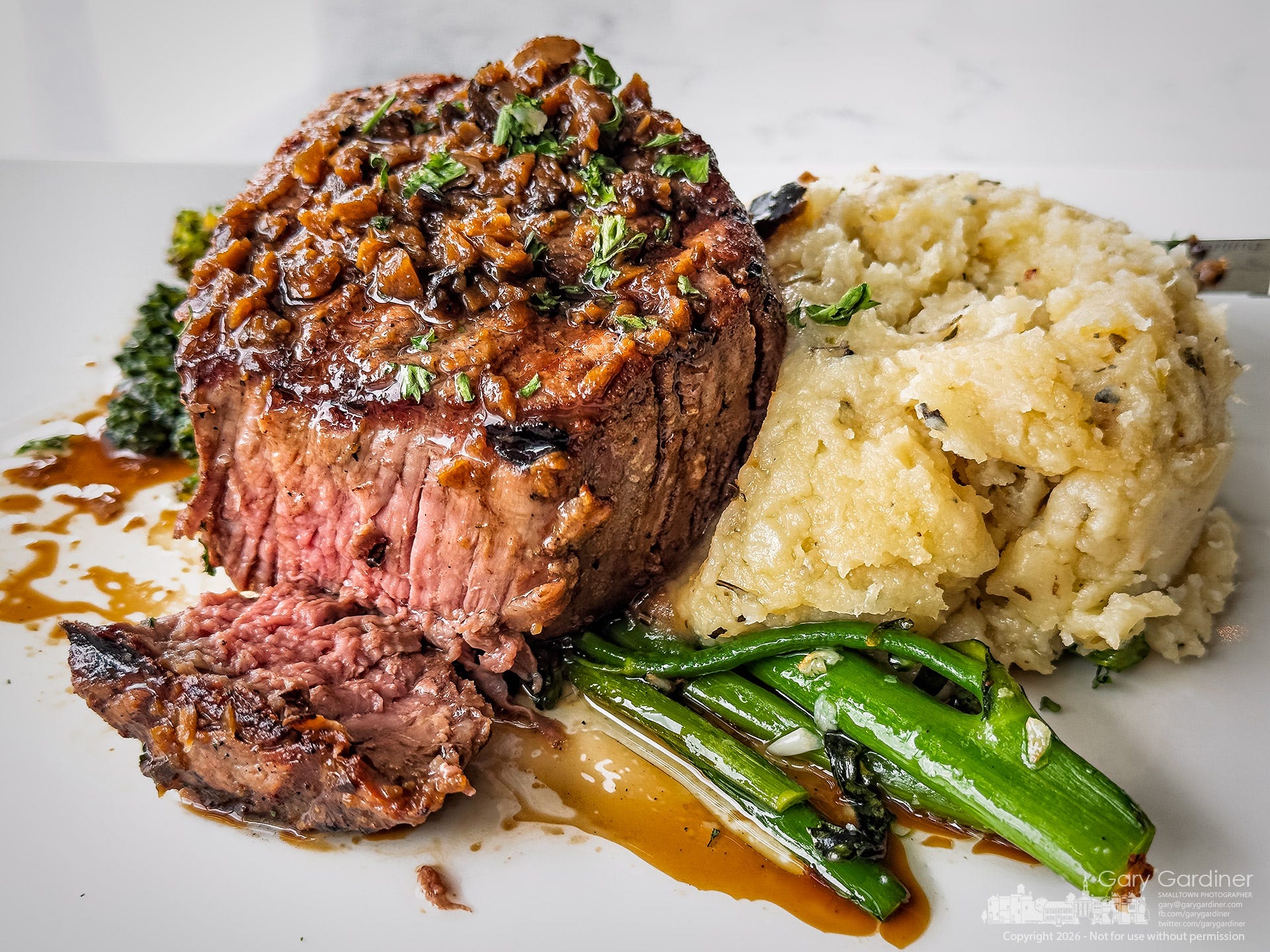
It arrived with broccoli florets and mashed potatoes, a familiar pairing that kept the plate anchored in steakhouse tradition. When my server, Haley, asked about the preparation, I told her it was exactly how I would have made it at home.
The meat came a true medium, which is how I prefer a filet, just beyond the red center of rare, with enough firmness to give the bite some character. Filets offer tenderness that sometimes eludes other cuts, but they can also become anonymous if the kitchen treats tenderness as the whole point. This one still felt like steak. Tender, yes, but not limp or lifeless. It had some resistance, and that made it satisfying.
The sides did what steakhouse sides are supposed to do. The mashed potatoes gave the plate a sense of comfort and weight, while the broccoli added color. Nothing on the plate tried to reinvent the form.
But a steakhouse is not just about steak.
That is why The Two-One remains an interesting case. Standalone steakhouses have long benefited from a certain mythology. They are built around arrival. You go there on purpose. The building belongs to the meal. The parking lot, the entrance, the bar, the dining room, the weight of the menu — all of it says you have come for one thing and one thing only.
A hotel restaurant begins from a different position. Fairly or not, it carries the suspicion that it exists partly for travelers, conferences, and convenience. It must prove it is not simply nearby food for people sleeping upstairs.
That credibility challenge is also what makes The Two-One a fitting place to begin this series on restaurants participating in Taste of Westerville. A city’s dining identity is rarely defined only by what is missing. It is also shaped by what is already here, sometimes in plain sight, sometimes behind assumptions that have gone untested.
Can a hotel restaurant become the answer to a civic complaint? Can it carry the expectations that come with the word steakhouse? Can it convince Westerville diners that the city’s long-sought destination dinner has been here all along, only in a setting some of them may have dismissed too quickly?
The Two-One does not fit every image people have of a steakhouse. It does not announce itself from a standalone building. It does not wrap the meal in the usual steakhouse theater of a heavy front door, a dim room, and a menu built almost entirely around beef. Its hotel setting remains part of the experience, and for some diners, that may still matter.
That makes The Two-One more than the first stop in this series. It makes it a test case.
Over the coming weeks, I will visit the Taste of Westerville participants that operate as restaurants with dine-in service and write about them as they are encountered in ordinary life, not in festival samples or one-bite impressions. Some of the event’s 25 participants are caterers or food businesses without such public dining rooms. The series will focus on places where readers can go, sit down, and have a meal.
It feels right to begin here, with a restaurant that sits at the intersection of appetite and assumption.
Westerville says it wants a steakhouse.
Maybe the city is not only waiting for one. Maybe it has been overlooking one.
The Two-One got the chance to answer.
Because this post is public, you’re encouraged to share it on social media.
The Westerville News is a reader-supported publication by Gary Gardiner, a lifelong journalist who believes hyper-local reporting is the future of news. This publication focuses exclusively on Westerville—its local news, influence on Central Ohio, and how surrounding areas shape the community.
Reader funding, including subscribers, protects editorial independence, so coverage is guided by journalists rather than owners or corporate profit goals. It also reduces pressure to chase clicks, letting the newsroom focus on stories worth readers’ time. And it helps keep the site accessible to everyone, including people who can’t pay or live in places where a free press is under threat.
Explore more hyper-local reporting by subscribing to The Hilliard Beacon, Civic Capacity, Marysville Matters, The Ohio Roundtable, Shelby News Reporter, This Week in Toledo, and Into the Morning by Krista Steele.


