

Westerville’s delayed Walnut Street vote echoes growth fights across Central Ohio
A study of other cities in Central Ohio
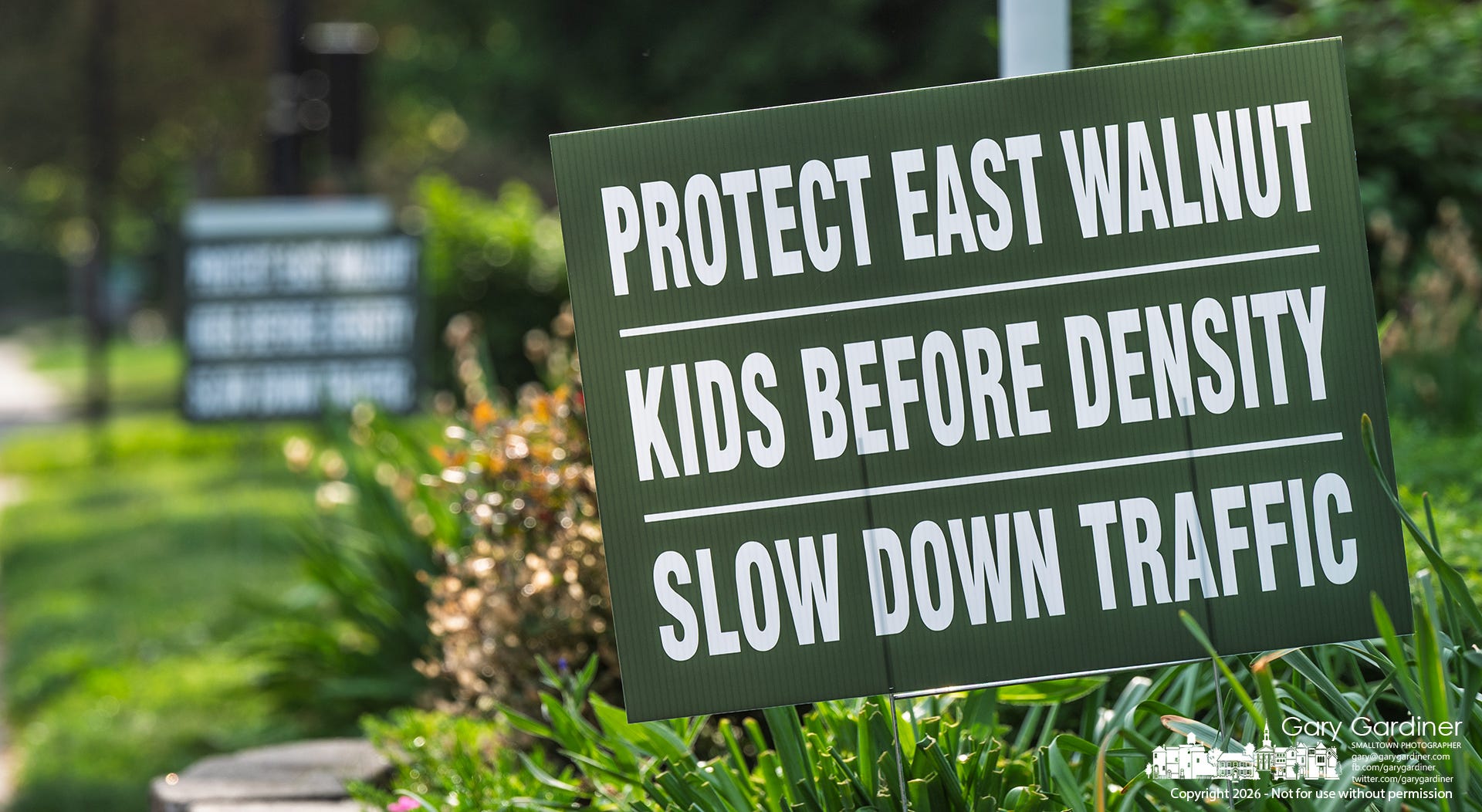
Westerville City Council’s unanimous decision to delay action on a proposed mixed-use development near Uptown until September spotlights a key question: how much growth and density are communities willing to accept for new housing, tax revenue, and redevelopment?
Across Central Ohio, suburbs, townships, and small towns are confronting a clear challenge: balancing growth and density with the desire to preserve community character. Westerville’s current debate exemplifies this regional dilemma.
The 64 E. Walnut St. project would bring apartments, hotel rooms, restaurants, and other commercial uses to Uptown’s edge. Residents worry about traffic, parking, density, height, and compatibility with the neighborhood.
However, Westerville’s debate does not occur in isolation; it echoes similar challenges seen in Grandview Heights, Upper Arlington, Bexley, Dublin, Gahanna, Hilliard, Powell, Sunbury, Galena, and nearby townships. Some projects moved forward, while others were revised, slowed, or paused, often in response to strong public opposition.
September’s delay gives Westerville time to decide if the Walnut Street proposal should advance, shrink, change, or be denied. It also lets the city review other communities’ experiences with similar projects.
A familiar suburban pressure point
Westerville, like some other suburbs, has fixed borders and limited room to expand. Developers value the few remaining parcels, while city officials see them as key to the tax base.
The city relies on a 2 percent income tax, and it has pursued economic development in other parts of Westerville, including land east of Africa Road, which is being prepared as a shovel-ready site with roads, sewer, and stormwater infrastructure. (Editor’s note: An additional .75% is levied for the school system.)
That larger strategy reflects a basic problem facing many Central Ohio suburbs: when land is scarce, cities look more closely at infill, redevelopment, and building up rather than out.
Large projects near historic districts or older neighborhoods can cause tension. The Walnut Street site is close to Uptown, where residents appreciate walkable, smaller-scale development.
This debate extends beyond a single parcel, focusing on whether Westerville’s future should mirror the denser redevelopment in nearby communities or maintain its historic scale. The outcome will shape how the city navigates growth moving forward.
The developer’s question
The Westerville proposal has sparked controversy over the developer selection and the project type the city considered.
The proposed Walnut Street project is from Continental Development Ventures, the same firm behind major mixed-use projects in Upper Arlington and Bexley. Those projects — Arlington Gateway in Upper Arlington and The Fitzgerald at 2200 East Main Street in Bexley — have made Continental part of a broader suburban redevelopment pattern.
Champion Companies, a local developer, spent two years discussing a lower-density concept for 64 E. Walnut St. before the city chose Continental.
Mayhew said Champion’s concept would have included fewer residential units, fewer hotel rooms, and more green space than the Continental proposal.
This account adds another layer to the debate, raising questions about the process and transparency of Westerville’s consideration of a smaller alternative.
Powell and the downtown-first model
Powell offers one of the more relevant comparisons for Westerville because it is also a growing suburb with limited room to expand and a historic downtown that residents want to protect.
Rather than relying on one large project at the edge of its downtown, Powell has emphasized compact, mixed-use redevelopment in and around its core. City planning documents describe downtown as both an economic and civic center, emphasizing walkability, infill, and higher-value development.
One example is Champion Companies’ mixed-use block along West Powell Road, which includes 64 apartments above ground-floor retail. The project added housing and restaurant space near Powell’s main corridor while keeping the development tied to the city’s downtown pattern.
Powell also has pursued redevelopment near Nocterra Brewing Co. on Depot Street, including infill housing and a planned three-story mixed-use building with office space and a rooftop bar.
For Westerville, Powell’s experience is relevant for two reasons. First, it shows how a suburb can pursue downtown density in smaller pieces rather than through a single larger project. Second, it sharpens the local question around Champion, which had discussed a lower-density plan for the Walnut Street site before Continental’s proposal became the focus.
Although Powell’s model may not directly translate to Westerville, it offers residents a local example of downtown-focused redevelopment that may better align with the scale preferred by some opponents in Westerville.
Grandview Heights and Dublin: when mixed-use becomes the new normal
Other Central Ohio communities have moved further toward large-scale mixed-use development.
Grandview Heights has been reshaped by projects such as Grandview Yard and Grandview Crossing, which added apartments, offices, hotels, restaurants, and retail over multiple phases. Those developments changed the scale of parts of the community, but they also became central to the city’s economic development strategy.
Dublin offers an even larger example. Its Bridge Street District and Bridge Park development created a dense mix of apartments, offices, hotels, parking garages, restaurants, and public spaces near the city’s historic core.
For supporters of mixed-use development, Dublin and Grandview show how suburbs can create new walkable districts, grow revenue, and attract businesses. Critics show how quickly a community can move from approving one major project to normalizing a much denser built environment.
Many Westerville residents see a larger issue in the Walnut Street proposal: approval of denser development here could set a precedent for future projects, permanently shifting the city’s character.
Upper Arlington and Bexley: approval after controversy
Upper Arlington and Bexley provide closer political comparisons because both are established suburbs with strong residential identities and limited open land.
In Upper Arlington, Arlington Gateway on Lane Avenue drew debate over height, density, and compatibility with the surrounding corridor. The project moved forward after revisions, reflecting a common outcome in suburban development fights: large proposals are not always rejected, but they are often reshaped.
Bexley faced similar questions with The Fitzgerald, a six-story mixed-use building at 2200 East Main Street that includes apartments, restaurant space, medical offices, and a parking garage. The project brought a level of height and intensity that stood apart from much of the surrounding low-rise environment.
Both examples matter to Westerville because they show how cities with strong neighborhood identities have handled projects that promised redevelopment but raised concerns about scale. They also matter because Continental is tied to those projects as well as the Westerville proposal.
That does not make the Westerville project identical to Arlington Gateway or The Fitzgerald. But it does place the Walnut Street debate within a recognizable development model now appearing across multiple Central Ohio suburbs.
Gahanna and Hilliard: redevelopment as economic strategy
In Gahanna and Hilliard, large mixed-use projects have been framed as economic development tools.
Gahanna approved a major redevelopment plan for its Creekside district, including hotel rooms, apartments, restaurants, and structured parking. The goal was to reinvigorate an area long promoted as an entertainment and dining destination.
Hilliard has pursued mixed-use and office-heavy development along the I-270 corridor, with apartments, hotel space, offices, and retail planned as part of a larger effort to create an urban-style employment and residential hub.
Those projects reflect the argument city officials and developers often make: suburbs need new development to compete for residents, employers, visitors, and tax revenue. Mixed-use projects are pitched as a way to create destinations, support local businesses, expand housing, and strengthen the tax base.
But residents often ask different questions. Will the roads handle it? Will parking spill into nearby neighborhoods? Will the project fit the city’s character? Will the promised revenue justify the disruption?
Those are the same questions now sitting on Westerville’s desk until September.
Sunbury and Galena: growth pressure reaches the next ring
Further from Columbus, Sunbury, and Galena show that development pressure is not limited to older suburbs.
In Sunbury, officials have faced intense debate over a planned data-center campus tied to a business and technology park. Residents raised concerns about water use, traffic, infrastructure, and whether the project would alter the community’s character. The city responded with a moratorium on new data-center development.
That fight is different from Westerville’s. It is not about a hotel-and-apartment building near a historic district. But the underlying question is similar: how much change should a community accept when a project promises investment but threatens to alter local identity?
Galena and the surrounding areas have seen another version of that pressure, as golf courses and rural land have been converted or proposed for housing, office, and retail uses. Those fights show how land once seen as open, rural, or recreational can become a target for redevelopment as the region grows.
For Westerville, the lesson is that growth pressure does not stop at the outer edge of established suburbs. It keeps moving — into townships, villages, former golf courses, old commercial corridors, and any parcel large enough to attract a developer’s pencil.
Westerville’s closest neighbors feel the same squeeze
The effects of Westerville’s growth also blur into nearby communities, especially Genoa Township, Galena, Blendon Township, and Sharon Township.
At State Route 3 and Polaris Parkway, the boundary between Westerville and Genoa Township is so tight that public-safety jurisdiction can depend on the precise location of an incident. A crash a few feet one way may fall to one agency; a few feet the other way may belong to another.
Blendon Township, south of Westerville along Alum Creek, has been carved into pockets of unincorporated land surrounded by Westerville, Worthington, and Columbus. In some areas, the Westerville Division of Fire provides emergency services even when the land is outside the city.
Sharon Township has faced a similar island effect, with remaining unincorporated areas squeezed between growing suburbs and Columbus. Galena, meanwhile, sits along the transition between older village character and newer housing and commercial pressure.
Together, those communities show that land-use decisions do not stop neatly at municipal borders. Traffic, emergency services, infrastructure, housing demand, and tax competition all spill across the lines.
That makes Westerville’s Walnut Street debate part of a larger regional pattern, not a local zoning skirmish sealed off from the rest of the map.
Harlem Township and the failed merger
Just east of Westerville, Harlem Township’s brief attempt to merge with the city in 2024 stands as another example of how growth pressure is reshaping the region’s borders.
Facing the possibility of being gradually carved up by Columbus annexations, along with land speculation tied to nearby Intel-driven development, township leaders floated a formal merger with Westerville. The goal was to preserve more local control by tying Harlem’s future to Westerville rather than allowing the township to be absorbed piece by piece by Columbus.
The idea quickly collapsed amid strong resident opposition and political turnover, with trustees resigning or being voted out after the proposal became public.
The episode showed how volatile border-change politics can be, even when officials frame the goal as preserving local control. Harlem Township did not merge with Westerville, but the debate revealed how communities on the region’s eastern edge are already shaped by the prospect of being absorbed and by the competing pulls of Columbus, Westerville, and industrial-scale development.
For Westerville residents debating the Walnut Street project, Harlem’s story is a reminder that the question of growth is not limited to one building. It is also about the long-term shape of cities, townships, and the boundary lines that determine who provides services, who collects taxes, and who gets to decide what comes next.
What Westerville must decide
By delaying the Walnut Street project until September, the Westerville City Council avoided an immediate decision. But it did not avoid the larger question.
Council members still must decide whether the project is appropriate for the edge of Uptown, whether it should be reduced or redesigned, and whether the city’s process for choosing a developer has been clear enough to satisfy public concerns.
The examples across Central Ohio do not point to one easy answer.
Grandview Heights and Dublin show how large mixed-use districts can become accepted parts of a suburb’s identity. Upper Arlington and Bexley show that controversial projects can move forward after revisions. Gahanna and Hilliard show how cities use redevelopment as an economic strategy. Powell shows a smaller-scale downtown model. Sunbury and Galena show how communities farther out are also slowing, resisting, or struggling to manage growth.
Westerville now has to decide which path it wants to follow.
The Walnut Street proposal may be one project, on one site, awaiting one future council vote. But the debate around it is bigger than that. It is about how a landlocked suburb grows, how much say residents have in shaping that growth, and whether the edge of Uptown should become the next place where Central Ohio’s push for density meets the limits of local tolerance.
For now, Westerville has bought itself time. By September, it will have to decide what that time was for.

Because this post is public, you’re encouraged to share it on social media.
The Westerville News is a reader-supported publication by Gary Gardiner, a lifelong journalist who believes hyper-local reporting is the future of news. This publication focuses exclusively on Westerville—its local news, influence on Central Ohio, and how surrounding areas shape the community.
Reader funding, including subscribers, protects editorial independence, so coverage is guided by journalists rather than owners or corporate profit goals. It also reduces pressure to chase clicks, letting the newsroom focus on stories worth readers’ time. And it helps keep the site accessible to everyone, including people who can’t pay or live in places where a free press is under threat.
Explore more hyper-local reporting by subscribing to The Hilliard Beacon, Civic Capacity, Marysville Matters, The Ohio Roundtable, Shelby News Reporter, This Week in Toledo, and Into the Morning by Krista Steele.
